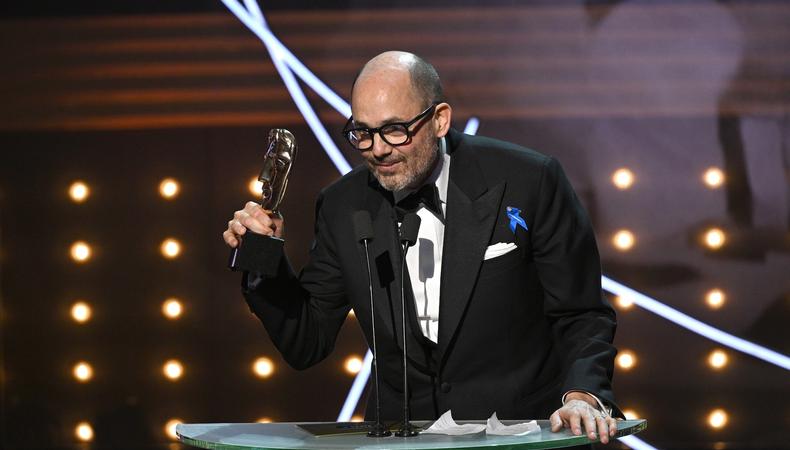
The winners of the 76th British Academy Film Awards were revealed at London’s Royal Festival Hall on 19 Feb., in a ceremony hosted by Richard E Grant. In a night of surprises, best film went to Netflix’s German-language World War I drama “All Quiet on the Western Front”.
The antiwar epic received the most nominations and proved to be the big winner, earning seven BAFTAs in total, including best film, director (for Edward Berger), film not in the English language, adapted screenplay, and cinematography. That’s the most BAFTAs ever won by a film not in English, toppling previous record holder “Cinema Paradiso” (1988), which took home five.
The other big winner was Irish comedy-drama “The Banshees of Inisherin,” which nabbed four awards, including outstanding British film of the year. In his acceptance speech, writer-director Martin McDonagh emphasized the Irishness of his film—but did note that Rosie, the stand-in donkey, was indeed from Stoke-on-Trent.
“Banshees” dominated in the supporting acting categories as well, with Kerry Condon and Barry Keoghan both winning their first BAFTAs. The heavily Oscar-tipped “Everything Everywhere All at Once” went home with only one BAFTA (for best editing).
One of evening’s biggest surprises came in the leading actor category, in which Austin Butler won the top prize for his performance in Baz Luhrmann biopic “Elvis.” Brendan Fraser may be the hot favourite for the Oscar, but in London, Colin Farrell had been the man to beat.
In his speech, Butler thanked the Presley family for “sharing with me who Elvis truly was,” adding that win “means the world to me.” “Elvis” also earned BAFTAs for best casting, costume design, and makeup and hair, equalling “Banshees”’ on the night with a total of four gongs.
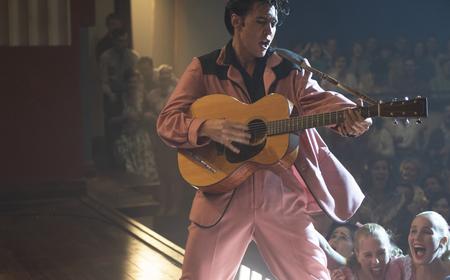 In ‘Elvis,’ Austin Butler Finds a Lead Role Worthy of His Ambitions
 There were no surprises in the best actress category, with Cate Blanchett winning for her turn in Todd Field psychodrama “Tár.” The actress said she’d feared that the decision to take on the role of a renowned conductor teetering on the brink was “potentially career-ending.” But a shiny new BAFTA (her fourth) and her Golden Globe win last month prove otherwise. It also cements her position as the one to beat on Oscars night.
Blanchett was also on hand to give a BAFTA fellowship award to costume designer Sandy Powell in honour of her long, successful career in film. For those just starting out, BAFTA’s Rising Star award is the gong to win; and unlike the other awards, the winner is chosen by the public. This year, “Death on the Nile” star Emma Mackey won the prize, beating out fellow “Sex Education” actor Aimee Lou Wood, as well as Naomi Ackie, Sheila Atim, and Daryl McCormack.
Behind the camera, Charlotte Wells, the writer-director of “Aftersun,” won the BAFTA for outstanding debut by a British writer, director, or producer.
In other categories, “Navalny,” about the Russian opposition leader who was poisoned and then jailed by Moscow, won for best documentary; and “Guillermo del Toro’s Pinocchio” came out on top for animated feature film. Both movies are also nominated in their respective Oscar categories.
It would be a brave move to predict what will happen at the Oscars next month, but the BAFTAs earned by “All Quiet on the Western Front,” “The Banshees of Inisherin,” and “Elvis” could spell future success.
For a full list of this year’s BAFTA film winners, visit the official site.
Check out Backstage’s UK audition listings!