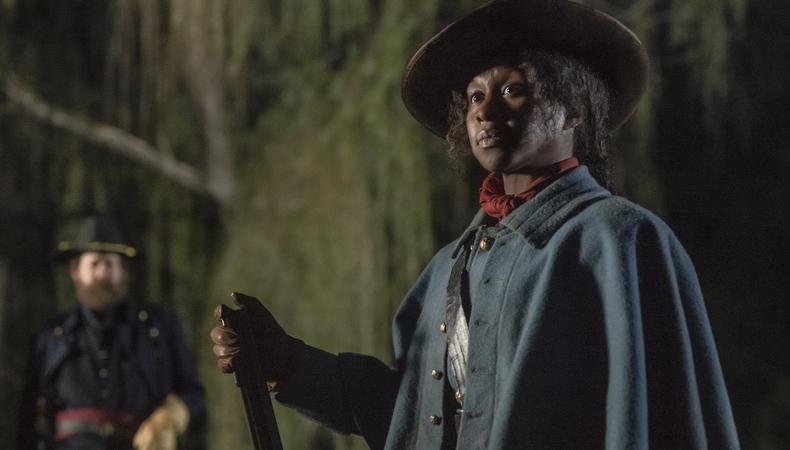
In “Harriet,” we see iconic abolitionist Harriet Tubman like we have never seen her before. That’s thanks to Cynthia Erivo, who plays her—but it’s also thanks to Paul Tazewell, who dressed her. Tazewell, a Tony Award–winning costume designer for film, television, and theater, speaks with Backstage about how his performance background makes him a better visual storyteller, and he weighs in on the ways actors can help—or hurt—the costume design process.
How would you describe the duties of the costume designer?
I am in the position as the costume designer to provide the initial visual insight into a character. It’s the visual that the audience responds to first, to understand the character they’re seeing within the scene and then how it all compares from character to character, to figure out where they are within the piece overall. Hopefully, I create an arc for the hero or heroine and show evolution.
How did you first venture into costume design?
I went to a high school that had a performing arts program, so I was exposed to the world of performance and developed a desire to be an actor and a dancer and to potentially go into the world of musical theater. But at the same time, because I was interested in drawing and painting and working with my hands and sewing, I also had this affinity for clothing, either in fashion or, probably more sensibly, with costumes. [I went to] the University of North Carolina School of the Arts [and studied] costume design. And from that point on, I decided to let go of performance in preference of designing for theater, and then eventually television and film.
Does your performance background influence how you design costumes for actors?
Absolutely. As an actor, the focus on character development and telling stories through the written word is the point—it is the ultimate point. With my love for fabric and color and period clothing, all of that, I feel perfectly suited to do what I’m doing.
READ: Why “Harriet” Has One of the Best Acting Ensembles of the Year
Tell me about the ways you work directly with actors as the costume designer.
The actor-designer relationship is a very intimate one, because it’s a place where the actor is getting at a character, which can often be a journey. With Cynthia, [for example,] she was tasked with creating her interpretation of Harriet, and I was directly part of that because the clothing that I dressed her Harriet in needed to be in line with how she saw Harriet. Same with the director [Kasi Lemmons]: I show her images and sketches and research and what my thoughts are; there needs to be a collaboration. It’s incumbent on me as a designer to be flexible and be a good listener and understand what the actors need for visual support. And then, hopefully, you arrive at a place where there’s a simpatico. My expertise is clothing. That’s my medium, that’s my way of communicating who a character is, who a person is. Cynthia’s medium is the word and the emotion and intention, so those two have to come together.
So, is it helpful to you when actors have strong opinions about their costumes?
At the end of the day, [working with an actor] is a challenge or it’s not. It just depends on how comfortable they are with that exchange. It is all about trust. I work to have the actor’s trust, but I am listening to what their point of view is and hope that we can both come to a place where we both feel good about where we end up. But I have to be willing to engage and they have to be willing to engage in order to come to that kind of place. That’s all about dialogue.
What was unique about “Harriet” compared to other projects you have designed for?
It’s telling the story of a person who actually existed, and there are preconceived ideas of who that person is, both based on what’s been written about her and on photographs of her. It became important for Kasi Lemmons to show Harriet through a modern lens and to show how miraculous and kind of extraordinary she was, as a 5-foot-1 woman, coming from the oppression she came from as a slave, and what she was able to do as far as helping others and all the work she did with the abolitionist movement.
How different is it to design costumes for a real person compared to designing for fictional stories?
It’s a balance of creating looks that are true to what they are, and then figuring out how much can you push for emotional impact. With this film, I started with images of the slaves on plantations, everything I could find of the period to back up what I had decided on for Harriet. It was important for me and Kasi, and indeed for Cynthia, to render her as she evolves into what ends up being a powerful and modern woman for her time. In order to do that, I tipped it just a bit. All of the silhouettes and all of the items that she’s wearing are indeed based on period silhouettes and look like period dresses and coats. But the way that she wears it has a much more modern feel, which I think gives the impression of a woman ahead of her time.
You’ve also worked extensively in theater; is there a major difference in costume design for different mediums?
There are some. With theater, you have more of an opportunity to take poetic license. With film, there isn’t much that is abstract—they’re usually shot in spaces that are true to the period because it’s a period film, so the interiors are fully propped with all the right period furniture, paintings on the walls, and wall color. In order for the character to fit perfectly within that environment, you have to hold true to what’s plausible with that period. It’s still using all the information that I already know; whether it’s theater or it’s film, that’s where I start. It just depends on how I interpret it.
What is one project that you did not work on whose costumes you find inspiring?
I love any work that creates a world that is believable and is done with a facility that creates beauty, even if it is a hugely distressed and apocalyptic expression of design. I admire so many designers that have come before me. Sandy Powell, Colleen Atwood—the more product that’s out here, with television and all of these amazing series that are being done, more and more great design work is accompanying them.
This story originally appeared in the Dec. 19 issue of Backstage Magazine. Subscribe here.
Ready to get to work? Check out Backstage’s film audition listings!