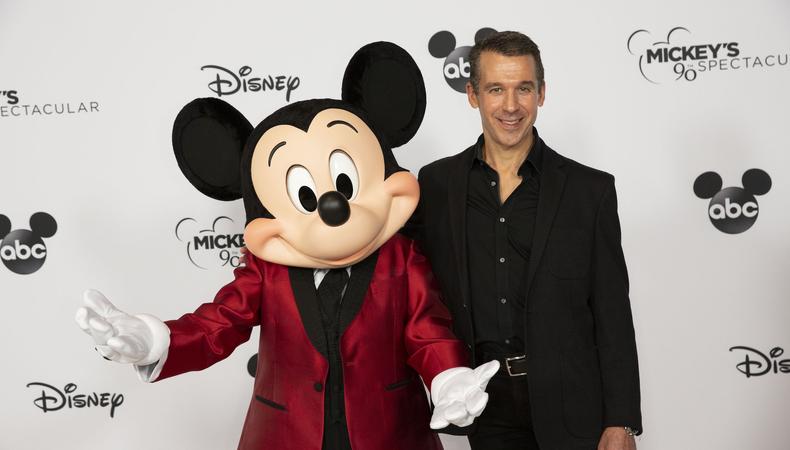
How do you honor an icon like Mickey Mouse?
Charlie Haykel, who produced the upcoming “Mickey’s 90th Spectacular” (Nov. 4 on ABC), explains the ways in which he recaptured the mouse’s magic for the small screen. Additionally, the veteran producer shares what he and his team look for in on-camera personalities, and his advice for all aspiring television producers.
What do producers of television specials really do?
I use a construction analogy: We as producers are the first people to hear about the project. Very frequently there’s an idea. We find the land, we design the house, we hire everybody, we schedule everybody to build each part of it and we choose each person based on what skills will be needed for that particular house. We decorate it and we landscape and we give the keys to the client, and hopefully the client walks through the front door and loves it.
What is the actual process for producing one of these things?
It always starts with, what is the story we’re trying to tell? How are we trying to make people feel? If it’s an Emmy Awards where there are 27 awards you have to hand out and it’s a three-hour show, you really only have about 21 minutes of content that you’re producing from a blank page. Those shows are about figuring out how [to] do it in an interesting and compelling way. How do we pace it, and who should we get to host? The host on those shows really shapes them, so it becomes: How do you support your host and put them in a position to do what they do in that given environment?
READ: How to Become a Producer
So who you put on camera is pretty imperative, then?
For sure, and for many reasons. You want whoever is going to present an award or tell a story or do anything on-camera to have a reason to be there. We put a lot of thought and consideration into who is doing what. We don’t just say, ‘We want the biggest star in every single slot.’ You can have the biggest stars, but if you spend 15 seconds giving someone [less flashy] context, it elevates it so much more than someone who just comes out and gives a very straight introduction. You want to connect it in that way—even if it’s not Beyoncé doing it.
What was unique about producing the Mickey’s 90th birthday special?
For shows like this, you have no structure when you start, so how do you tell that story? What do you want to say about Mickey and how do you do it in an interesting way and give it humor and emotion? You want to take the audience on a ride with high moments and surprises. We have a wonderful group of artistic collaborators who we’ve worked with for many years, and we knock ideas around and put some stuff up on a board and you eventually start to see what the show’s going to look like. Sometimes you have no time to do a show and other times you have a year to do it. But no matter how much time you have to do it, it always ends up boiling down to the last four weeks.
READ: Be the New Triple Threat: Actor-Writer-Producer
Is there a major difference between producing something that is taped and a live show?
The difference is with live, it becomes all about timing. But with taped shows, too, we very much take the approach that it’s got to run like it’s a live show. You need that audience energy. If it turns into a TV taping, the audience wilts and that affects the performers and you really do feel that. You’ve got to keep it moving; however, when you’re taped, you’ve got the ability to let things breathe. Live, you have that energy and that unpredictability. We plan out everything we can anticipate, but you also have to have the bandwidth to anticipate what you can’t anticipate. You want a live show to feel like it’s under control but maybe it’s about to go out of control. That’s why people want to watch live, because of the moments you can’t produce. You just have to hope those moments don’t go on too long!
What advice do you have for aspiring TV producers?
Do as many things as you can and work for as many different people as you can so you get exposed to as many different things as you can when you’re younger. I always took jobs based on what I was going to learn and who I was going to be exposed to. Be strategic. Learn about what everybody else does and be able to have an intelligent conversation about it, because you’re going to be in a situation as a producer when you’re going to have to talk to a sound engineer or a lighting designer or an editor or music director. And when you go in to get a job, sell yourself. You should have a story about who you are and you should be able to sell that story.
Ready to book your own TV gig? Check out Backstage’s TV audition listings!