
Though it may be the particular purview of philosophers and Vulcans, we all use logic to find some semblance of objective truth. Most people like to think of themselves as reasonable beings, so a surefire way to get them on your side is by appealing through the rhetoric of logos.
Logos is a form of rhetoric based on (you got it!) an argument’s underlying logic. Someone using logos clearly lays out their claim, the reasons for the claim, and the facts, figures, and other forms of evidence that convincingly support it.
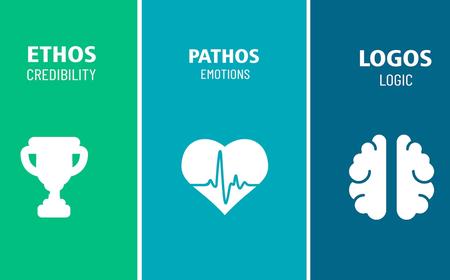
The term is attributed to the father of modern rhetoric, Aristotle, who named ethos, pathos, and logos as the three main modes of persuasion. Ethos is an argument’s credibility (the character of the person making the argument), pathos comes from an argument’s emotional components (how the person hearing the argument feels), and logos refers to the soundness of the argument itself.
You can find logos in anything persuasive, from everyday squabbles about what to eat for dinner to Super Bowl advertisements. Think of any commercial that invokes statistics, anecdotes, images, or facts to prove a product’s quality, necessity, and efficacy. These allow the audience to see the flow of logic and thus (hopefully) believe the conclusion.
 Ethos, Pathos, Logos: How to Use the Modes of Persuasion
1. Understand your own logic.
Take the time to sit with your argument and build a map of how your logic flows from the claim to the reasons for it. Do the reasons back up your claim in a way that makes sense? Are there better reasons you can give, or perhaps a better way you can present the ones you have? Analyzing the logic behind what you want to argue better prepares you to present it to (and persuade!) your audience.
For instance, a screenwriter pitching their movie script might claim something along the lines of “You should definitely make this movie.” To use logos to support this argument, the screenwriter must know why the movie should be made, why it should be made now, and why they should be the one to make it. Armed with these reasons, they’ll be able to make a compelling argument for producing the film.
2. Compile evidence.
After analyzing the logic and reasons behind your argument, you need to find evidence that sufficiently supports those reasons, evidence that can take a variety of forms:
- Data: Nothing says you’re a trustworthy person who knows what you’re talking about like dropping some sweet, sweet facts and figures—just be sure to double-check that they’re accurate.
- Real-world examples: Case studies, success stories, and results from clients are the proof in your pudding.
- Comparisons: Us versus them analysis shows exactly why and how your product or service is superior.
- Visuals: Infographics, images, and video demonstrations can all be powerfully persuasive.
3. Think syllogistically.
Sometimes it’s difficult to properly break down your claim when it’s swirling around in your head in a jumbled mess. Instead, try writing it as a syllogism. This three-part deductive argument is composed of a major premise, a minor premise, and a conclusion; when properly assembled, it logically explains the argument. The classic example reads “All men are mortal/ Socrates is a man/ Therefore, Socrates is mortal.”
Imagine you’re a health and wellness influencer hired by a skincare brand to sell its products. You might use this exercise to start with the major premise “I, your favorite influencer, have clear, healthy skin.” If you follow this by the minor premise “I use [X] brand’s skincare products,” then the logical conclusion becomes “I use [X] brand’s skincare products, which gives me clear, healthy skin.” With this deductive reasoning in mind, you’ll likely decide it wise to post clips of you authentically incorporating the brand’s products as part of your daily routine: using its revitalizing face wash in your GRWM, spritzing its toner mist on your face to freshen up before an important meeting, wiping your makeup off using its cleansing oil after a big night out, and so on. Thanks to your expertly crafted syllogism, your followers will be led to believe that the brand is to thank for your flawless look—and then they will buy its products so that they, too, can have skin that glows.
4. Ask if your argument is valid and sound.
In Aristotle’s formation, all arguments can be said to be valid and sound when the premises behind them are true and reasonably reach the stated conclusion. The logic might be valid in an argument if it flows correctly, but it’s only sound when the premises are factually correct.
For example, though it may be tempting to stretch the truth about special skills on your acting résumé to try and land a gig, doing so would mean you’re presenting an argument (“You should hire me to portray this clown character”) based on false premises (“I can definitely juggle”). But a truthful résumé that highlights your real-life training, experience, and skills creates a valid, sound argument about why the casting director should hire you…while also ensuring you won’t be asked to juggle on command.
5. Examine your assumptions.
Connecting your claim with the reasons backing it up is a bridge of assumption. To claim something like “The weather must be nice because the sky is blue” assumes that blue skies are always a sign of good weather, and even implies a specific quality of what “good weather” even is. Breaking down the warrant behind your claim helps you avoid logical pitfalls and potential counterarguments.
Let’s say you’re a sustainability UGC creator whose vibe is equal parts authentic and eco-warrior. One day, a company with a history of dumping plastics offers you a killer partnership. While you may be able to come up with an argument, reasons, and evidence to support your taking the deal, considering the principles behind it will likely expose its flaws: “I would like to take the deal because I need money for X, Y, and Z” versus “Accepting money from this company would make me a sellout complicit in greenwashing.”
Here are examples of companies and influencers using logos to persuade their audiences that they’re making smart choices with their time and money.
OxiClean: In these classic infomercials, the boisterous Billy Mays claims that the stain remover has the power to remove heavy stains without the damage of chlorine bleach, then demonstrates its effects before the viewers’ very eyes. The commercial invites audiences to see this demonstration as reasonable evidence for Mays’ claim, making them ask themselves just why they don’t have OxiClean in their house yet.
Progressive Insurance: Beloved spokesperson Flo shows viewers clearly how much money they can save by switching to Progressive. By comparing rates and savings with those of other popular car insurance companies, she proves Progressive’s value through the oh-so-logical power of math—and guides viewers to the rational conclusion that transferring makes financial sense.
Lexi Reed: The diet and exercise influencer posts regularly about her health journey to share her story and draw followers to her gamified weight loss platform, DietBet. This post includes numbers (127 pounds and 300 pounds), a description of Reed’s real-life weight loss experience, and a visual side-by-side comparison of two different weights, making this single post a logos rhetoric trifecta.