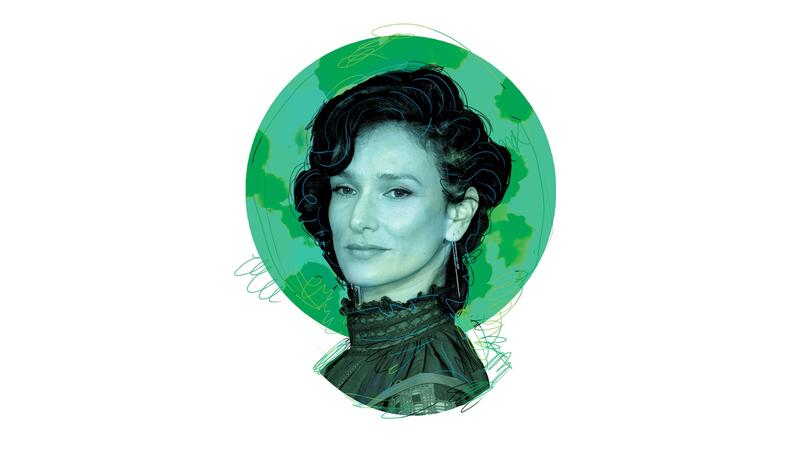
In the midst of a prolific theater career in London (which includes credits in “Titus Andronicus” at the Globe Theatre, “Ivanov” at the National Theatre, and “The Vertical Hour” at the Royal Court), Indira Varma was thrust into the international spotlight when she was cast as Ellaria Sand on “Game of Thrones.” The Royal Academy of Dramatic Art graduate returns to television with another fantasy epic, Amazon Prime’s “Carnival Row.” Here, Varma reflects on some of her earliest career milestones.
How did you first get your Equity card?
When we went to drama school, we were given provisional Equity [status] when we graduated. It wasn’t the old-school Catch-22 situation where you had to get a job, but in order to get a job, you needed an Equity card. You were already given a way in. My very first job was a film called “Kama Sutra,” and it was the lead. Can you believe it? That was my first job, and it was pretty baptism-by-fire, in a good way. I learned so much. In drama school in those days—I was there from ’92 to ’95—we didn’t do film technique, so I learned everything on the job there. It was really informative.
Tell us about your first day on that professional set, especially coming from a theater background.
The thing about drama school and me entering into it was a love of the stage and performing live and using text and rehearsing. Suddenly, we’re asked to film and everyone’s going, “It looks amazing, the way the light catches the glint in your earring.” And I was like, “You care about the glint in my earring? What about the emotion I’m trying to express?” I suddenly realized it was a visual medium and I needed to get my head around that. They taught me, brilliantly, how to contain a performance and how to have that lovely secretive relationship with the camera and the audience beyond the lens. For me, acting is about the relationship with the people you’re working with and the magic that happens in connection and in reaction.
READ: ‘Game of Thrones’ CD Nina Gold Shares What She Looks for in Auditions
What advice would you give your younger self?
Don’t take any of it too seriously, but work really hard. I feel like young people think it’s a given that they’re going to achieve what they dream of achieving. In a funny way, that’s how they should think, but at the same time, it should be coupled with a sense of discipline. I remember I had a teacher I adored at drama school who said, “Talent without discipline is a bad habit.” As a young person, I wasn’t a particularly hard worker. I’d wing it; I was inventing. [Also,] don’t dwell on the disappointment, because there will be so many. Take all the work you can. Don’t judge the work. I’ve had moments where someone has said, “Come in and audition for this,” and I go, “I don’t want to play that part.” But you go in and you meet the director and you think [you] want to work with that director or you hear of what other actors are involved or the director’s concept for the piece is amazing. There’s joy to be had in the unexpected. We had Adrian Lester come to speak to us when I was still at RADA, and he said, “The three years of your acting training are teaching you how to learn to be an actor. It will take 10 years in the profession to learn how to be an actor.” I thought that was really key. Just because you’ve gone to drama school doesn’t mean that you’re now an actor. It’s a lifelong training. The privilege of rehearsal is about experimentation and learning. If you’re open to learning throughout your career, you’ll get better.
What performance should every actor see and why?
There are so many. Often, the ones that have really struck me have been live, because there is no director or editor who’s gone in there with scissors and made the performance better. When you see an actor for three and a half hours develop a role and tell a story and connect with an audience and be generous with their fellow players, that’s what makes my skin tingle.
What is your worst audition horror story?
I think auditions are horror stories in themselves. One thing that jumps to mind was, years ago, there was an indie film, and there was a scene we had to learn and that was fine. It was to play a comedian. And then, suddenly, the director just said, “OK, so, what would your standup [act] be?” And I was like, “Oh, god, I don’t bloody know. I’m an actor! I work with text!” I’m good at structured improv, but I’m not a standup comedian. That was the most embarrassing thing ever. That was really exposing. I think auditions can be really exposing because you’re not what they want and people treat you like you’re not what they want. The people who are behind the table need to understand how excruciatingly difficult audition situations are. They certainly don’t bring out your best qualities as an actor. It’s like exams. There are some people who are brilliant at coursework and some people who are brilliant at exams. That doesn’t mean one’s more intelligent than the other. Essentially, for TV and film, it’s a line-learning exercise. Believe me: The older you get, the harder it is to learn lines two days before, and often you’re not given audition material until the day before, either. Sometimes, if you’ve got the paper in your hand, you can explore more because I think performing is about making mistakes; that’s when you discover things. Not bringing a finished performance. That goes for TV and film, as well. It’s exciting when a fly lands on a person’s shoulder and the other person responds to it. You can’t practice for that. You’ve got to be alive.
What’s the wildest thing you ever did to get a role?
I got “Game of Thrones” because a guy I’d worked with sent me a one-line email saying, “Why aren’t you in ‘Game of Thrones’?” and I was like, “Yeah, why aren’t I?” I said to a friend of mine who was a first AD on [the show], “Why aren’t I on ‘Game of Thrones’?” and he said, “I’ll find out.” And because I’d worked with the HBO lot, they were like, “Oh, yeah, I guess there’s something there, but I don’t know if she’d want to do it. It’s not big enough.” But I went in and I did audition for it.
This story originally appeared in the Aug. 29 issue of Backstage Magazine. Subscribe here.
Ready to get to work? Check out Backstage’s TV audition listings!