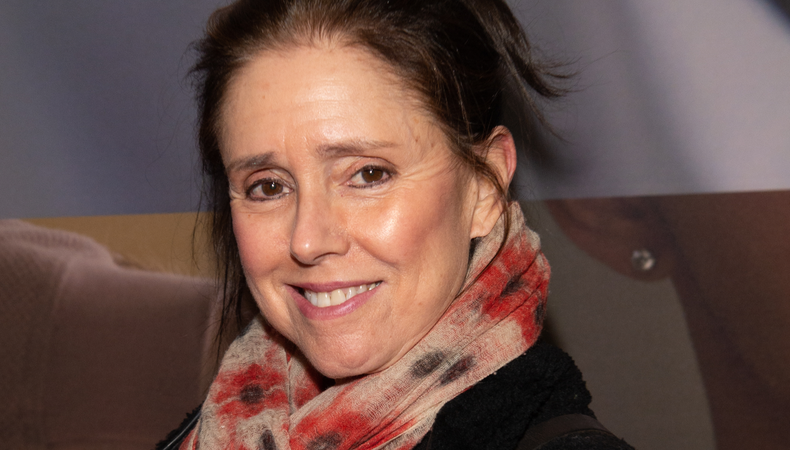
“In the Envelope: The Actor’s Podcast” features intimate, in-depth conversations with today’s most noteworthy film, television, and theater actors and creators. Full of both know-how and inspiration, “In the Envelope” airs weekly to cover everything from practical advice on navigating the industry, to how your favorite projects are made, to personal stories of success and failure alike. Join host and Awards Editor Jack Smart for this guide on how to live the creative life from those who are doing it every day.
“I’m a director,” Julie Taymor states at one point in her “In the Envelope” interview. It’s the closest the multidisciplinary artist comes to classifying herself under one skill set, or perhaps the easiest label to encompass every source of inspiration that goes into her award-winning work: producing, writing and composing, designing sets, costumes, and even masks and puppets. So varied are those inspirations, and so ambitious is her reach that it may be more helpful to identify everything that Taymor isn’t.
“It’s conceptual, it’s interior truth,” she says of her creative process. “To me, movies, art, theater, opera is there to give the subjective experience, on an equal par with the objective.”
 How to Become a Film Director
 Across a decades-spanning career—from her Tony-winning “The Lion King” adaptation (the highest-grossing entertainment title in box office history) to big screen extravaganzas “Titus,” “Frida,” and “Across the Universe”—Taymor has always been channeling inspiration into each storytelling endeavor rather than boxing herself in. The Massachusetts native began as the youngest member of the Boston Children’s Theatre, the first of many theater companies in which she acted, directed, and designed. But her studies also took her to Paris (for mime), New York City (for filmmaking—and acting, using Backstage), Oberlin College (as a mythology and folklore major), and Japan and Indonesia (for dance, mask work, and puppetry), all of which infuse her celebrated productions. “I’m very much on the job, self-taught in theater and in film and in opera,” Taymor says.
Although travel is restricted now amid the COVID-19 pandemic, she sees it as crucial for developing artists; her Julie Taymor World Theater Fellowship sends enterprising young thespians abroad. “I came alive as a creative artist in Indonesia,” she explains. “That, to me, was my trial by fire. I think travel gives you a vocabulary. It’s important. We get too insular, especially Americans.”
So how can artists—be they directors, writers, actors, designers, or especially some combination of the four—develop a distinct storytelling style? “Eat a lot, look at a lot,” advises Taymor. “Find something that you’re really, really passionate about.” It was genuine passion, she says, that led to Salma Hayek’s Oscar-nominated Frida Kahlo in “Frida,” or taking a bloody “Titus Andronicus” and Helen Mirren–led “The Tempest” from page to screen. Those same impulses inform Taymor’s newest take on biographical film: Roadside Attractions’ “The Glorias,” starring Julianne Moore, Alicia Vikander, Lulu Wilson, and Ryan Kiera Armstrong as Gloria Steinem at different points in her journey as a feminist activist (plus Janelle Monáe, Lorraine Toussaint, Bette Midler, and more).
Actors auditioning for Taymor would do well to remember her theatrical roots. For “The Glorias,” filmed in Savannah, Georgia, even those trying out for one-line roles were given feedback. Background actors, Taymor says, are “the landscape as much as the landscape” in her films. “On my wall in my office in Savannah, there’s a huge wall of faces, and I put them together and I look at them, and all of them are meaningful to me.... And I want to see how you use your body. Movement is very important.”
Another tip for early-career artists: “Don’t do it for the money!” Taymor, in fact, encourages any path that teaches storytellers how to do a lot with a little. As she points out (speaking from considerable experience), Hollywood and the theater and opera industries seldom provide directors with projects that steadily grow in scope and budget. “The scale of the story has to be appropriate to the story,” she says. “And if you can do it with minimal means, actually, you will have more freedom. [Choreographer] Garth Fagan always said that...limitations are freedom.”
Stay tuned at the end of this podcast episode for Backstage casting insider Christine McKenna-Tirella’s thoughts and pointers: check out our cover story with another theater legend, Mark Rylance, right here, and apply now for San Jose Stage Company’s virtual production of “Persuasion,” some animated medical explainer videos, and this hair beauty shoot. And don’t forget to subscribe for more “In the Envelope” every week!
Listen now on:
Looking for remote work? Backstage has got you covered! Click here for auditions you can do from home!