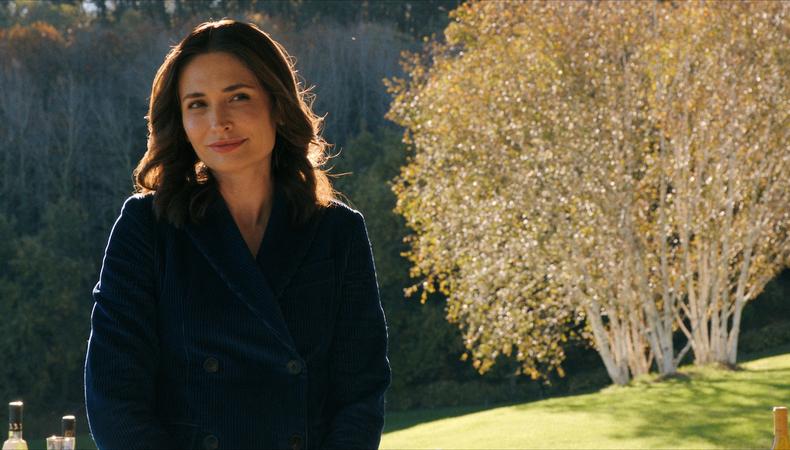
On Vince Gilligan’s Apple TV sci-fi drama “Pluribus,” Karolina Wydra delivers a mesmerizing performance as Zosia, the ego-stripped, otherworldly face of an alien-like hive mind known as the Others. Once a normal human, Zosia is now the main voice and body for the collective.
“A lot of different things went into creating Zosia. It was the most exciting challenge I have experienced to date as an actor,” Wydra tells us, highlighting how her close collaboration with Gilligan was essential to bringing his vision for the Others to life.
In this exclusive conversation, Wydra details the unique challenges of acting as an emissary for billions of minds as well as suppressing her own human instincts in scenes. To give form to this massive collective consciousness, she drew on a blend of subconscious dreamwork (an acting technique using dream imagery for character development), specialized physical movements, and a profound sense of love drawn from her real-life experience of motherhood. The actor guides us through her intense preparation and her deep onscreen partnership with costar Rhea Seehorn, who plays Carol Sturka, the one character the collective can’t control.
What type of preparation went into creating Zosia?
When I auditioned for [“Pluribus”], I didn’t know anything about the world. And when I discovered what this character is, it was pretty mind-blowing. Then the fear set in of: Oh my God, how am I going to tackle the whole world in my brain?
I’m in love with the craft of acting. I love doing a lot of prep, and I was blessed with Rhea, who’s also such an avid prepper for her characters. Having a [scene] partner who is so generous pushes you to go even further, deeper, and work harder on your own craft.
I do a lot of dreamwork, which is tapping into the subconscious of the character. [Understanding] the level of the subconscious gave me the feel for the world, who Zosia is, and the energy that she carries. A lot of meditation came from my dreamwork—because meditation gets you into a certain state of being, peace, serenity, contentment, and connection, where the ego gets removed and you feel connected to the world in a very spiritual way. I did research on spiritual leaders and how they move about the world, because there’s a way that she carries herself. The physical aspect was working on being really relaxed, being in my body, and being present.
The beautiful challenge of playing Zosia was: [Typically] whenever you approach a scene, whatever is happening with you on the day, you go, “Well, just give it to the character. You’re just going to go on this emotional journey of mirroring one another, and whatever you’re experiencing, just be honest and truthful in the moment.” But Zosia doesn’t have nerves. So the first days on set, I was quite nervous and excited. Doing the body work and the prep, where I would relax into my body and be present, was very important. So when the nerves would come in, I would have to find a way to be more in a state of relaxation.
That was one aspect. Script analysis is another thing that I always do, and Rhea as well, and we’d always talk about that. Then I’d work with Vince on the day, as far as fine-tuning and finding the sweet spot of where Zosia lives. Something we would talk about is the indulgent mother.
And with each episode—because I would get the [scripts] as they came out—I would actually learn new things about [the Others]. The journey was discovering that they’re not afraid of death. So, like in [Episode 3’s] grenade scene, I would have to suppress, most of the time, my natural instincts as a human being. At the same time, this character, Zosia, is a full-fledged human being. She’s not a robot; she’s a full-fledged human being that’s altered. She doesn’t live in the full spectrum of emotions. Her emotions are altered, and she only has a certain amount of emotions that she gets to express. So I was fine-tuning that on the day.
I like to think of my process as making a great soup. There are just so many ingredients you throw in, let it boil, and then throw it all away. On the day, just allow yourself to be present. That was another thing about Zosia—she is very present in every moment. She is unflappable.
Not being able to mirror emotions is quite challenging because it’s our natural instinct as human beings. You’re smiling right now; I want to smile. I’m like, “Oh, she’s pleasant. OK, I feel safe.” Right? Especially in acting, that’s when you really let things boil and cook. You get lost in the scene. So this was very much about how you can’t do that, and finding ways to still be fully available, but in a different state.
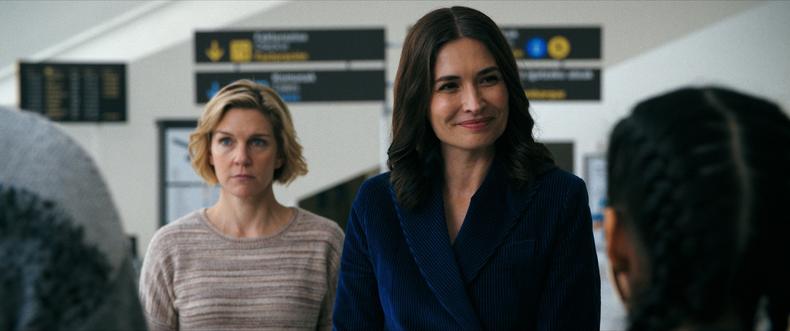
There are a lot of heated moments between you and Rhea’s character, where Carol is very expressive. How did you restrain yourself in those moments?
We’re very lucky that we get to do many takes. At first, you can’t help it, you would go there. Vince would help me and guide me. He would be like, “OK, we need to pull back. We need to hold that space and not be affected by it.” Sometimes it would take a few takes. And sometimes it would feel really odd in my body. It took a lot of trust in Vince and his vision, because it would feel very much like going against my instincts, which was truly so exciting, because I got to really collaborate and trust. It was all the prep that I did, all the things that I had in my little bag of tricks, all the things that I came prepared with. So if things would come up, I would be able to find my way through it, be present, hold the space for her, and breathe through it.
If you watch Zosia and the way the Others are about the world, you see that everything is thought out by Vince, which is so brilliant. If you watch Zosia, she speaks in a very proper way. The Others speak very properly. They’re the greatest lawyers. They’re very diplomatic with the way they speak, the choices of their words. Even my physical distance from [Carol], how close I got to her, how comfortable I got with her, when I got to sit down, and when I did not—everything had its purpose.
To go back to the grenade scene, my natural instinct was I had the urgency to go and grab the grenade. That’d be my natural instinct—we can’t die. And Gordon Smith, our director, would say, “You can’t do that. You still have to ask her permission and her agency, and you have to approach her slowly and make sure that she doesn’t feel afraid. And then ask for permission, and then do it.” So a lot of this stuff went against my instincts, but it played so well. My body would be like, this feels strange, but when I saw it, I went, “Wow.” It added so much to this world that Vince created, and it was so exciting to go on that journey.
Then, in Episode 8, you do see a transition to Zosia—within that world, but there is a difference in the way she behaves. You see how the Others behave toward her when the shifts start to happen, which was so fun to carve and create. I had such a great time doing it.
Did you find yourself imagining what it would be like to have thousands of people’s thoughts in your mind all at once?
I still think about it. I’m like, there’s gotta be a way to kind of tune out the channel and then plug back in. Because if there was constant noise and everyone talking at the same time, I think it would be quite overwhelming.
There are moments when I do separate from [Carol], and I do telepathically communicate. I don’t communicate with everyone, but I’m downloading information from the people who are giving me the information to make sure I can give it to her. If everyone were talking all at once? Oh my God. I would have to be like, “Everybody, shut up!”
You worked with a movement choreographer, Nito Larioza, to develop Zosia’s glitching physical movements. What was that process like?
We would practice how they lived in our body. The glitches weren’t like seizures; it’s as if you’re short-circuiting. We focused on our hands and how you would do it, the kind of temperature, how the glitches would happen in different parts of your body, and how violent they would get.
Also, we would carve it based on how the camera was set up—how much more intense they were or less intense [depending on] how far away the camera was. We did a lot of practice with Nito, and he was brilliant. He did such a great job with everyone.
Going from that, we would talk about when you wake up after you short-circuit: Their bodies were a little bit achy, and it would take a second to reprogram yourself to go back to the state, as if you just broke down a little bit. And then you go, “Oh, OK, let me come back in.”
Was there anything you learned from practicing dreamwork that you used during those intense physical transitions?
Dreamwork always affects everything I do, because dreams give you so many potent images and experiences that you can take bits and pieces and use them when you need them. It always lives inside of me. In my prep, I find things and dissect them like: OK, on the day, I think I’m going to need this, this, and this.
I put it into music, too. Music is very important to me. I always make a playlist for all of my characters. Zosia has an awesome playlist; I still want to listen to it. But it’s hard for me to share it because it’s such a personal playlist. I just feel like, energetically, if I put it out there… I want to keep it very personal. It’s the same with dreamwork; it’s so personal.
Also, for characters, I love to do perfume. For me, it’s all the senses. And it just depends on each character. Sometimes if I need shoes, I find shoes, put them on, and step into the character. Because Zosia has so many different elements that went into creating her, I used everything that I could to make her come alive—things that I didn’t use before. But perfume I usually use for most of my characters, and I can share the perfume for her—it’s Le Labo Vanille.
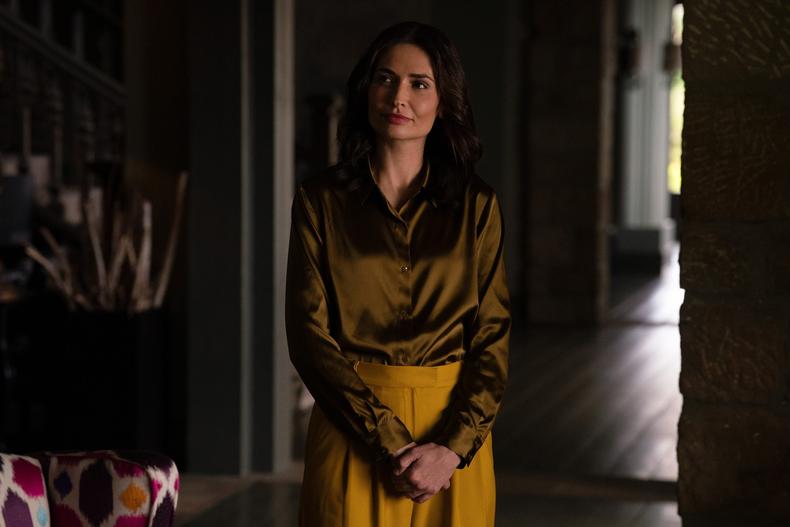
You’ve played iconic villains in your past, like my personal favorite, the vampire Violet Mazurski on HBO’s “True Blood.” How refreshing, or difficult, was it to pivot to someone as purely kind or loving as Zosia?
Thank you for saying that. I was laughing with my friends [when I got this role] because I used to only play quite villainous or very flawed characters. I’ve always wanted to experience someone like Zosia, but I never got cast as that. Part of me feels like because I became a mother and I took that break, something shifted in who I am, in my being, and in my presence in the world. I was able to tap into Zosia and understand her on another level as far as what it means to be a mother.
I definitely use that toward Carol, because Zosia loves Carol unconditionally. No matter what she does, I love her truly, unconditionally, and I will do anything for her—and my children. If my child was running in front of a bus, I would go and jump in front of a bus. I would do anything. Before being a mother, I couldn’t understand that. I remember in classes, teachers would talk about how a mother would do that, and I would literally scratch my head, going, “Well, I hope I would do that.” Because I was a very selfish person. I was living for myself. Not until I had that experience was I able to truly understand the depth of that. So it was really exciting to be seen in a different way.
My close friends were literally laughing that I got to play Zosia because it’s so the opposite of who I am. There is an element of me, but I am Eastern European—I’m very passionate, I’m very outspoken, and I have a big personality. I even said that to Vince: “Vince, I am a big personality, and I’m very spicy. If I see somebody hurting somebody, boy, you better watch out.” I’m like Violet in that way, where I’m like, “OK, let’s go. You do not mess with me, and you do not mess with my people.”
So it was a very exciting challenge to step into those shoes and do something so drastically different. I’m so grateful to Vince for casting me in this role because I’ve always wanted to experience that. I never expected a character like that, but it was an exciting challenge to be seen as something else. Even on “Sneaky Pete,” I played a con artist. Violet is a very deeply flawed woman who carries a lot of baggage, and at the same time, she’s a badass that I just admired and loved so much. And then on “Justified,” I played another con artist! So, yeah, it was a very exciting thing to play. Thank you for saying that about Violet—she was a fun character, very misunderstood.
Let’s talk about your chemistry test with Rhea. Looking back, what was the exact moment you knew this partnership was going to work?
When you test, you don’t know. I thought I walked out of that test and I was terrible. So I did not feel like I was going to get the role. But I was in awe of Rhea. Rhea is one of those beautiful actors who gives everything and then some, and is incredibly generous. On the day, she could tell I was nervous, and I could feel she had my back and wanted me to do my best. She would ask me, “What do you need from me? What can I do? How can I help you? If there’s anything, please let me know.” And she was like that the whole season. When you have a partner like that, it’s the most incredible gift you can ask for.
On weekends, we would meet, rehearse, and talk about the scenes. We really worked nonstop. We just love this craft so much. When you have someone who’s as passionate as you are, it’s just exhilarating. It gets you so excited, and she taught me a lot. She and I have the same banter, and we get along really well. There are a lot of things that made us feel really aligned, and that was such a wonderful thing. She’s just such a special lady; I just love her so much. I get to learn by watching her, and she’s such a phenomenal actor. It’s a gift. She gave everything that she could to me at that test. I could tell she wanted me to do well and really wanted me to shine so I could get this role. I owe her so much.
Now you’re gonna make me cry! [Laughs] Sometimes when I talk about it… When you bring me back to the memory of something, I start to relive it, and it’s just so special to my heart. She’s very special to my heart. And to everyone, by the way. Everyone on set. She’s just such a giver. When you have people like Vince and Rhea to work with, it makes everyone feel so safe and so excited to work the hardest they’ve ever worked, to bring the best parts of themselves, and to challenge themselves over and over again. You get the best out of people.
During the audition process, it’s been said that you were given sides to a much later episode in which Zosia showed some emotion. How did that early look at her potential individuality shape how you played the character?
It was interesting. They took the emotionality out when we shot it. There was one moment when her feelings about what was happening really affected her—watching Carol struggle so much. But when I tested for it and did that scene, Vince actually asked me to remove [the emotion]. Then they changed it in Episode 3. Because a lot of actresses, I heard, would come in and cry during that moment—and it was a very emotional moment. But I understand how that wouldn’t work for the world. It just didn’t serve the story.
There is a question that comes up later in Episode 8: Is Zosia removing herself and detaching from the collective, and are you seeing more of her individuality? Or is it just a performance for Carol—because Zosia knows all the memories of Helen [Carol’s deceased wife]—to make Carol feel happy, safe, and closest to someone. Do we perform for her? There are all these things to question.
I, for instance, didn’t ask Vince about [it]. I mean, there is an individuality to all of us because we all have our own personalities, but individuality in the sense that I have my free thought is not there because I’m part of the collective. But again, there’s a moment [in Episode 8] where I do have to separate myself to go to the memory of who Zosia is, about the mango ice cream. There is a pause, and I have to remove myself to travel [and think], Wait a second, who is this individual? What did this individual like? That was a very interesting thing to play.
But I didn’t ask Vince who Zosia was [before she joined the hive in the Joining] because I didn’t want it to color who Zosia is today. She’s not the same person; she is who she is today in the Joining, so that was my focus. And I’m very curious to find out who she is.
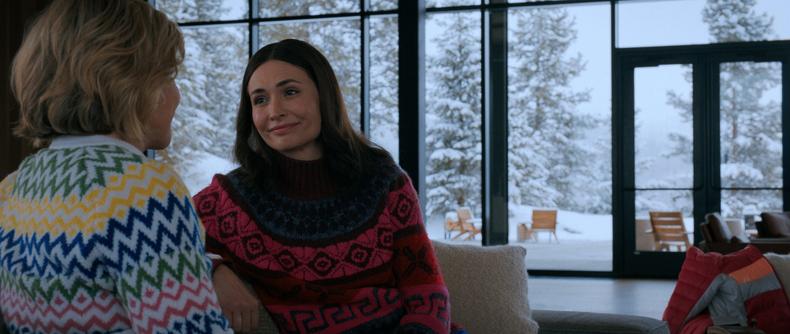
Vince is famous for his precise, visual storytelling. What’s the most specific note he gave you that maybe changed how you saw Zosia?
It wasn’t just Zosia; we would discuss the Others, the world that he created. Some of it was, we would say, they could be like an indulgent mother with their child, right? Give them whatever they want to make them happy, making sure they feel good and safe, and we want to satisfy them. Or an indulgent grandma, who you go to and they’ll give you everything and anything just to make you happy, and they’re just so happy to see you and love you so much.
And the moments of removing the empathy—that was a huge thing for me in certain scenes. Vince would work with me on just removing that and going more into the contentment. Also, I couldn’t judge the Joining. There’s nothing that I could judge about Zosia’s decisions, because you can’t play a character when you judge them; you have to fully commit to what they’re doing—and to really build what the Joining meant. Everything I did came from that, because [the Others] know better what [Carol] needs, and we have to share this gift with her; it’s a biological imperative.
Vince [would remind me] that Zosia needs to come from that place constantly, like she’s doing everything for a greater purpose, and that the “old schoolers” need this. Like in Episode 3, when [Carol’s] like, “Do you think I’m drowning?” and [Zosia says], “You just don’t know it.” So, yeah, those are the moments that solidified [the character]. It wasn’t just one thing; it was a few things, because the Others are so complex. They’re not as simple as we are—and we’re not simple. We as human beings are complex ourselves.
I love this saying: “We know what it’s like to be you, but you don’t know what it’s like to be us,” right? At the end, I told Vince, “I think [the Others are] the greatest villains,” and Vince said, “No, I don’t think so.” I go, “Really?” He had a different idea about that. The only reason why I say that is because when somebody believes that they know better than you, it’s very dangerous. If somebody’s like, “Oh, but I really know what’s best for you,” that’s really scary.
What’s one thing you think an actor can learn from your performance as Zosia?
That’s such a hard question! Why don’t you tell me? I’m curious. What would you say?
I think it’s your prep work!
Yes, that’s a great one. Thank you. Prep work, definitely. As actors, prep is the greatest thing we can do so nothing goes missing, everything has its detail, and everything has its purpose. There’s a reason why you’re doing things, and understanding where [the character is] coming from is very important. That’s what I was taught in all my theater classes: Know everything and anything about the character and their backstory. Obviously, for Zosia, there wasn’t a backstory, but if there is a backstory, go into details.
[Acting coach] John Markland gave me a beautiful tool: a bunch of questions about who I am, then the same questions about who the character is, and then you start to see the similarities and differences. Zosia and I are very different. She has integrity. I’m not saying that I don’t have integrity, but her integrity is on a whole other level. So what does that mean and look like? It was very interesting to even do that. There are so many different things—now I’m starting to remember them all—but a lot went into creating Zosia. Prep would be the thing, yes. Thank you.
What are you most excited about for Season 2?
I’m really excited for the whole cast to be back together. I cannot wait to be able to see each other every day. Carlos-Manuel Vesga [who plays Manousos] lives in Colombia, so we rarely get to see him. The whole cast is so deeply connected.
As far as the story goes, I know nothing, so I’m really curious to find out where it goes. I’m just excited to be back on set with everyone and exploring whatever Vince has in store.
This interview has been edited for clarity and length.