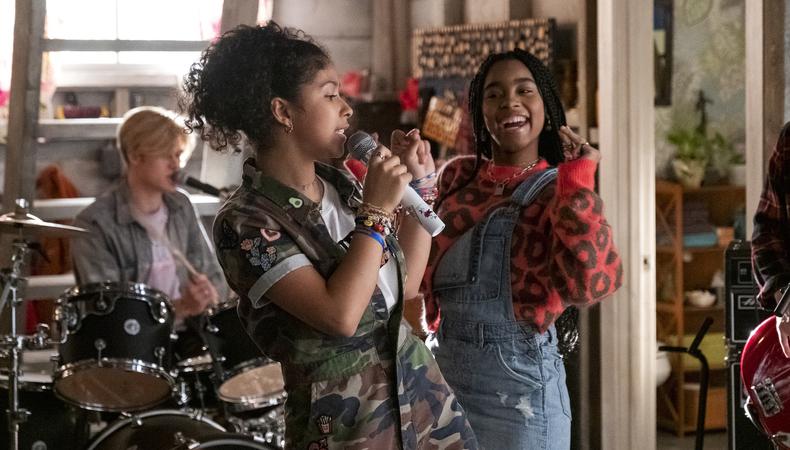
With his new Netflix musical series “Julie and the Phantoms,” Kenny Ortega continues his practice of discovering untapped young talent and watching as they turn into superstars. However, the director-producer-choreographer, who’s helmed on-camera Disney classics like “Hocus Pocus” and the “High School Musical” franchise, insists that he’s never generated star quality in performers like Zac Efron, Dove Cameron, and Leonardo DiCaprio. Instead, he simply scouts it and then gives it space to flourish. Here’s how he’s learned to spot someone special when they walk into the room (and how you can become that someone, too).
Tell me about the genesis of “Julie and the Phantoms.”
We actually pitched it. My agent wanted to pair me up with these two showrunners—Dan Cross and David Hoge—for a while, and called on the three of us, [saying,] “This is a project that was a very successful Brazilian kids’ television program, and I think this might be something you could all have a fun time putting together.” We looked into it, and got excited that we had no boundaries, a freedom to come at it anew. I absolutely love Dave and Dan and where their heads were at and as men; they are just really cool people. We took it to Netflix, and I hadn’t even signed my [Netflix overall] deal yet. It was the first project that I had been part of bringing to Netflix, and they grabbed it right away.
 How to Audition for Netflix
 The show is full of supremely talented young actors who can also perform musically. What was the casting process like?
I was a big voice in the casting for “Julie and the Phantoms,” proudly. I was supported by Netflix and supported by our showrunners, Dave and Dan. We wanted to create a band. You can’t force that. You have to take your time and make sure that the personalities in the room together have a connection. So [I worked] with [casting company] La Padura and Hart—they were introduced to me at the Disney Channel over 15 years ago. Their ability to discover young talent is just incredible.
“That’s the biggest thing for me to know: When that person is in the room, they have the intelligence, the generosity, the enthusiasm, the passion, and the bravery, the courage, to jump in with me.”
[“Phantoms” lead] Madison Reyes came from a search that went across all of North America; they sent letters to 1,000 schools. This girl, 14 years old, her teacher walked up to her and said, “Netflix is looking for a Latinx girl to be the leading character in a series who can sing and play music and act. Why don’t you check it out?” She went home, and, having never been in front of a camera, never been in a recording studio, never auditioned on tape for anything, put together the most magical tape, all by herself. She dragged her electric piano out onto her porch, and she just spelled me. I knew right when I first saw it that she was going to be the girl.
You’ve been helping turn young unknowns into superstars for decades. What qualities stand out to you in performers?
One thing I will say is that they turn themselves into stars. That’s the biggest thing for me to know: When that person is in the room, they have the intelligence, the generosity, the enthusiasm, the passion, and the bravery, the courage, to jump in with me. I’m looking for that potential, that promise. And then, all I do, really—not to say that I don’t guide or steer or do my best to be an influence—but what I really do is try to create an environment that makes them feel like real partners who have real voices, where they feel safe and can take risks and be fearless. When you pick the right people and you put them in that kind of environment, magic is going to happen. It’s not something that I teach or I do. I don’t magically have this gift to turn young people into breakouts, into stars. It’s really knowing that you’re in the room with someone who has that potential within them already and helping them to have the confidence to do the work, to make it happen.
What advice would you give an actor who wants to get cast in one of your projects?
I learned this along the way, and I asked these questions of casting directors: When do you know that you’re standing in front of somebody who’s really special, and that you want to cast them? The [answer] is, for actors, don’t abandon yourself in the process of striving to be in this industry. Those colors are important. Bring those colors into the room with you. Study, of course. Study technique, get a great foundation, a really good education; all of it’s going to come in handy for you as an actor to draw upon. But I’d say don’t abandon your humanness, your unique colors that make you who you are. And then you bounce into the room with those—or maybe not bounce. When I met Leonardo DiCaprio all these years ago, he came through the door shuffling, and 20 minutes later I was like, “Oh, my God, who is this guy?” Make sure, when you’re walking into a room to meet people, [that] you’re present and not just the character that you’re about to audition for.
READ: Brandon Victor Dixon on Performing in a TV Musical
How do you find so much untapped talent for your projects?
It’s taking your time, having patience, believing that that person is out there, or that that group of people is out there. [In] all of these projects that I do, chemistry is such an important thing. You need a little time to really know if it’s there. You can’t just do it in one meeting. Agents sometimes used to get a little perturbed with me because I’d keep the actors for hours and hours, more like a theatrical audition than a TV audition. But, eventually, they’d figure it out. Look what comes from it: extraordinary talent! Dove Cameron, Sofia Carson, Booboo Stewart, Cameron Boyce, who I miss so much. You have to take your time.
What about music makes for effective storytelling?
It isn’t for everyone, and I know that. I’ve met some pretty tough folks who just will not sit through it and suspend their disbelief. But for those of us who do, and who enjoy music-driven storytelling, I would say that when music does the job of moving a story forward, moving character forward, raising the stakes, setting up the next chapter in the story—when music can do that, it’s really fantastic. It’s like a script, but in a musical form. At a certain dramatic moment within a story, when words can no longer be enough, music clearly sells the moment. I think it has a more dramatic ability when placed within the storytelling. Arriving at the right moment, music can really move you emotionally. It can create great magic.
Since there are so many components, can you break down the process for preparing and directing the actors for a filmed musical?
We do a big prep. I’ve been supported for this throughout my TV career, with Disney Channel and now with Netflix. Prep is everything in a musical. If you rush through prep, you’re going to hurt people. You could make people crazy because they’re stepping onto the set unprepared, insecure. Every time I step into one of these new projects, it’s the first thing I talk about: making sure everybody understands I’m going to need an awesome prep. I create a kind of factory with the help of choreographers and art directors and songwriters, producers. And the kids go through this whole factory experience. Through the course of a day, they have dance training, they have scene work, they have movable instruction. With “Julie and the Phantoms,” they have instrument rehearsals. You give them six to eight weeks of that, so by the time you’re ready to roll the cameras, they’re ready. Every day, too, when they arrive, you make sure they have the opportunity to wake their voices, stretch their bodies. It’s just preparation and then taking care of people, so they step onto the set and they can surrender themselves to the work and to each other.
This story originally appeared in the Sept. 10 issue of Backstage Magazine. Subscribe here.
Looking for remote work? Backstage has got you covered! Click here for auditions you can do from home!