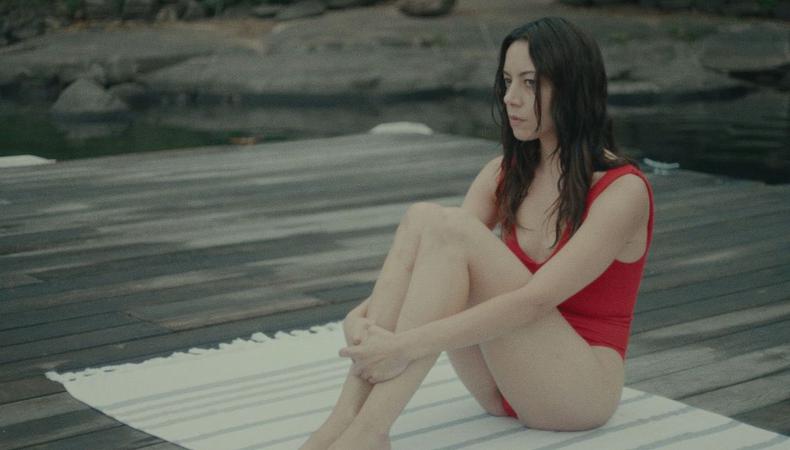
As a searing exploration of the interplay between artists’ professional and personal lives (to both toxic and euphoric ends), “Black Bear” is one of the year’s best films about filmmaking—and all it entails. In other words: DIY creators of all kinds will either get brutal delight from the obvious parallels to their experiences on indie film sets, or they’ll be watching through their fingers knowing they’re guilty of the film’s less flattering portrayals of the artist at work.
“Imposing [my] vision is what I try to avoid doing and [I] try and stay open to what the actors are bringing, because their own ideas may be more exciting or interesting than the ones that I have.”
Buoyed by a reliably stellar, often winking performance by Aubrey Plaza (most recently seen breaking hearts in Hulu’s holiday hit, “Happiest Season”), the film begins by following Allison (Plaza), a writers’ block–addled screenwriter who escapes to a remote lake house in hopes of reirrigating her creative juices. The home’s owners, Gabe and Blair (Christopher Abbott and Sarah Gadon), are also there to accompany Allison in her stay, despite the clear-as-day fissures in their unraveling partnership. Intrigued by the unhappy couple, Allison toys with their dwindling fire for the rest of her stay, antagonizing deep-seated jealousies and resentments and stoking ideological differences—to devastating ends.
The film then flips on its head at the midway point and becomes an entirely new narrative. Here, the central trio are at the heart of their own indie film set, recreating similar circumstances of Part 1 with reversed roles, meta-style; as the film-within-a-film’s troubled star, it’s now Plaza’s turn to unravel for the sake of another’s creative inspiration. Throw in a spot-on satirical look at contemporary low-budget filmmaking, and this unexpectedly ambitious two-parter from writer-director Lawrence Michael Levine will almost certainly have you reflecting on your own craft and the creative practices therein.
 Aubrey Plaza Is Redefining Her Career—Here’s How She Did It
 It turns out, that was in part the point. After several years working in a more commercial space following his “Wild Canaries” feature film directorial debut in 2014, Levine shares he had “enough money saved up that I could take some time and just do something for myself”—something more “adventurous” that harkened to influences like John Cassavetes and other forebearers of early American independent film and European art cinema. Capturing in “Black Bear” experiences he’d had firsthand as a filmmaker as well as toxic creativity tales of yore about the likes of Stanley Kubrick and Jean-Luc Godard, Levine shares that the passion project was a desired break from the more lucrative work he’d been doing, where he felt “constrained by those limitations.” He admits, too, of course, that indie film comes with limitations all its own.
“You have different limitations, in terms of budget and stuff like that. I knew that I needed to keep things small, I was probably going to keep the locations minimal, and the number of people in the cast really small,” he explains. “I came up with this idea of telling a story in two parts—one in which Aubrey’s character would be a homewrecker and another in which her home would be wrecked; she would play both roles, and those two sides would reflect each other in interesting and resonant ways.”
To play that character, Allison, Plaza was always his top choice. “I knew that I wanted to make a movie that was more mysterious, and Aubrey’s very enigmatic in a lot of ways, so I think the role really suited her.” All the leads in the film, as a matter of fact, were Levine’s first pick. “I didn't offer these parts to anybody else,” he says. “I was really lucky. All the people that I really wanted to work with ended up doing it.”
READ: What You Need to Know About
Making an Indie Film
Reflecting on his working relationship with the cast once everyone was in place, Levine, who himself has experience acting in front of the camera, says that he tries to foster a set that he would want to be on as a performer. Unlike some of the means to an end you’ll witness in “Black Bear,” he gives his actors the space to do what they need to do, how they need to do it.
“I do try to treat actors the ways that I’ve enjoyed being treated on set; I do bring that awareness to a set,” he says. “That being said, you’re wearing a different hat [as a director], and you have different concerns. It’s difficult, but the way that I like to be treated on set is to be trusted to do my job, and then if I’m ever confused, or in need of help, or badly misreading a scene or embarrassing myself in some way, the director is there to step in and help, but not necessarily to impose their rigid vision or interpretation on the actors before they’ve even started. It’s more of a collaborative discussion as the takes proceed.
“I don’t really coach the actors to deliver lines in a particular way before they start to work,” he continues. “Imposing [my] vision is what I try to avoid doing and [I] try and stay open to what the actors are bringing, because their own ideas may be more exciting or interesting than the ones that I have.”
As far as the advice he has for other actors and creators who want to get started in indie film themselves, speaking from his own experience, Levine says to have your eyes on the prize and be prepared to be in it for the long haul.
“I would just say hang in there—particularly if you want to go the independent route. You’ve gotta love it; it’s not going to make you a lot of money. And along the way, if you can develop some skills that will allow you to function in a more commercial vein, it’s helpful.”
Looking for remote work? Backstage has got you covered! Click here for auditions you can do from home!