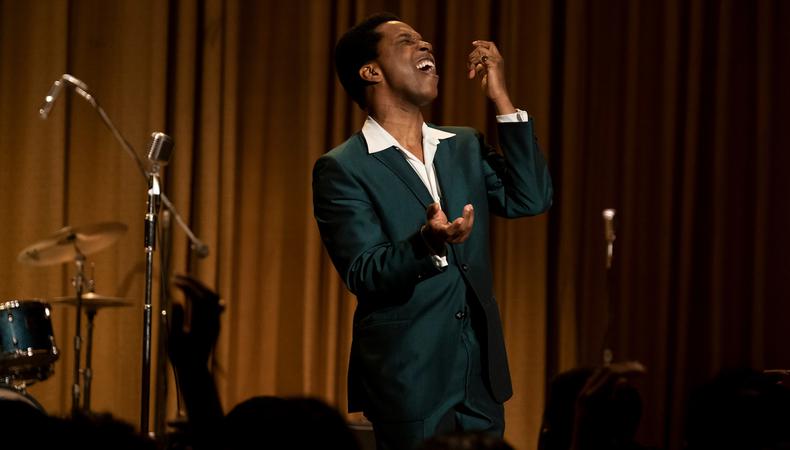
Alongside Regina King in her directorial debut, director of photography Tami Reiker developed a visually and emotionally electric world for “One Night in Miami,” the upcoming film adaptation of Kemp Powers’ play of the same name (streaming on Amazon Prime Video Dec. 25). Fictionalizing an evening shared by four famous friends, the film stars Kingsley Ben-Adir as Malcolm X, Eli Goree as Cassius Clay/Muhammad Ali, Leslie Odom Jr. as Sam Cooke, and Aldis Hodge as Jim Brown.
How did you come to “One Night” as cinematographer?
The producers of the film reached out to my agent, and my agent sent me this script, and I absolutely loved it. We created a look book with ideas and visual references. I met with Regina, and we totally hit it off—and we were on our way to New Orleans.
 What it Was Like Casting Muhammad Ali + Malcolm X for Regina King’s ‘One Night in Miami’
 How did you and King work together to establish the visual aesthetic?
She really wanted to use a lot of historical references, to use the exact location—we couldn’t use the exact location, but [we could] mimic the exact location of the Hampton House or [“The Tonight Show Starring Johnny Carson”]. We had all the footage. We studied the expo fights, the one in Wembley and the one in Miami, and we recreated that. We made a lookbook of visual references, [including] a lot of street photographers like Garry Winogrand, and definitely the “Greatest of All Time” Ali book. That was our bible for the fight; [it had] the most incredible photographs.
And then creating the color palette, we worked really closely with the production designer and Francine [Jamison-Tanchuck], the costume designer. The four of us met in pre-production constantly, pulling colors and creating this very rich, saturated, vibrant palette with those vibrant blues and warms and greens that we felt were Miami, making sure we incorporated a lot of neon.
You opted to shoot mostly long takes to allow the actors more emotional freedom. What was it like to prepare and shoot those?
This was the most difficult thing about the film. The vast majority of the film takes place in one room, and we didn’t have much rehearsal time. The actors were coming from all over the place. Kingsley was in London, Leslie was in New York, and they also are incredibly busy men—they had other projects that they were coming and going from, so we didn’t really get them until a few days before the actual filming started to see it on its feet in this space. I had already presented to Regina this idea that we both knew we wanted to keep the camera floating and moving and not have it static. And so I presented this idea that we would shoot A and B cameras on jib arms operated manually — the operators are swinging them so that the camera could always keep floating between characters and discovering different moments.
We had these daunting 15-page scenes that were wall-to-wall dialogue, and Regina, being an actor-director, really wanted to give the actors the freedom to move within the space and discover things, [so] we would do 15-minute-long takes. It was a little bit daunting at first. It’s very hard for the entire crew when there are no marks on the ground; the cameraperson had to remember, seven minutes in, they’re going to move to the bathroom. But we couldn’t imagine doing it any other way, and I think the actors really loved it also.
Was your work on this film different from how you normally approach your work with actors?
This is definitely a different approach. In every film, there might be one time in a film where you have five pages of dialogue. This is three-quarters of the film with very long, really intense, incredible dialogue. As far as working with the actors goes, I would say in this film in particular, we wanted to have the camera observing and floating and staying out of the way and allowing them the space to discover things and move around in space. Between takes, I would have to tweak a little if someone went into a corner that was dark or the light was wrong. This film, more than any other I’ve worked on, watching the transformations, watching the four actors become these incredible icons…was thrilling.
How did you get into cinematography?
I always had a love for still photography when I was younger. I got my first film camera when I was 12, and that became my passion. I spent all my high school years in a darkroom and decided to go to NYU. I went to NYU film school undergrad, and that’s where I fell in love with cinematography, shooting everyone’s student films, and then I stayed in New York. There was a big indie scene in New York in the ’90s. That’s where I met [filmmaker] Lisa Cholodenko and shot “High Art.”
What advice would you give to aspiring cinematographers?
My advice would be to shoot everything. It’s so incredible these days, you have access to cameras that are not expensive. Just shoot as much as you can, shoot it with your iPhone, shoot it with any camera that you can get; you work for free, and you need to keep building a reel so you have something to present. Whether you’re doing that in film school or on your own with your friends, just keep shooting. It’s an incredible time right now. Doors are opening up. It’s really changing. I am on another project right now and they’re going to have alternating DPs, and it’s incredible; every female DP is out there working, they’re on a show. It’s a really amazing moment right now. Keep going!
Looking for remote work? Backstage has got you covered! Click here for auditions you can do from home!