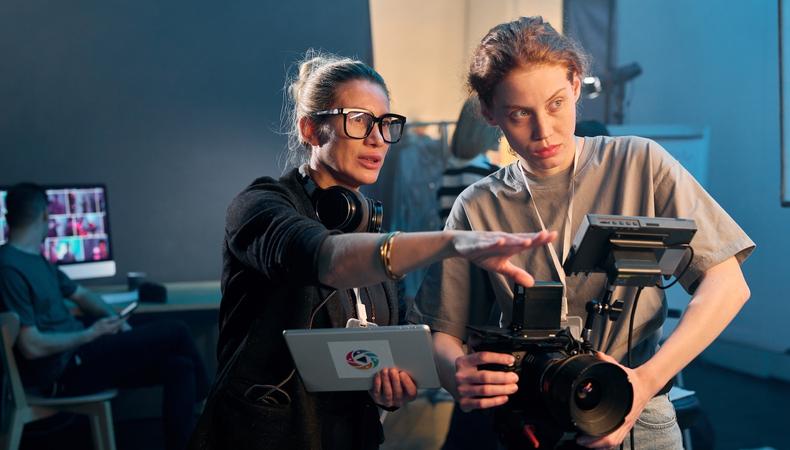
When Jordan Peele cuts to an eerily tight close-up of a character’s face, or Emerald Fennell frames a scene in a way that exposes the artifice of class, their creative choices are operating within a long tradition of cinematic thinking. Film theory is the study of how those choices work and why they matter. It’s a vital field of study for anyone interested in critically thinking about the way we intake visual media, from TikToks to docuseries to features and beyond.
Film theory is the study of how films and moving images more generally create meaning, and how audiences interpret them. It combines elements of philosophy, psychology, art criticism, and cultural analysis to examine cinema as both an artistic medium and a social force.
At its core, film theory is concerned with questions like:
- How does editing influence perception?
- What role does the director play in shaping a film’s meaning?
- How do cultural contexts shape how we interpret moving images?
- What makes film unique as an art form?
Why film theory matters
We are inundated with moving images precisely because they’re so easy to consume without thinking—but film theory helps us move beyond passive consumption.
Most people can tell when a movie works, but not always why. Film theory provides language and structure for understanding those instincts. It turns vague reactions—“that scene felt off” or “that shot was powerful”—into more precise observations. It can be used to critically examine the images you take in. For instance: How is lighting and mise-en-scène in an ad making you crave the product? How is editing and music in a news clip on Reels being used to manipulate your emotions?
Do filmmakers benefit from film theory?
This is where the debate becomes practical. On one hand, many successful filmmakers have little formal engagement with film theory. They rely on instinct, experience, and collaboration. For them, storytelling is intuitive rather than theoretical.
On the other hand, studying film theory can provide:
- A deeper understanding of cinematic tools
- A broader creative vocabulary
- Historical awareness of how film language has evolved
- Insight into audience perception
For directors, theory can sharpen decision-making. For writers, it can clarify structure and theme. For actors, it can deepen understanding of tone, framing, and how performance interacts with editing.
An actor who understands montage, for example, may approach performance differently, knowing that emotion can be shaped in the edit. A director aware of auteur theory may think more consciously about consistency across projects.
Film theory is not a single discipline but a collection of perspectives. Here are some of the most influential schools of thought. While we’ll discuss specifically how they relate to the analysis of films, keep in mind that many of these ideas can be applied to digital media, marketing, and more.
Auteur theory
Auteur theory argues that the director is the primary “author” of a film. According to this view, a director’s personal style, themes, and worldview shape a film in a way that is consistent across their body of work. The theory gained prominence through critics associated with the French New Wave, particularly François Truffaut, who argued in the pages of Cahiers du Cinéma that directors should be seen as artists rather than technicians. Directors often associated with auteur theory include filmmakers whose work is recognizable through recurring stylistic and thematic elements, such as Alfred Hitchcock, Stanley Kubrick, and Quentin Tarantino.
Soviet montage theory
Developed by Russian filmmakers like Sergei Eisenstein, Soviet montage theory emphasizes the power of editing to create meaning. Rather than viewing shots as self-contained units, montage theory argues that meaning emerges from the collision of images—in other words, juxtaposition. By placing two shots in sequence, filmmakers can generate ideas that are not present in either shot alone. A classic example is the “Kuleshov Effect,” which demonstrates how audiences interpret emotion based on editing rather than performance alone.
Formalism
Formalism focuses on the technical and stylistic elements of film such as lighting, composition, editing, sound, and structure. Formalist theorists argue that film is an art form defined by its manipulation of reality, not just its representation of it. Stylization, exaggeration, and visual design are central. In cinema’s early days, formalism was a key intellectual movement that pushed audiences to consider film as a legitimate art form.
Realism
In contrast to formalism, realism emphasizes authenticity and the faithful representation of everyday life. Theorists like André Bazin argued that film’s power lies in its ability to capture reality, often favoring long takes, deep focus, and minimal editing. Films influenced by realism often avoid overt stylization, allowing events to unfold naturally. Pure realism is, of course, impossible to achieve—every film involves choices that shape reality in some way.
Psychoanalytic film theory
This approach draws from psychology, particularly Freudian and Lacanian ideas, to explore how films engage the subconscious. It often examines desire, identity, the role of the gaze, and hidden meanings beneath the surface narrative. Psychoanalytic theory is frequently used to analyze how audiences relate to characters and how films construct subjectivity. It offers insight into why films affect us emotionally and psychologically.
Feminist film theory
Feminist film theory examines how films represent gender, power, identity, and inequality. Like psychoanalytic theory, it frequently draws from Freudian and Lacanian frameworks. A key concept is the “male gaze,” introduced by Laura Mulvey in her 1975 essay “Visual Pleasure and Narrative Cinema,” which uses Freudian and Lacanian analysis to describe how visual media often frames women from a heterosexual male perspective. Feminist frameworks challenge assumptions and broaden understanding of representation—ideas that extend far beyond feminist studies and can be applied to race, postcolonialism, class, and more.
Structuralism and semiotics
Structuralist and semiotic approaches treat film as a system of signs. These theories analyze how meaning is constructed through symbols, codes, and conventions, similar to how language works. For example, a close-up might signal emotional intensity, lighting can indicate moral alignment, and genre conventions create audience expectations. This approach helps filmmakers understand how audiences interpret visual language.
Film theory is not about turning movies into academic puzzles. At its best, it’s about understanding how visual media works: how images, sounds, and performances combine to create meaning.
It offers tools for analysis but also for creation. For those working in film such as directors, writers, actors, and editors, it can be a valuable resource—not because it provides answers, but because it sharpens the questions. And in filmmaking, asking better questions often leads to better work.
There’s no project too small to benefit from a bit of film theory. The next time you’re shooting a TikTok, you may think about how your camera can be used to subvert the male gaze, or how cutting from shot to shot can create meaning through juxtaposition. But even if you don’t, trust us—those theories are still at play.