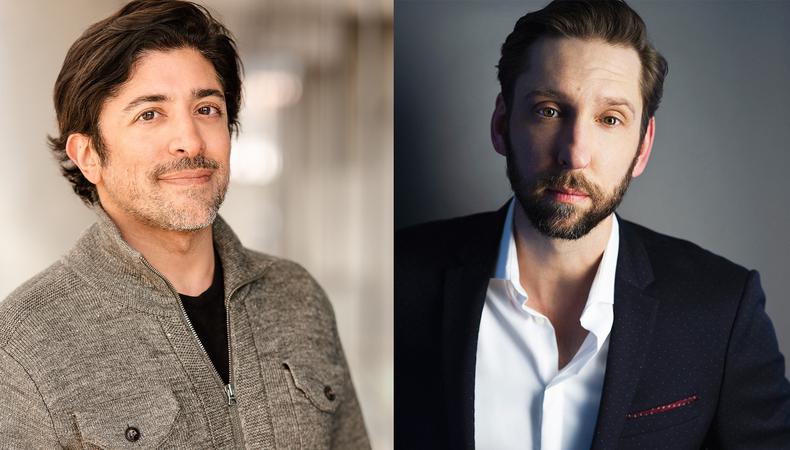
Joel David Moore and Rishi Bajaj come from diametrically opposed worlds—or so it would seem. Moore is a writer, director, and actor who’s starred in “Avatar,” among many other projects, and Bajaj hails from the business realm. But after many shared whiskeys and ideas on Moore’s ninth floor balcony in New York City, the two realized their combined backgrounds could be the recipe to storytelling success. And thus their production company was born, called—what else?—Balcony 9.
How did Balcony 9 come to be?
Joel David Moore: Rishi was one of my wife’s best friends, that’s how we met. And I lived on the 9th floor balcony in Chelsea. Rishi comes from a financial background and had a crazy amount of success at a young age. But where we found each other was decades into both of our careers in separate industries, and we felt like there was a lot of overlap. We just started sitting out on that balcony drinking whiskeys, talking about life, figuring out how we could actually make an overlap that made business sense. After about a year of exploration, we started our development fund called Balcony 9, and the rest is history. We’re off to a great couple of years’ start—obviously, the pandemic slowed everybody down, but didn’t seem to slow us down too much because we have six active features that have either already been shot or are going into production all around the world.
 How to Become a Producer
 Balcony 9 has a very specific intent and mission. I know about the “how,” so can you tell me about the “why” of founding the company?
Rishi Bajaj: As Joel said, when he came to New York, we did spend a lot of time together, we became really close friends, and we both really enjoy films. And there’s certain films that we really respond to. We both really like films about underdogs; we really like films that are based on a true story. And I’m not saying we’re limited to just that; Joel likes to say this all the time, that our genre is quality. But there are certain films and themes and concepts that we typically respond to, and those are stories we really want to tell. I think we want things that are conceptual, that we think there’s a real audience for. And that’s really what we’re trying to do. Time will tell, but I think some of the things that we’ve found, some of the things we’re moving into production, are really great films that people are really going to enjoy.
JDM: To speak to what attracts us: underrepresented communities, underrepresented stories, fish-out-of-water stories. I’ve made anything from a half-million-dollar movie to billion-dollar franchise with “Avatar.” I understand production. What I wanted to understand is how to take stories that might seem to be hard to make, or hard to conceive as far as how you can bring it to a general audience or bring it to many quadrants when you’re looking at the market and looking at selling a movie, and I think we’ve found a lot of great, promising stories that can still hit a general market.
I’m sure it varies, but, generally, how do you find the stories you want to produce?
JDM: I take nothing away from Rishi and his social network, which is vast and spans across the country. But, you know, I spent 20 years building relationships in my industry. And so, once I announced that we were starting this development fund—our first look came in just a couple months after that. We actually announced on a project called “Little Princes,” which we’re setting up right now. It’s a beautiful story based on a bestselling novel about a very fallible American who goes over to Nepal and finds a group of trafficked children that got away, and he one by one starts to replace them back with their families.
On the creative side, how do you aid in the developmental process of these stories?
RB: Joel obviously has been doing this for a long time and has a tremendous amount of experience in writing, directing, acting, on all sides of the camera. And I think that when we get something we like, we have a team that can really put a lot of effort into it to make it, or refine it, so that it moves from where it was to where it can be something that can actually be produced into a film. People who are bringing the script to us or other producers we’re working for can sort of trust that if we like something, we’re gonna keep putting resources behind it until it gets made. I think that our issue is going to be [that] we just don’t like to be working on things and having things kind of end up in the file. If we’re putting time and resources behind it, we’re really trying to get it executed and we wanna get it executed pretty quickly, so that people aren’t just in this sort of limbo or purgatory with a script that we really love.
JDM: I have to say, I had a production company before with one of my best buds Zach Levi, and we did some good work together. I directed the first film under that banner that I had ever directed called “Spiral” that Zach was in. We dissolved that company because it just wasn’t working. What works about this is Rishi. What works about this is that I have a partner that I speak to every day, who, when I’m coming with the creative avenue, he’s coming with the financial understanding of, “OK, so, how do we recoup? What’s the strategic model behind this? Let’s not dive in head-first until we’ve done our homework and made sure that we have an outlet for where this is going.” It’s almost like while I’m trying to tell the story at hand, he’s also coming and telling the business story. So, there are two stories being told: one is whatever the feature or podcast is, and then there’s the story of how, as a company, are we coming and putting together a beginning, middle, and end to the business opportunity as well? I didn’t realize how important that was to running a company until I had it, and this is where I think our two brains together, and my experience in this industry mixed with his business acumen, really set us apart from a lot of smaller companies that are growing.
 What It’s Actually Like to Be a Producer, According to Caitlin Gold
Speaking further to your very different backgrounds, what is the advice you’d offer to aspiring producers who are coming from your respective realms?
JDM: Find yourself a Rishi Bajaj.
RB: I’d probably say the same thing to anyone coming from finance: Find yourself a Joel.
JDM: I go back to my days of picking up Backstage and looking in the back five pages—this was before I knew what a mark was and where to stand on a set. I would try to find any nonunion gigs, because I didn’t have my SAG card and I needed to figure all that out. These gigs would pay $150 a pop or whatever and at the beginning of my career, I made relationships just by being aggressive and figuring out how to get in front of people. With this path, if I’m thinking about producing, it’s that instead of trying to do everything yourself, work with others. Employ other people who are really good at what they do in their lane, so that you can stay in your lane. It’s just building a team around you that don’t do what you do, and do whatever it is that you don’t do far better than you could.
RB: We’re two years into this, right? It’s tough to be in a position to give advice. We’re trying to build this company and we’re trying to do it as successfully as we can and we’re trying to draw from different elements of our experiences to create the best company we can. And there are a lot of talented people in Hollywood. There are a lot of really great artists and really great, savvy financial minds, and we’re trying to learn as much as we can from people that we know. And I’m trying to draw from experiences of looking at companies over 20 years, and building my own firm, and being on the boards of public companies to build the best production and multimedia company that we can with Balcony 9. But that said, I feel that we have learned a lot over the past two years and we have learned primarily what works and what doesn’t. What we’re just trying to do is build that muscle memory every day to figure out more and more what’s working and what doesn’t, so that our hit rate keeps going up and up. Because if we’re spending time on things that are getting made, and we’re not wasting time on things that aren’t, I think we’re gonna build the best company we can.
It’s a hard business, you know, but, running an investment fund’s a hard business. And there are tons of people who run investment funds. What separates a good investment fund from one that fails? A lot of it is cause, as Joel pointed out, it’s hustle, it’s tenacity, it’s waking up every day and delivering. In Hollywood, especially, there is this dynamic where there are a lot of promises that get made that don’t get fulfilled. What we’re really trying to do is create a company where when we say we’re going to do something, we do it. We show up on time, and that’s all you can really hope for. And then you just kinda cross your fingers and hope you get some good luck, too.
This story originally appeared in the May 13 issue of Backstage Magazine. Subscribe here.
Looking for remote work? Backstage has got you covered! Click here for auditions you can do from home!