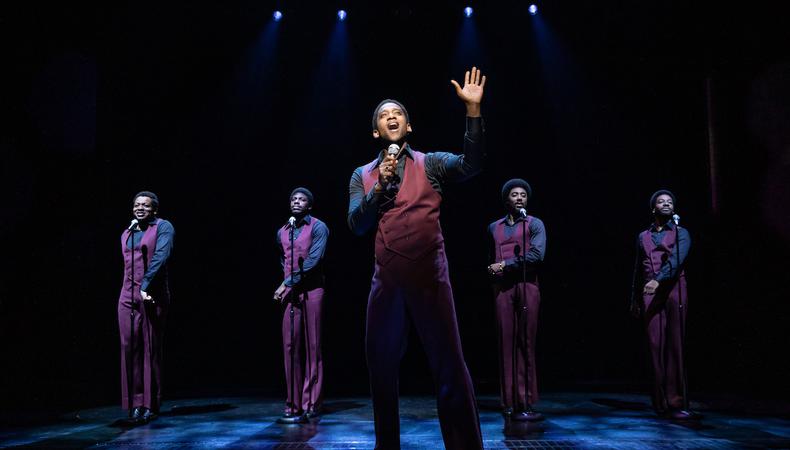
More Black actors were hired in the 2018–19 season on Broadway and Off-Broadway compared to previous seasons according to a new report by the Asian American Performers Action Coalition. Yet as Black representation on stage has increased, representation for other marginalized groups decreased: white actors still occupied a majority (58.6%) of all stage roles and over 80% of lead roles. Plus, for every $1 spent on white actors, only $0.70 was spent on BIPOC actors, highlighting a racial pay gap within theater.
The annual report, “The Visibility Report: Racial Representation on NYC Stages,” was created with support from the American Theatre Wing. Said AAPAC in the report, “The story of the 2018–19 theater season is one of an industry under pressure to diversify without a clear idea of how best to do it without fundamentally upsetting existing power structures.”
The report analyzed the Broadway shows that opened during the 2018–19 season, and the works produced at the 18 largest non-profit theater companies in New York City. The season was notable because it was the last full theater season before the COVID-19 pandemic (that year, “Hadestown” won the Tony Award for best musical).
The data is also extensive, measuring demographics of actors, playwrights, composers, librettists, lyricists, directors, artistic directors, designers, Broadway producers, general managers, and board members.
For actors, the report found that in NYC, white actors continue to be overrepresented in relation to their population in NYC (white people make up 32.1% of the population in NYC but occupy more than half of the roles). Meanwhile, 29% of roles went to Black actors—up from 23.2% the previous season—6.2% went to Asian American actors; 4.8% went to Latino/a actors; 1.3% went to Middle Eastern/North African actors; 0% on Indigenous actors; and 18% went to mixed-race actors.
 Exclusive: Years of Theater Diversity Data Now Housed in 1 Place With Launch of Counting Together Website
 Said the report: “While it is a positive indication that the industry seems to be placing more value on Black representation this season than in years past, it is also alarming that all other BIPOC races tumbled. It’s as if the industry could not hold more than one aspect of diversity at a time, especially if doing so would threaten the perceived primacy of white stories and white bodies on stage.”
Meanwhile, white actors played 80% of all lead roles in musicals and 89.7% of all lead roles in plays. And on Broadway, most of the gains in representation for marginalized groups were in chorus roles. The report said that BIPOC actors are more likely to be hired in featured and supporting roles, or in the chorus.
Because there is a lack of opportunity for BIPOC actors, there is also a wage gap. AAPAC analyzed the production contracts within the non-profit theaters, where actors are paid different amounts based on the sizes of the theaters. They found that for every $1 spent by the non-profits on white actors, only $0.71 cents was spent on BIPOC actors. Broken down by race, the disparity is even more stark: $0.53 on Black actors, $0.10 on Asian American actors, $0.05 on Latinx actors, $0.02 on MENA actors, and $0 on Indigenous actors.
AAPAC also noted that a wage gap likely exists for Broadway as well: “It is also highly likely that a significant earnings gap exists on Broadway where it is general practice for principal actors to negotiate higher-than-minimum contractual salaries but not as common for chorus members to do so. However, as negotiated salaries are not published, it is impossible to discern earnings disparity for Broadway at this time.”
When it comes to behind the scenes, AAPAC found that 80.5% of writers produced in NYC are white, 81.3% of directors are white, 77.4% of designers are white, 100% of artistic directors at non-profit theaters are white, and 93.6% of Broadway producers are white. And in the nonprofit world, 92.2% of all private and government funding went to theaters run primarily by white administrators, while theaters of color receive only 7.8% of all funding.
AAPAC found that although the theater industry had been frequently speaking about the need for diversity, that talk has not translated into substantive action. The group pointed out a number of ways to support BIPOC artists. One is to allocate more funding specifically to theaters run by people of color, which usually provide BIPOC artists with opportunities they would not get elsewhere.
The second is to have BIPOC writers create stories specifically about those communities, citing shows like “Ain’t Too Proud,” written by Dominique Morisseau and featuring the music of the Temptations, and “Choir Boy” by Tarell Alvin McCraney.
“The sheer volume of culturally specific shows being produced makes a difference,” said AAPAC. “Twenty-two Black-written productions had stories that clearly focused on the Black experience and were populated by Black-specific characters, benefiting Black actors and making them the most represented BIPOC group on stage by far this season. This benefit did not translate for other BIPOC actors primarily due to significantly fewer productions centering on the Asian American, Latinx, MENA, and Indigenous experience. With only 8 out of 103 productions centering their stories, for Latinx, MENA, and Asian American actors, the number of culturally-specific productions was simply not enough to boost their visibility on stage during the 2018–19 season.”
AAPAC is a volunteer organization of actors. The steering committee includes Pun Bandhu, Cindy Cheung, Vichet Chum, Angel Desai, Christine Toy Johnson, Peter Kim, Julienne Hanzelka Kim, Kenneth Lee, Eileen Rivera, Lipica Shah, and Nandita Shenoy.