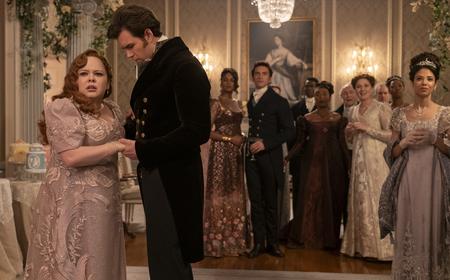
Photo Source: Carol Rosegg
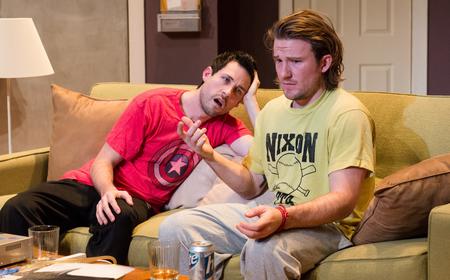
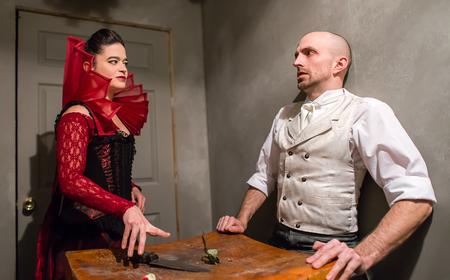
Marks envisions what happens between the second and third acts of Ibsen's classic, setting his play at the stag party Judge Brack throws for friend George Tesman. Tesman has just returned from his honeymoon with his wife, Hedda Tesman née Gabler, daughter of a general, bored and unhappy. Also on hand is Eilert Lovborg, Hedda's old flame, a writer who has just completed a book on the future. The evening includes argumentative discussion about Lovborg's book, heavy drinking, and offstage sex with the women Brack has supplied as an entertainment.
Marks' script works as an elaboration on the characters of the three men, and it helps if you're familiar with the circumstances of Ibsen's play. We see Brack's devious intentions in throwing the party: to lead astray both Tesman and Lovborg, who only recently licked his problems with drink and general debauchery. Brack, you see, has his own thing for Hedda. We see Lovborg grimly attempting to resist the party's temptations. But the play most successfully examines the mix of optimism and uncertainty within Tesman, making him a surprisingly likeable fellow despite his impenetrable cluelessness. Josh Barrett's engaging performance helps considerably. Alexander Alioto as Brack and Michael Crane as Lovborg register as believable gentlemen of the late 19th century. Director Geordie Broadwater keeps the party talk moving.
Things fall apart, though, when Marks introduces a fourth character, a doleful cigarette-smoking woman complaining about a baby crying offstage. She's apparently a vision of the future, appearing several times and seen only by Tesman. Her appearances, along with the twisty time-warp ending, seem to be nothing more than an attempt to give the play stand-alone meaning apart from Ibsen's "Hedda." It registers as dramaturgical doodling, debilitating the ingenious writing elsewhere in the play.
Presented by Babel Theatre Project at 59E59 Theaters, 59 E. 59th St., NYC. March 3–14. Tue. and Wed., 7:30 p.m.; Thu.–Sat.., 8:30 p.m.; Sun., 3:30 p.m. (212) 279-4200 or www.ticketcentral.com.