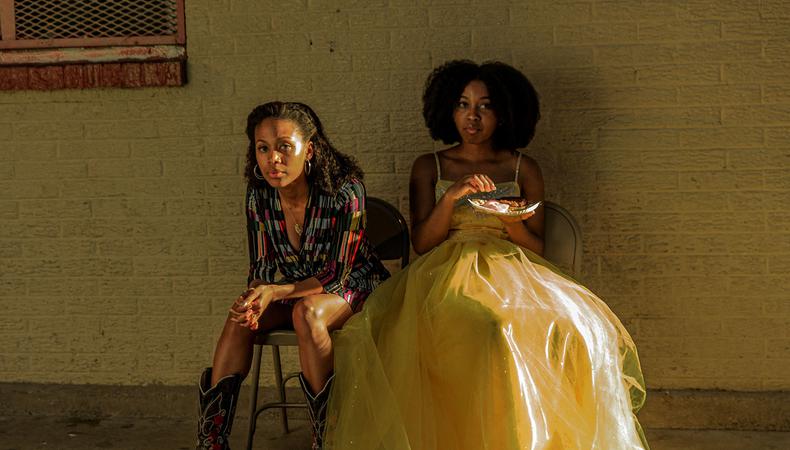
“They had a grit about them, and a really strong sense of determination,” says Channing Godfrey Peoples, of the Black women who comprised the community she grew up in, in particular her mother. “But they also carried themselves with grace. And I really wanted to tell a story that centered a Black woman in that way.”
And so came “Miss Juneteenth,” Peoples’ feature film writing and directorial debut, that has been taking the indie film circuit by storm since last summer. Set amid a sweltering Texas summer, the film’s impetus is a Miss Juneteenth pageant, the real event held annually across the country for young Black women. However, this is a mother-daughter story at its core, a dynamic delicately explored on-camera by Nicole Beharie as Turquoise and Alexis Chikaeze as the teenaged Kai.
 How ‘Miss Juneteenth’ Star Nicole Beharie Booked Her First Film Without an Agent
 “As a director I’m very naturalistic, my approach is always conversational, people actually listening to each other. So I wanted actors who could handle these characters in a very human way,” Peoples explains. “Nicole Beharie is someone who can definitely handle subtlety and nuance, and I was further convinced of that when I saw her read for Turquoise. As far as Alexis Chikaeze, this is actually her first feature film. I was looking to cast that role as specifically as possible, ideally with someone from the region. Also, one of the early descriptions of Kai is, ‘Her eyes look like she’s seen too much, too soon.’ And I saw that in Alexis immediately. I just wanted to reach out to her.”
Realness was also Peoples’ working style on set, and informed everything from the authentic atmosphere—including on-location shooting—to how she would communicate with her actors. Only in full immersion, the filmmaker insists, could she really “be with my characters.”
That also meant rounding out the cast with the area’s actual inhabitants. “I knew that I wanted to fill the major roles with professional actors and then surround them with real folks from the community, real people who actually make these spaces what they are,” she says. “Those are the folks that inspired me to create this story. I felt like they deserved to be seen onscreen.”
But don’t mistake Peoples’ quest for naturalism with imprecision. Though she embraces those “magic moments” of improv, she’s also a self-describing “stickler” for keeping to the script. “Especially in this film, where we were navigating so much thematically,” she says.
LISTEN: Nicole Beharie on Handling the Industry’s
‘High Highs and Low Lows’
Of course, that amalgam actually begins long before anyone has arrived to set, during her writing process. That’s when she tries to get as deep “in it” as possible, nailing the dialogue down to the slightest inflection—and thus leaving little room for wiggling. “I’m digging deeper and deeper, trying to get to know the characters as intimately as possible,” she says. “I literally am writing like I’ve heard people talk my whole life! And so at some point, the characters start speaking for themselves.”
Part of what has made this film such a success is the way in which it gracefully threads weighty subjects with joy. And though that wasn’t necessarily a conscious intent, it was a welcome byproduct thanks to one of life’s serendipities: Just as Peoples finally got the greenlight to make “Miss Juneteenth,” a seven-year journey, she found out she was pregnant—with a daughter, of course.
“I have to give my daughter that credit,” she says of the film’s overall shape. “And it’s just interesting that she came into being at the time that she did. Because I look back and I say, ‘Wow, I don’t know what the film would have looked like without me understanding that uniquely.’ ”
The piece she ended up with—which is nominated for best first screenplay and best first feature at the 2021 Indie Spirit Awards, as well as nods for its two leading actors—is the result of initially unrestrained creative output followed by honing, shaping, and eventual cutting. The admittedly tricky balance is exactly what Peoples prescribes for writers of all levels.
“I don’t think you should start by editing yourself when you sit down to write; I think you should just get it all out. Whatever it is,” she says. “There was so much more world when this script started, and then it became refined to make sure Turquoise and Kai’s story was upfront. So I think any advice I would have is to really trust your instincts, even in the writing process. And then allow yourself to refine it as it goes on.”
Looking for remote work? Backstage has got you covered! Click here for auditions you can do from home!