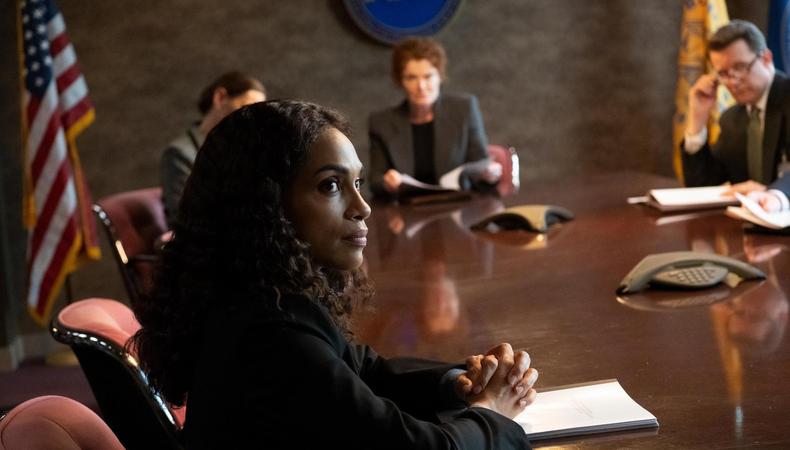
Creating a TV show that finds an audience is an odds-defying success; making one that garners critical acclaim and becomes popular binge-bait is a total triumph. Top that sundae with a cherry of timely, needle-moving social activism, and you achieve something even rarer: a genuine public service.
So it’s little wonder that Hulu’s limited series “Dopesick” and its creator-showrunner-director, Danny Strong, are awash in 2022 Emmy nominations—14 in total, including best limited series.
“I was just really enraged how one company that was managed by one family can make billions of dollars and create so much suffering for millions of people,” Strong says of Purdue Pharma’s notorious Sackler family. “It was just grotesque to me.”
If you ask Strong about himself or his career, which began in acting and eventually brought him to screenwriting and directing, there’s usually a reluctant pause. But if you ask about his “Dopesick” collaborators—or any of the writers, journalists, and artists (shoutout to photographer Nan Goldin) who helped expose the roots of the opioid crisis, which was fueled by Purdue’s highly addictive drug OxyContin—Strong hits the ground running like a practiced public speaker.
RELATED: The Director Behind ‘Dopesick’ Explains Why There’s More Diversity on TV Than in Film
Ditto for questions about wonky policy issues, potential prosecutions, and the Sacklers’ tactics both past and present. “I’ve been very vocal about this. I’m not calling for [former Purdue chairman and president] Richard Sackler’s incarceration,” Strong says. “I just believe he needs to be indicted and tried before a jury of his peers. And the fact that he hasn’t yet I think is a grave injustice.”
Also galling, he notes, is “the government collusion—the way institutions that are supposed to protect us from this criminality enabled or turned a blind eye to it. Through that, this story becomes even more profound, because it goes to the very heart of the dark side of American capitalism.”
While making “Dopesick,” Strong immersed himself in research and brought journalist Beth Macy into the writers’ room. She wrote the 2018 book the series is based on, which draws from interviews with members of the communities that were hit hardest by the opioid crisis.
“Michael Keaton is one of the more difficult actors in Hollywood to get. I mean, everyone wants Michael, and he doesn’t work all the time. And it was really crazy and insane when he said yes.”
Strong garnered his first Emmy nomination in 2008 for writing the HBO limited series “Recount”; he went on to win for both writing and best miniseries for 2012’s “Game Change.” This year, he says he’s “thrilled” to nab his first directing nomination (in addition to another for writing), as well as to see so many “Dopesick” cast members and production colleagues nominated. But he stresses that, for him, the awards spotlight is chiefly about keeping the opioid epidemic in the cultural conversation in order to drive further change.
Strong says he’s not sure if there’s been an uptick in viewership of the miniseries thanks to the Emmy buzz. “No idea,” he admits. “I love Hulu and had a wonderful experience working with them. I’m so grateful to them for making the show. But all of these streamers, they just keep the information locked down as tight as they can.
“If you find out, let me know,” he adds.
Before Hulu said yes, “Dopesick” was far from an easy sell. It helped that the series features real-life boardroom villains of Shakespearean proportions—and that the epidemic’s fallout forged enough real-life heroes for Strong to craft the composite characters that populate the show.
One superhero arguably did the most to push Strong’s project over the finish line: Batman—or, at least, Michael Keaton, who had a limited window to shoot “Dopesick” before donning the cape and cowl once again for DC’s upcoming film “The Flash.”
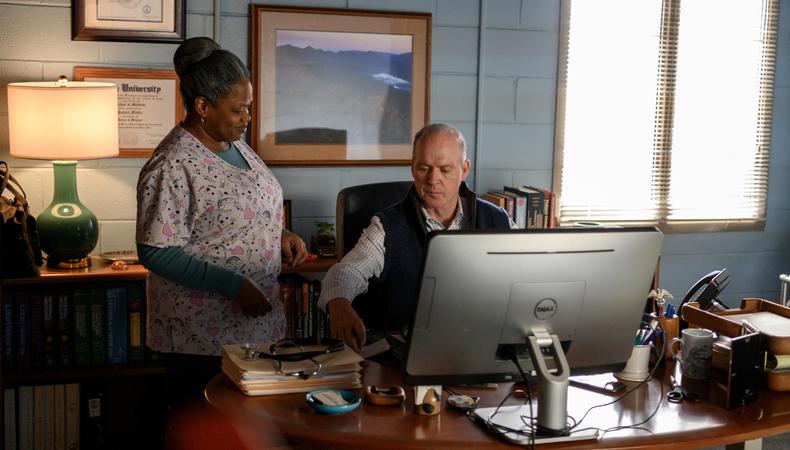 Gene Page/Hulu
The historically selective actor had a nephew who succumbed to opioid addiction—as anyone who saw his candid Screen Actors Guild Award speech in February won’t soon forget. It served as a reminder of the pain and loss that haunts countless families.
Strong figured that Keaton would say no to “Dopesick,” but he asked anyway. “Michael Keaton is one of the more difficult actors in Hollywood to get,” the Strong says. “I mean, everyone wants Michael, and he doesn’t work all the time. And it was really crazy and insane when he said yes—because now I have this project that no one in Hollywood wanted to make, and suddenly Hulu stepped up and said it would. And then six weeks later, I’ve got Barry Levinson directing the first two episodes and Michael Keaton playing the central character, and we went from the project no one wanted to make to, all of a sudden, a project everyone wanted to be a part of.”
Keaton’s performance set the bar high—and on-set morale even higher. His scenes needed to be shot first, with different directors responsible for various episodes often taking turns filming the actor on the same day.
Strong says it wasn’t the easiest way to work, “but everything [Keaton] did was more powerful than the next. We were all just blown away. And to have it all in the can before we basically shot episodes three through eight was an unbelievable gift. It just gives you all this confidence going into the rest of the shoot, knowing you’ve got gold. I’ve also never met a more normal movie star. To be so famous and beloved, yet so cool and down-to-earth, is really impressive in its own right.”
 Michael Keaton on How to Persevere in Hollywood: ‘Desperation Will Kill You’
 Strong himself is hitting his stride, with a list of credits that includes a network TV hit (Fox’s “Empire,” which he co-created with Lee Daniels), a blockbuster movie franchise (two “Hunger Games” sequels), and a prestige film (“Lee Daniels’ The Butler”). And as someone whose work often ventures into Aaron Sorkin territory, it’s fitting that Strong also has designs on Broadway; he’s been developing two original musical theater projects for years.
Not that he has been spared his fair (or unfair) share of setbacks. He made his feature film directorial debut with “Rebel in the Rye,” a promising J.D. Salinger indie biopic that charged out of Sundance in 2017 with an A-list star and a domestic distribution deal. You might remember the actor: Kevin Spacey. The film expanded to 100 theaters in about four weeks; but within a day of Spacey’s #MeToo scandal breaking, “Rebel” was pulled from all of them. Netflix deal: nixed. Airline distribution plan: grounded. You’re not likely to find many people who saw Strong’s labor of love.
One of them, however, was John Goldwyn, “Dexter” producer and grandson of Hollywood founding father Samuel Goldwyn (the “G” in MGM). The producer loved “Rebel” so much that he called Strong to ask if he’d be interested in tackling an ambitious story that would become “Dopesick,” the creator’s crowning achievement to date.
“Yeah, crazy business!” Strong says with a deflecting laugh. (He seems less interested in dramatizations of his own story.)
Fair enough. When asked what his dream project would be if he were offered a “Citizen Kane”–style deal that included an automatic greenlight and total creative control, he gives another stock Strong answer.
“No clue,” he says, followed by another pause. Then, polite as ever, he reconsiders. “I think if I did know, actually, I wouldn’t say—because I wouldn’t want to give that idea away.”
Every TV writer knows the value of a good cliffhanger.
This story originally appeared in the Aug. 4 issue of Backstage Magazine.