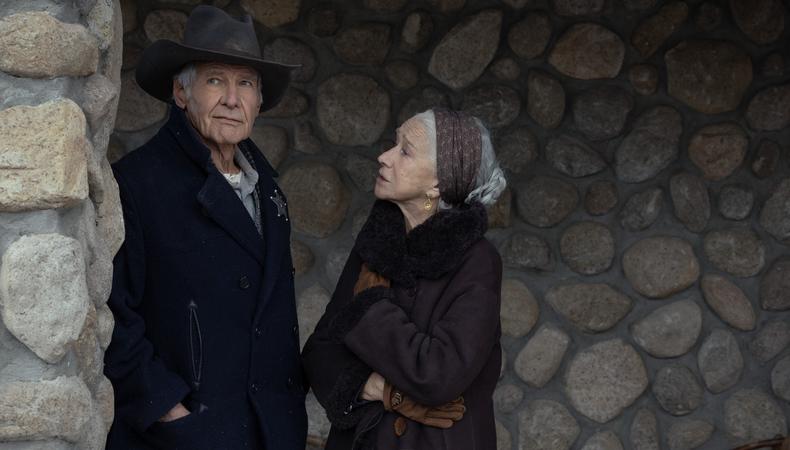
After a two-year wait, Taylor Sheridan’s “1923” is back and off to a (literal) bang, returning the unrelenting Montana plains to the small screen. While it’s no surprise that anything starring Harrison Ford and Helen Mirren would be a master class for actors watching at home, the “Yellowstone” prequel has a lot to offer when it comes to lessons on believability, preparation, and commitment.
The craft of big ensemble work
Like the other entries in Sheridan’s universe, “1923” is a big ensemble piece that showcases both acting legends and performers just starting out. Despite this, the show feels cohesive, with every character seamlessly blending into its storyworld without pulling focus or fading into the background. The trick is performative confidence, according to Michelle Randolph, who plays Elizabeth Strafford and holds her own with icons Ford (as Jacob Dutton) and Mirren (as Cara Dutton). “When you’re acting opposite true legends, you just have to convince yourself you’re meant to be there, because it’s sink or swim,” she explained to Backstage.
If you similarly find yourself sharing the screen with acting royalty, try and soak up as much as you can from watching them work—but don’t allow yourself to be intimidated, since that can negatively impact your craft. Remind yourself that you were cast for a reason and belong there as much as anyone else.
 How to Overcome Imposter Syndrome
 Embracing the terrain
A shocking amount of “1923” is shot on location, both in the American West and the African savanna. Although they work on rugged terrain, in extreme temperatures, and alongside many real, unpredictable animal costars (CGI home-invader wolf aside), its actors successfully deliver polished, powerful performances. Darren Mann, who plays Jack Dutton, found that the extreme conditions—“down to -15 Fahrenheit and 20-mile-an-hour winds”—even helped him create a sense of veracity. “That authenticity helped me to react instead of act, so it’s all a blessing,” he explained in an interview with Taste of Country.
As the stars of “1923” demonstrate, it’s best to work with rather than against your environment. Do your best to live “truthfully under imaginary circumstances” (as per Sanford Meisner) by responding to your surroundings instinctively and naturally.
The power of preparation
The title says it all: “1923” is a period piece. While being transported to another era can be a lot of fun for actors, it also means wearing unusual and restrictive costumes, speaking antiquated language, and adopting the manners and social norms of a bygone era in a way that reads as lived-in and natural. The show is also a Western, which requires its own special set of skills. To prepare for filming, the entire cast was sent to a two-week “cowboy camp” to learn to ride horses and use period-accurate guns, all while wearing heavy costumes. This was necessary training but no easy feat, according to Brian Geraghty, who plays Zane Davis. “We got to have highs and lows together before we started, which actually was really good for bonding,” he told E! News. “We would all be terrible, and then the next day progress. We all got to be vulnerable. As adults, it’s not easy to learn a new skill.” Easy or not, the preparation shows. The entire cast looks incredibly comfortable riding—even 82-year-old Ford!
 How to Act in a Period Piece
Though you may not be lucky enough to have special training provided by production, prepping any special skills required for a role can have a huge payoff when it comes to making your performance believable. You’ll have the space to focus on your acting, instead of worrying about sliding off the saddle.
Keeping those accents sharp
The Western setting of “1923” also means that the American melting pot is on full display, with actors portraying characters from all around the world. The number of actors taking on accents that aren’t their own is much higher than you’d think, mostly due to how convincing everyone is. The British Mirren adopts Cara’s Irish accent, fellow Brit Jerome Flynn plays the Scottish immigrant Banner, and American actor Julia Schlaepfer takes on London posh as Alex—and that’s just the tip of the accent iceberg.
Let this serve as a reminder to keep the accents in your arsenal sharp. You never know when you’ll be asked to perform one for a role (or insist on it, as was the case with Mirren). The best accent work is one that goes undetected for the audience.
 The Ultimate Guide to Doing Accents as an Actor
Convincing combat and taking care
The entire series opens with a voiceover provided by Isabel May (as Elsa Dutton), who states, “Violence has always haunted this family…and where it doesn’t follow, we hunt it down, we seek it.” Beyond the plight of the Dutton clan, this might as well be the thesis statement for the entire show. “1923” is incredibly violent, not just with guns but also through scene after scene of hand-to-hand combat, assault, and general brutality toward one another.
Aminah Nieves, who plays Teonna Rainwater, emphasized the importance of taking the time to recover from this type of ongoing aggression. “We have an incredible stunt crew,” she said in an interview with the Hollywood Reporter. “They go through the action moments with us about 10 to 30 minutes before we go on. Really, the beautiful thing about this show and crew is, if we needed a moment, we could take as long as we needed. I felt so safe with everyone there…that I could just go up to them and be like, ‘Hey, I need five minutes. I just need to catch my breath.’ ”
If you’re asked to perform combat onscreen or onstage, keep in mind that even the most intense and convincing fight choreography can (and should!) still be executed safely and confidently. Perhaps more importantly, remember to take care of and advocate for yourself while filming intense material.