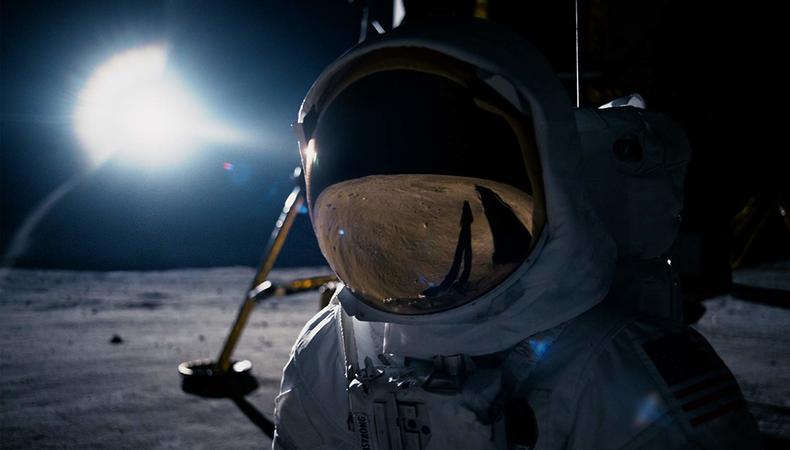
In “First Man,” director Damien Chazelle reteams with his “La La Land” leading man Ryan Gosling for a deeply personal take on Neil Armstrong’s 1969 Apollo 11 mission to the moon. But the cinematic trip might not have been possible without the aid of veteran visual effects supervisor Paul Lambert. Lambert, an Oscar-winner for 2017’s “Blade Runner 2049” (which also starred Gosling), was tasked with re-creating some of the most iconic moments from the 1960s’ space program—no small feat.
His approach was one rooted to the greatest degree possible in earthly realism. Rather than generate a vast number of entirely computer generated shots, Lambert and his team created CG footage of the moon and stars that was projected onto a massive LED screen standing 35 feet tall and 65 feet wide. That screen served as a backdrop for a replica spacecraft on set, which then moved in sync with what was being shown on the screen.
They also employed some classic filmmaking techniques, using both miniature replicas of the various spacecraft seen in the film and incorporating 70 mm archival footage from NASA that was discovered at Alabama’s Marshall Space Center into the drama. As for the actual moon landing, it was shot on location at the Vulcan Rock Quarry outside of Atlanta, Georgia with IMAX cameras and re-touched by Lambert’s team during post-production. “It just added a level of believability to entire sequences,” Lambert says.
How did you approach Damien Chazelle’s desire to avoid digital effects to the greatest degree possible?
We had discussions about how we were going to do the movie. It became very apparent that there was going to be a big push to try and do as much in-camera as possible. Being a space movie, we were always going to have computer graphics, something which Damien wasn’t too keen on. We came up with a philosophy that if one of our craft was going to be close up to camera, we would either use a full-scale or 80 percent scale version. If it was going to be a mid-shot, we would use a miniature, and if it was going to be a wide shot, it was ok to use visual effects. Damien wasn’t interested in shooting anything with a green or a blue screen. This LED screen we could put the content on was absolutely invaluable. As well as giving us background, it gave us a real subtlety. We got reflections in camera and interactive light from the screen going into the capsule.
That must have been incredibly helpful to the actors.
Usually in my world, you work on a five- or six-second shot, but on this, we actually rendered up entire sequences through continuous Quicktime of [Ryan Gosling in] the X-15 jet when it drops from the B-52, goes through the cloud, goes up to the atmosphere, bounces and comes back down, skims over the mountain and lands. We had that entire clip and Ryan was looking at it so he was able to react to the actual imagery. He sat in the X-15 and bounced around in the gimbal because it actually shook and he sees the horizon come up on the screen and he’s reacting to that. We’re getting that reflection of the visual effects content on the visor and in his eyes. If we were doing this green screen, he’d be pretending the horizon was there and in post, we would add a CG reflection and potentially add it to his eyes.
READ: How ‘First Man’ Elicits Emotion From a Famously Stoic Neil Armstrong
How did you go about restoring and using the archival footage that was incorporated into the film?
We had great access to the NASA archives. As we were pulling visuals, it became apparent that some of it we could actually use. We came up with a technique that cleaned up the archival footage and made it look brand new. We were able to degrade the image again to fit in with the rest of the production, which was shot on 16 mm and 35 mm.
How extensive was the VFX work that was required for the lunar landing sequence?
There were mounds in the quarry we had to clean up and we had to make the terrain to be a little more like the lunar surface. We had to clean up the camera and crew from the reflection in the astronauts’ helmets. We had astronauts on bungees to make it feel as if they were on a different gravity. Then to finish it off in post, we would add some CG dust to their feet whenever they step on the floor, and that was slowed down to make it mimic a more 1/6th gravity kind of look. Because it was shot with IMAX, you get a lot of detail. There were footprints everywhere that we weren’t supposed to have. The last thing you want is a great big vista of this virgin lunar surface and these markings like man had been there already. We had to go through it meticulously to clean all that up.
You also got sunburned during the filming of that sequence?
Cinematographer Linus came up with this idea to build the most powerful movie light ever made to try to replicate the sun and when I thought I had chapped lips from filming in the cold, I actually got sunburned from that light. It was so strong. We were trying to replicate the sun. Obviously, we were replicating other things about it as well.
How did you get started in visual effects?
I actually found it quite late in life. I had gone to university and I was in aeronautics. It just wasn’t for me. I had been in a class where people could look up into the sky and see a plane and they could tell you everything about that particular plane. That wasn’t me. After that, I went to art college and I was training to be a sculptor and doing a part-time job where I fell into the film industry servicing edit machines. That’s where things sparked in my head. I’d found something which was highly technical but also highly visual. It was the perfect fit.
What advice would you give to someone interested in breaking into the field?
If you have a passion for what you’re doing, you’ll do really well. Things happen because you’re so focused on trying to do the best job you can. Learn everything. Every day for me, even now, I learn something new. Every job is different. Every experience is different. As a visual effects supervisor, I love to find people who bring something to the table. I want to see ideas. I want to see people bring something to me so that I can then work with them, just like I do with the director. I can’t do this without a fantastic team of artists. I do pride myself on finding people who bring different things to the film.
Check out Backstage’s film audition listings!