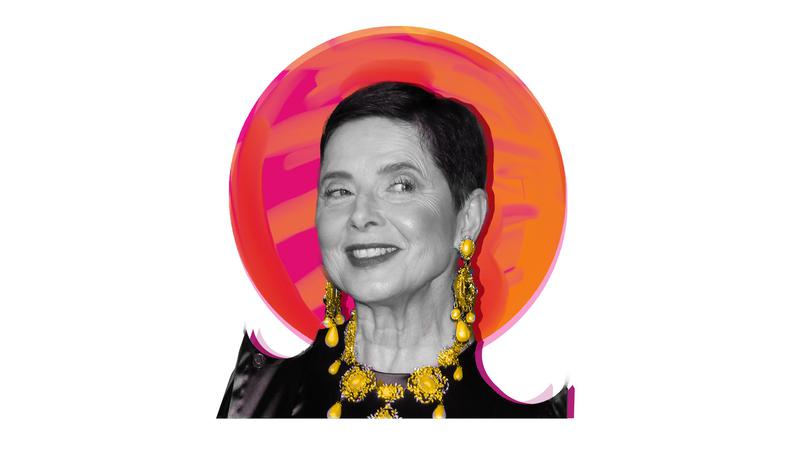
No stranger to a life in show business, Isabella Rossellini—famed daughter of actor Ingrid Bergman and director Roberto Rossellini, and a beloved artist and actor in her own right—has enjoyed a vibrant, decades-spanning career in front of and behind the camera. Now the Emmy and Golden Globe nominee is fusing her love of animals, nature, and performance into one. Having completed her master’s degree in animal behavior and conservation at Hunter College in New York City just last year, Rossellini is taking her comedic one-woman (and one-dog) show “Link Link Circus” to stages in San Francisco, Los Angeles, and Malibu. Exploring the links between humans and animals while incorporating the latest scientific discoveries about animal minds, intelligence, and emotions, the show is personal, informative, and most of all, grade-A entertainment.
READ: How to Write a Solo Show (That People Actually Want to See)
I’m sure you spent plenty of time on sets growing up. Tell us about your first day on a professional set.
I worked with my dad in the summer when school was closed. I wanted to work with costumes. I thought I was going to be a costume designer. My dad allowed me to be in the costume department of his films when there wasn’t any school and if he was shooting films. You learned a lot. You learn how a film is organized, all the different departments, how you can contribute, how you should disappear, not disturb other people doing their jobs. I was more on my dad’s films than my mother’s because the directors are more the boss on the films. He allowed us to come visit and hang out, or when I was 17 or 18 to get these apprenticeships with the costume designers who were working with him.
It was very informative for me to work with Italian television. I worked when I was 19 to 23 with a group of comedians that also included Roberto Benigni—the only one known in America, he won an Oscar for “Life is Beautiful” several years ago. Working with comedians and short format films, that was very helpful in terms of learning how to improvise, learning how to get along with people. It was a little bit like “Saturday Night Live” in Italy. There were always guest stars, there was a lot of movement, it was once a week and two hours long. That’s where I learned most of my work, my craft as a filmmaker in general, also acting because you had to be on your feet, you had to improvise. The show goes on so you can’t get stuck. You have to solve problems.
What was the moment you decided you wanted to be an actor?
I never thought it was something. I don’t think of myself exclusively as an actress, I think of [myself as] somebody who’s also acting. I also direct, I write. Nowadays, I write more than act. I also love modeling. Modeling included costume designing, it was modern costume. It was a love of costumes. When I do my work that I write, I think I took the combination of my love of fashion, my studies on costume designing, acting, and directing all together. When I did my series “Green Porno,” “Seduce Me,” or when I do my monologues, I feel all my loves come together. When I just act on a film of somebody else, it can be interesting, some things are more interesting than others, but it’s when I do my own thing that I feel that every part of me is used.
How did you first get your SAG-AFTRA card?
I think the first American film I made was “White Nights” with Mikhail Baryshnikov and Gregory Hines. Taylor Hackford was the director, and before that came out I also did “Blue Velvet,” so it must’ve been those films. But I was also working in advertising and advertisement is also covered by SAG. I remember the union called me and said, “You have to belong to the union.” I signed up for the American union around ’82 or ’83.
What’s the wildest thing you ever did to get a role?
My career is a little bit different because I came with a big education as a model. I sometimes met casting directors, but I think most of the time I was hired by the directors who wanted me, who would see me in other films.
READ: How Kyle MacLachlan Builds a Character
So I take it you never had any nightmare auditions then.
I did! You do go to an audition and you love the part, you would like to have the part, you don’t get the part. That happens to every actor. I could tell you I tested for “Death Becomes Her” and I was one of the first people they tested. Robert Zemeckis, the director, said to me, “I have to test many more people, and the studio wants a superstar.” And maybe I was a superstar as a model, but I don’t think I was a superstar as an actress. Robert Zemeckis liked me, but he said, “I have to see other people and I’ll let you know.” I waited two months and I thought they chose somebody else. Then Robert called me and he said, “It’s you!” I thought that was so flattering. He must’ve seen 50 people for that role, so I felt very good.
When I tested for “Blue Velvet,” it was a very controversial film. When David Lynch asked to see me for the part, I asked if I could read with Kyle MacLachlan, who had been cast, instead of a casting director who may not know how to act and just throws you the line. I thought it was so complicated, the film, that it was important that I would act the scene. Then I asked David if I could get off the script, so I didn’t have to worry about word-by-word and improvise around the scene. What I mean by that is an exercise that actors do. If you have to do a scene in a film where you have a fight with your husband, the actual scene might be two or three minutes long because a film is a synthesis of reality. But sometimes you take that scene and say, “Let’s play it out and pretend we are this couple fighting.” They would fight for half an hour; let’s keep it up and fight for half an hour. It helps keep you grounded. I asked David to do that exercise with Kyle. It was very helpful. I understood the film was controversial and I had an idea how to play Dorothy Vallens that I wasn’t sure it was correct or what David wanted. It was wonderful to sometimes test to make sure we’re all on the same wavelength.
What advice would you give your younger self?
To be more experimental. You always feel so diminished as an actor because you are reduced to so many roles. You go to so many auditions and you feel like you’re competing. It’s art, it’s about understanding. The competition and [the feeling of] “I’m going to win this award and show off”—stay away from that as much as possible.
What has “Link Link Circus” added to your abilities as a performer, writer, and producer?
I don’t think of my life as a résumé. I do things that are interesting to me and hope that they’ll find an audience. If I find an audience of 20 people or two million people—hopefully it’s two million people, but if it’s 20 people and [the project is] interesting to me and it’s satisfactory, I’ll still do it. I was always interested in animals and animal behavior, so I went back to university to get a master’s in animal behavior. And then I wanted to translate that science, it’s like my muse. A director will write about love, will write about conflict; my muse is animal behavior. So I write about it. Now there’s a new wave of museums asking me to do lectures where I show films that are comical, they are funny but understandable, where science is presented in an entertaining way. This is what I try to do. I want my audience to go [through] two reactions: to laugh, and then go, “Ah, that’s interesting.”
What performance should every actor see and why?
I’m 67 years old—can you imagine how many films I’ve seen and how many actors I admire! I’d miss so much. I was in Paris [recently] and I went to see a musician, 83 years old, his name is Paolo Conte. I went to see him and he was singing and dancing. There was no pretense. It was an old man singing with an old man voice and all the emotions were there. There was a sincerity and he was so moving and I thought this is what art is about, showing your soul, showing your heart. That was something most recently I saw and was inspired.
Want more stories and advice from the best in the biz? Read more from the Backstage 5 here!