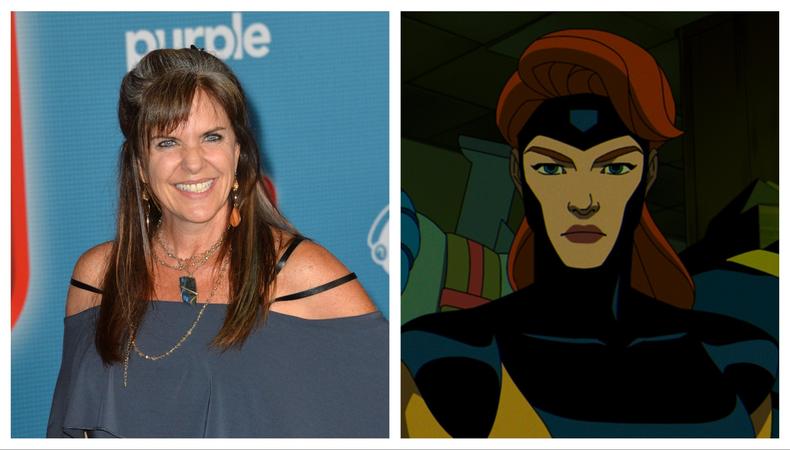
With more than 400 credits to her name, Jennifer Hale is one of the most prolific voice actors of all time. (Until 2024, she held the Guinness World Record for most video game roles.) A fixture of both the golden age of Cartoon Network and the advent of narrative-heavy video games, Hale is responsible for dozens of enduring fan-favorite characters across every type of medium.
“Being able to stay with a character over the course of years is a gift. It is like doing a long-running series or a film trilogy,” Hale told us. “You reach a depth and familiarity with a character that allows you to add even more detail and spontaneity, and to really trust it and let it come to life even more. I just try to bring as much humanity as I can to every character. To me, it’s all about humanity and specificity.”
If you’re an aspiring voice actor (be it for cartoons, video games, dubbing or otherwise), let the arc of Hale’s career act as a roadmap.
“Spider-Man: The Animated Series” (1994–1998): Felicia Hardy, aka Black Cat
After graduating from Alabama’s Birmingham-Southern College with a business degree, Hale moved to L.A. She set her sights on voice acting after bit parts on shows like “Camp Wilder” and “In the Heat of the Night” weren’t paying the bills. “I thought, Well, I’ll just take voiceover and see if I can make some money there,” she told the New Yorker.
Her first major animation role was the master of disguise Ivy on Fox’s “Where on Earth Is Carmen Sandiego?” in 1994—which also broke open the door to video games, as she was asked to take part in the 1995 spinoff game, “Carmen Sandiego: Junior Detective Edition.” That same year, she appeared on the network’s “Spider-Man: The Animated Series” as the voice of Felicia Hardy, aka Black Cat, demonstrating her skill at giving a character layers and nuance. Black Cat is an adversary, but also a love interest and ally with complicated morals.
The role began a partnership with Marvel that has lasted decades, with Hale voicing everyone from Spider-Woman and Ghost on “Iron Man” (1994–1996) to Ms. Marvel on Disney XD’s “The Avengers: Earth’s Mightiest Heroes” (2010–2012).
“The Powerpuff Girls” (1998–2004): Ms. Keane, Princess Morbucks, and Sedusa
From the very first episode, Hale was a key part of Craig McCracken’s influential Cartoon Network series “The Powerpuff Girls.” She provided the voices for kindly kindergarten teacher Ms. Keane, the bewitching supervillain Sedusa, and spoiled Princess Morbucks, who envies the titular trio. These three contrasting characters truly showed off Hale’s range, as well as her ability to make despicable antagonists funny and sympathetic.
They also prove that having the ability to cross mediums can give a voice actor’s career long-term stability. Hale reprised these roles in McCracken’s “The Powerpuff Girls Movie” (2002), four video game spinoffs, and the series’ 2016 revival.
“Star Wars: Knights of the Old Republic” (2003): Bastila Shan
Though Hale had numerous video game credits under her belt, including the very first “Baldur’s Gate” from BioWare in 1998, it was 2003’s “Star Wars: Knights of the Old Republic” that first let her mold a character who would stand the test of time. That would be the meditative Jedi named Bastila Shan, one of the most beloved characters in the game, and one who has become an integral part of the “Old Republic” time period of the “Star Wars” franchise.
Hale reprised the role in two sequels, “Star Wars: Knights of the Old Republic II—The Sith Lords” (2004) and “Star Wars: The Old Republic” (2011). Perhaps more importantly, she cemented a fruitful relationship with BioWare, which led to arguably her most popular character ever (more on that in a bit).
“Avatar: The Last Airbender” (2005–2008): Avatar Kyoshi
The best voice actors can take a side character without much screen time or dialogue and make them stick in the viewer’s memory. That’s what Hale did with the Earth Kingdom–born Avatar Kyoshi, who appears only a handful of times on Nickelodeon’s “Avatar: The Last Airbender” and yet became an iconic part of the TV series thanks to the actor’s remarkable, stoic take. Kyoshi exploded in popularity, appearing in comics, spinoff novels, and mobile games, with Hale herself signing back on for a guest appearance on the sequel series, “The Legend of Korra.”
“Mass Effect” (2007): Commander Shepard
Commander Shepard of the “Mass Effect” video game franchise—the role that has defined Hale’s career—is one of the most fan-cherished characters of the past 20 years. Though you choose the character’s gender and voice when you start the game, Hale’s imposing and forceful yet empathic female version is the canon portrayal in the eyes (and ears) of many players. Given the choice-driven narrative of “Mass Effect” and its sequels, Hale’s task is a mighty one; she has to portray different versions of Shepard depending on which way the player guides her. The fact that she pulls it off so effectively is why she’s a video game legend.
“X-Men ’97” (2024): Jean Grey and Madelyne Pryor
If you want to build a voice acting career that lasts, you’ll need to be able to create characters from scratch and take on roles from the past. Hale inherited the part of psychic mutant Jean Grey (as well as her clone, Madelyne Pryor) from Catherine Disher, who voiced the characters on Fox’s ’90s series “X-Men.” On Disney+’s revival series, “X-Men ’97,” Hale not only offers subtle differences between Jean and her double, but also infuses a weariness to them both that adds to the trauma of their storyline.