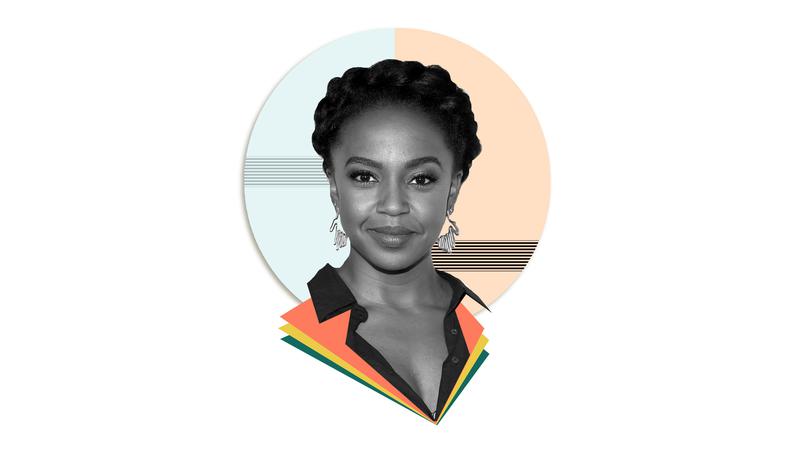
For as long as she can remember, Jerrika Hinton has pursued creative endeavors, from acting in plays in her hometown of Dallas, to photography, directing, and playwriting, equipping her with a multifaceted approach to reading scripts, building her characters, and learning on set. With an impressive resume which includes over 100 episodes as Stephanie Edwards on “Grey’s Anatomy,” HBO’s “Here and Now,” Apple TV+’s “Servant,” and Amazon Prime Video’s “Hunters” opposite Al Pacino and Logan Lerman, Hinton reveals how she built confidence on set—and the importance of advocating for herself and for the benefit of the project at large.
You have many interests, so what was the moment you decided acting was what you were going to pursue full time?
Performing is something that I’ve done since I was a very small child, genuinely since preschool. It was probably some blend of I found it and my mother wanted me to be engaged in school activities. I grew up in the theater, went to school for directing and playwriting. In all of my adolescent genius, I was just like, “Why would I pay $30,000 a year for them to teach me what I’ve been doing?” I think it was probably at that point, in my college years, that I realized, “acting is something that I’ll continue to do throughout my life.” But I have so many other interests. I like to learn about other things.
Does having a background in writing and directing help you when you step in front of the camera?
It helps me long before I step in front of the camera. These are things that help me: They inform the way that I read scripts, they inform the way that I consume entertainment, sometimes in a really obnoxious way. I wish I could turn my brain off. [Laughs] I’m looking for certain things that satiate my curiosity, that pacify this wild artistic spirit that constantly wants to be doing new things and be doing things of good quality. Particularly the writing, the playwriting background, that’s what’s informing those choices and how I’m sifting through the information in a script.
When it comes to directing on set, it absolutely helps to be familiar with certain terminology. To understand camera placement, to understand lightning, to understand lenses as well—that’s my photography and my directing that’s helped me in regards to all of that. I have the kind of brain that works better with a lot of information and I think that’s not unusual in the arts. Really understanding the gears of the machine allows me to just focus on the singular gear that is my job. On days when things aren’t running as smoothly as they could, knowing how all of the gears work helps me to relax and focus on what my particular job is.
Tell us about your first day on a professional set.
I feel like I had two first days. When I think back to the little bit that I did in Texas before moving out to California, I remember I was amazed at the number of people on a film set! I think this really small indie movie was my first job. I remember not knowing what everyone’s job was. I remember being very afraid of being in the way. I remember a lot of wonder and fear about my very first job. Then when I came to L.A., what I remember then was the excitement of having a job in Los Angeles. And then again, that fear of not wanting to get in the way. The anxiety involved of having your learning curve on display. Acting for the camera is very different than being on stage. I remember a deep desire to get it right. I was probably just a ball of nerves, I was probably a wreck!
What advice would you give that young, nervous actor?
I would tell that young, nervous actor to breathe. Everybody wants them to do a good job. Everyone is there in support of the work. In ideal circumstances, everyone is there in support of the work, to turn out a good product everyone can stand behind. My advice would be to trust in that. There’s nothing wrong with asking questions. Don’t just act questions when you need clarity to do your job well, but also take an interest in those around you. Pay attention, be the kind of person you want to work with. Be engaged, have your homework done, come prepared. And then be open. I hate saying it because it sounds so rudimentary but some days it really is that simple. Everyone wants to do a good job and go home. [Laughs] And mistakes are allowed! Everyone is going to make mistakes, people are making mistakes you don’t even get to see.
What is your worst audition horror story?
They’re all racist nightmare stories. [Laughs] Being told to be “more homegirl,” “say it more Black,” “say it less Black.” I remember, this was probably my fourth year or so [in Los Angeles], I remember a particular commercial audition where they were stuck on a very typical reading of a character and truly the direction was “be more homegirl.” After the third or fourth time of them saying that, I just stopped and I looked at the casting director and said, “As you can see, I have a problem with that.” I don’t remember what their response was. Of course, I didn’t get the job.
Given where we are in the world, do you see what’s happening with protests and activism having a profound effect in Hollywood?
Time will tell. One should always be wise about speaking too soon when it comes to things like that. Progress does not just happen in one direction, as we all know. We’re experiencing a lot of hope and optimism. We’re also seeing reactionary decisions from higher up. This is cynical, am I supposed to be inspirational right now? Because some of that behavior is to completely cover their ass. And some of that behavior comes from a legitimate desire to rectify and to find parity and do the right things going forward. When you have motivations like that that are all over the spectrum, the motivations themselves, I think, dictate what kind of change will occur and so that’s why I say time will tell. Because if it’s just reactionary measures to cover your ass, that’s not sustainable. If it’s based in a legitimate desire to improve circumstances, that’s what’s sustainable. That’s what matters. That’s what I hope we’re getting a significant amount of.
 Resources During the Black Lives Matter Movement
 How do you typically prepare for an audition?
I’m very emotion-based, I approach character very much from the heart. Building up their heart, their inner world, their imagination, their childhood memories, their dreams. My approach to auditions is to really focus on making that character a real person and understanding who they are even outside of the circumstances of the scene itself for the audition.
What has playing Millie Morris on “Hunters”—a queer, Black FBI agent—added to your acting skills?
I definitely now have a little more experience understanding firearms in my toolbelt! [Laughs] I know more about the Federal Bureau of Investigations. That’s part of the process as well: Doing the research. If you work for the Bureau, you need to know what it’s like to work for the Bureau as a Black woman in 1977. She helped me sharpen the tools that I already had. The additional tools I have come from coming into a greater awareness of myself within this job and to be more willing to ask for things I might’ve been afraid to before. Definitely being more willing to say no to certain things.... That’s a really valuable lesson, especially going forward in my career.
How did you first get your SAG-AFTRA card?
Texas is a right-to-work state so you could work on jobs without being in the union, so it’d have to be L.A. That means it was my first job in L.A., most likely. I can’t remember what my first commercial job was! But my first TV job, if I’m remembering correctly, was a little co-star on “Gilmore Girls,” cast by Jami Rudofsky and Mara Casey. I’m still good friends with them both.
What performance should every actor see and why?
Don Cheadle in “Devil In a Blue Dress.” That performance stands out in my memory—you talk about a scene-stealing, show-stealing performance, that man runs away with the movie and it is beautiful. It’s amazing. Whoopi Goldberg in “The Color Purple.” Frances McDormand in “Fargo.” Catherine Keener in everything she does. Angela Bassett in “What’s Love Got To Do With It.” When we go outside of movies, “A Different World” was formative for me in seeing diversity of women, different characters, different performances. The same thing with “Living Single,” Erika Alexander in “Living Single.”
Looking for remote work? Backstage has got you covered! Click here for auditions you can do from home!