From independent films to the Marvel Cinematic Universe, Scottish actor Karen Gillan has spent her days on set pushing through scene after scene and working tirelessly on fight sequences. Regardless of the size of the film—most recently, she starred in Riley Stearns’ “Dual” and Judd Apatow and Pam Brady’s “The Bubble”—for Gillan, acting is acting.
You’ve worked on both independent films and blockbusters. How do you approach your work on smaller sets?
My job is exactly the same. I don’t feel a huge difference, other than that everything around me is so much bigger on blockbuster films. Ultimately, I still have to stand somewhere and act when I hear “action.” It is nice, because it makes these giant films a little less intimidating, knowing the size is not relevant to my particular job.
Is there anything freeing about acting in independent films?
You get through so much material in a day, because you don’t have seven months to shoot everything like a Marvel movie; you’ve got to shoot a film in 20 days. You have this real sense of momentum; you’re getting through so much material; you’re doing so much acting that you can really get into the groove. Sometimes, on larger films, you might spend four days not even talking [on camera]; you’re doing action sequences or more technical things.
READ: What NOT to Do Your First Time on an Indie Film Set
What have your roles in “The Bubble” and “Dual” added to your acting skills?
“The Bubble” was my first time being in an improvised movie. I find that so freeing. In anything I’ve done since, I’m improvising so much more. I learned to switch off the thing that judges yourself before you say something. It was the opposite end of the spectrum for “Dual,” because it was word-for-word. It had to be perfect, because Riley Stearns has a very specific style of writing. It’s best served if you are completely off-book, no paraphrasing. “Let me deliver this exactly how it was intended and in this Riley Stearns style, which is very unique.”
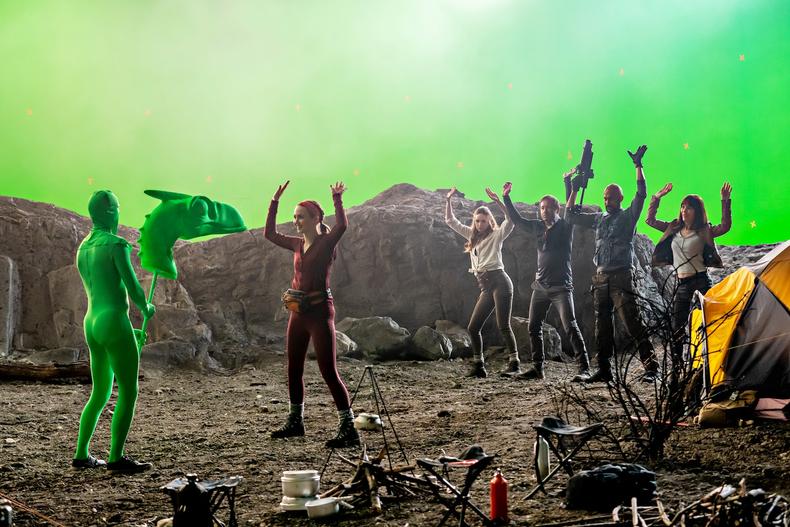 Iris Apatow, Karen Gillan, David Duchovny, Keegan-Michael Key, and Leslie Mann in “The Bubble.” CRED Laura Radford/Netflix
What advice would you give your younger self?
Turn it down a notch. A little ambiguity goes a long way. The main thing I’ve learned from spending so much time on camera is that if I’m feeling it, it’s coming across. I learned to trust that the camera picks everything up, whereas when I started, I [thought], I have to really tell people what I’m feeling. Actually, all I need to do is feel it and not worry about the rest.
What is your worst audition horror story?
I remember doing a movie [audition] and then asking my agents what the feedback was. And [they] said, “It seemed like she was auditioning for a completely different movie from anyone else who came in.” I thought I was totally normal, that it went well. I thought maybe it would happen—and then I got that reaction.
What performance should every actor see and why?
Isabelle Huppert in “The Piano Teacher.” Her final moment is in a close-up, and it’s maybe one of the best pieces of acting I’ve ever seen in my life. She’s not even speaking; it’s just a facial expression she makes. I’ve watched it over and over again and I’ve analyzed it. How did they come up with that choice? Was it from [director] Michael Haneke? Was it from Isabelle herself? I’m fascinated and think it’s amazing.
This story originally appeared in the May 5 issue of Backstage Magazine.