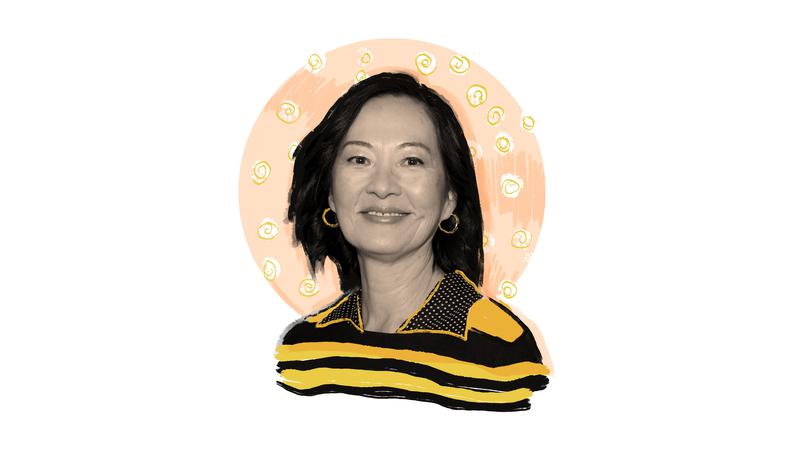
Rosalind Chao credits much of her early acting breaks to her family’s restaurant in Anaheim, California. The Chinese-American pancake house was where she was discovered by her first agent, where a commercial casting director hired her—and where she sometimes grab branded pens to dole out in auditions. After a stint in London starring in the new play “The Great Wave” at the National Theatre, and recent film credits in “The Laundromat” and “Plus One,” she now assumes a matriarchal role as Hua Li, Mulan’s mother, in the live-action adaptation of the animated Disney classic. Here, Chao describes how her career as a journalist helped with audition prep and her tips for young actors. (In short: Never stop training.)
“If I had one piece of advice for young actors now, it’s train train train, and then train some more.”
Your parents got you involved in acting from a young age, but what was the moment you decided you wanted to be an actor?
I always loved it from the time I was a kid. I still remember the smell of sound stages and thinking, I like this smell. Being onstage, backstage, that scent, getting to know stage managers, I felt very drawn to the whole package. I think the real moment when I knew when I was going to pursue acting was I was [a journalist]. Back then, you had to give up your Screen Actor’s Guild in order to be heard on camera or seen on camera as a journalist. I did a story they thought they could use my voice on—it was a radio news station—and they came to me and said, “We can’t use it unless you let go of your SAG membership.” And that’s when I thought: There’s no way I’m letting go of my SAG membership; I’m going to be an actor.
 How ‘Mulan’ Director Niki Caro Cast Her Warrior + Encouraged Her to ‘Woman Up’
 Speaking of SAG membership, how did you first get your SAG-AFTRA card?
It was a commercial. Someone found me in my parents’ restaurant and so I did commercials to start out with. I don’t even think I signed the paperwork, I think my parents did. It didn't mean that much to me until I got older and I realized this is what I love.
How did you land your first agent?
I was a kid. There was an agency called Bessie Loo Agency, and she basically found me. Everything happened through my parents’ restaurant. She found me. I’ve been trying to help kids who are super talented and I’ve been trying to help them find an agent. It’s tough right now, but you can’t give up. It’s like finding your mate in life. You have to find the right chemistry. If they don’t want you, you don’t want to be with them.
“I think that’s key, to find your empathy in playing whatever character. That can only be done [by] understanding where they come from and their personal history.”
What’s the wildest thing you ever did to get a role? I read you gave Alan Alda a pen from your parents’ restaurant at your audition for “M*A*S*H.”
I don’t think that’s how I got the role, but I was so used to seeing my dad hand out his pens when he was doing business, so I think that's why I did it. [Laughs] I had it in my hand. I was just like, “Here, keep it as a souvenir.” Like he wants a pen from Chao’s Restaurant. For roles, I’ve mainly gone through the normal channels: Just auditioning, being as well-prepared as possible. I really do believe every time you’re on a set, you have to be easy to work with. It’s like the restaurant business: If you get a delicious meal, you will go back to that restaurant. Some of my work has come about that way. Other than that, it’s been the normal channels of auditioning and throwing that spaghetti against the wall until it sticks.
How does your history as a journalist impact how you prepare for roles or auditions?
You need to really find out everything you can about a person that you’re playing if it's somebody historical. Even though in “The Laundromat” I was playing a character based on a real-life person, [Steven Soderbergh] took it into a fairy tale version of that to tell the story of money laundering. I still did extensive research to get a sense of what makes somebody do what they do and to find your empathy. I think that’s key, to find your empathy in playing whatever character. That can only be done [by] understanding where they come from and their personal history.
What has playing this latest role in “Mulan” added to your acting skills?
As far as playing her mom, it was very easy for me to tap into. My daughter was leaving for college at the same time that I went to England to perform onstage at the National Theatre in Britain. I felt like that offer was never going to come again and my daughter was the strong one, telling me if I didn’t do it, I would be sending her the message that I didn’t think she could handle the college prep stuff. It’s a little bit like that when you have a daughter with a very strong sense of herself and a will. The mother-child bond, it crosses all time and geographical boundaries.
“There are so many wonderful actors out there right now. For actors, I think they need to drink up every single opportunity to see good work if they can.”
What is your worst audition horror story?
I have so many, I don’t even know what to pick! I’ve done terrible auditions. It’s not my forte. I’ve done ones where I felt like I was really proud of what I did and not gotten the role and I’ve done auditions where I felt it did not go well and I’ve gotten the role. It’s very unpredictable. I once had an audition where I went in and somebody ate their lunch and did not look up once while I was auditioning. You have to be thick-skinned. You have to remind yourself it's really not about you, even though it feels like it is. You’re digging deep into your heart to deliver for these people and you're not always digging deep for people who appreciate it. You have to understand that it has nothing to do with what you’re delivering, it has more to do with outside influences. I’ve been on the other side before, and I have friends who are casting directors, and a lot of times, who gets cast doesn’t necessarily have to do with things you are in control of.
What advice would you give your younger self?
If I had one piece of advice for young actors now, it’s train train train, and then train some more. [And] don’t sweat the small stuff. Debra Zane, who cast “Mulan,” brought me in to read. I was about to leave for London. I wasn’t actually going to go in because I was about to leave to be on stage. I thought, you know what, I haven’t met Debra Zane so I’m just going to go in anyway. When I went in, I explained to her, “I don’t think I can do this because I’m going to be in London for six months and it doesn’t work with the ‘Mulan’ schedule.” She said, “This schedule is in constant transition. I really want to put you down for us, just in case.” I really didn’t think I had the audition prepared as if I was going to be able to do the role. She really encouraged me to read for her anyway.
What performance should every actor see and why?
Lesley Manville in “Phantom Thread.” Willem Dafoe in “The Lighthouse.” Every performance in “Parasite.” There are so many wonderful actors out there right now. For actors, I think they need to drink up every single opportunity to see good work if they can. I saw an old copy of “Mean Streets” at our local, retro moviehouse, and De Niro—you can’t argue with that. He’s so good.
Looking for remote work? Backstage has got you covered! Click here for auditions you can do from home!