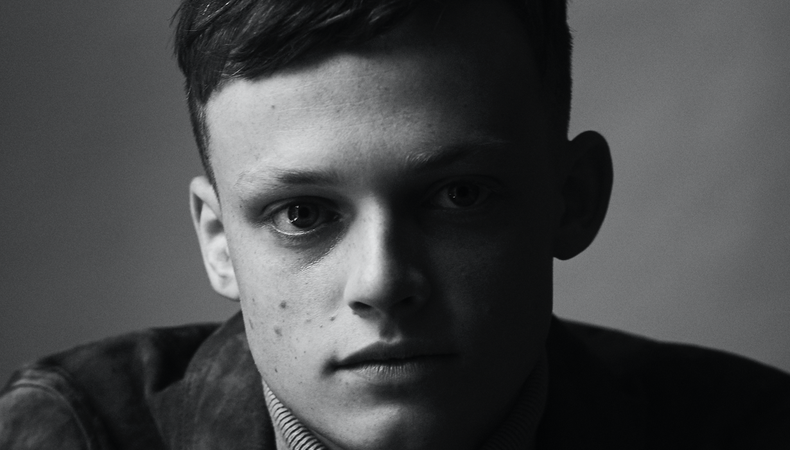
UK actor Anson Boon has packed a lot of career into the past two years. A 2019 Screen Star of Tomorrow, he’s worked with Sam Mendes and Benedict Cumberbatch on 1917, featured in Netflix’s The Alienist, and is co-lead opposite Sex Education’s Emma Mackey in this year’s brooding drama The Winter Lake. Roger Mitchell’s film Blackbird premieres this month in the US, seeing Boon acting opposite Kate Winslet and Susan Sarandon. It’s clear that Boon is an exciting and focused talent, but like every successful actor, he’s had to learn the elusive art of auditioning, and he shares those valuable insights in this honest and heartfelt account of his journey from outsider with no easy route in, to booking roles with the best in the business.
What I’ve learned
It is not easy to back yourself as an actor. Some are blessed with enough self-belief to own their talent and correctly value themselves, but so many of us are dreadfully insecure about our ability. “Am I really cut out for this? Do I have what it takes to make it? Was that take good enough? Was I completely rubbish in tonight’s performance?” – these are all questions I’ve asked myself on an immeasurable amount of occasions.
To be fair, who could blame us? Our job is like no other. We massively expose ourselves emotionally and physically, often in front of complete strangers. It is almost unnatural, and yet we put ourselves through it because we love it.
I didn’t grow up in London or anywhere that offered easier access to the entertainment industry, and had no family or friends who worked in the arts, so all I had to go off was self-belief, which is easier to tap into when you’re a 16-year-old with stars in your eyes. I had spent my childhood messing about with acting and developing my own natural instincts, and decided after a brief period of studying drama at my local college that I just really wanted to work. I knew it was a risk, jumping into one of the most competitive industries with no formal training, but I just had a gut yearning to learn on the job. The 16-year-old me then spent all of his time writing CVs and covering emails, creating showreels, watching old cinema, researching every corner of the industry and plotting his route into those sought-after audition rooms. I worked so hard to get an agent to believe in me, and it’s important to celebrate the victories – such as an agent taking you on – to build the self-belief that you are, in fact, good enough.
 6 London TV Agents All Working Actors Need to Know
 Once I eventually started auditioning, I entered what a lot of new actors, including my then-self, think of as a vicious cycle. You start to see the same faces in the waiting rooms, and the same people seem to book every job. It wasn’t until I had weaved myself through various small parts to become one of these people that started to book lots of jobs that I realised a few very important things, which I genuinely believe make you more successful when auditioning.
The key to success in auditions
Firstly, you have to stop waiting for the phone to ring. For a long time, my life revolved around waiting to see my agent’s caller ID come up on my phone to tell me about an audition, and it really wasn’t healthy. It makes you desperate, which shines through your performance so clearly when you do get an audition. It causes you to overthink every single inch of the process, which can only induce bad nerves and the mentality that your life depends on this audition. Once I realised waiting for the phone to ring was hindering me massively, I made sure to find other things to occupy my mind. Getting another job, finding new hobbies, playing sports or anything that appeals to you, that passes your time between auditions in a healthy way, steers your focus away from your life depending on the next audition and broadens your horizons which is so important for your craft.
Secondly, you don’t have to perform a perfect version of the film or play in your audition. I spent my first few auditions thinking I needed to transport the audition panel from that basement in Soho to the set of their project, and give them a fully executed performance of the character. I soon learned that this is not what they want to see. You’re simply showing them that you understand the role, and you can demonstrate your version of that character in the space they’ve provided you with so that they, as the visionaries, can in their head see if you fit into their puzzle or not. Obviously, it changes as you progress to the lead roles in major productions but certainly, when starting out and reading for the day-player roles, I found this simplistic approach very effective.
 What Maisie Williams Learned From Her ‘Game of Thrones’ Audition
 Lastly, when you do eventually book that job, the self-doubt doesn’t stop for many actors, including myself. I initially saw the audition as the all-important hurdle that I needed to clear, but once I started clearing them I realised the real race comes with the job. When you don’t have much experience and you’re popping into an already established cast and crew to deliver a few lines over a few days shooting, you start to wonder if you’re good enough to be there. All you need to do is consider the obvious: you’re there because the director has specifically chosen you to take on this challenge and play this part. They want you to do well, and most importantly, they believe in you.
My parents always used to say to me that there’s no point putting yourself down, because enough people will do it for you. This is something that I always try to bear in mind at work. Acting is creative and highly subjective. There is no right or wrong – there’s just your perception of a character, and the director’s. Sometimes, those two versions go together and you book the job, and sometimes they don’t. It doesn’t mean you’re a bad actor if you and the director have different ideas on the character. Never beat yourself up; remember why you do this job – because you love it. Playing pretend is fun, and remember that we get to work doing something we love, which is a gift many people don’t have. Be your biggest supporter and I firmly believe that if you work hard and believe it will happen, it will.
That’s all I’ve ever done, and it’s the best advice I can give.
More industry advice for UK actors? Click here.