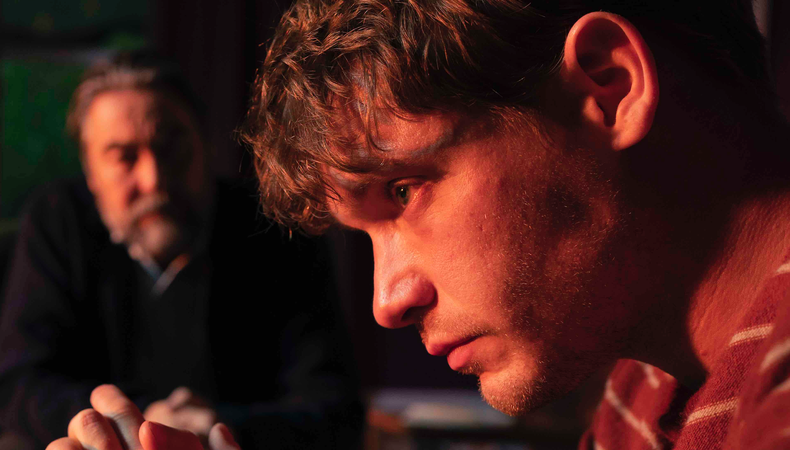
The following Career Dispatch essay was written by Billy Howle, who followed his star turn on BBC (and now Netflix) hit The Serpent with his current role co-starring with Jared Harris and Cush Jumbo in Britbox and AMC+’s The Beast Must Die. He writes here about the mercurial – and sometimes brutal – nature of the acting industry, and the importance of staying open and following your own path.
In my final year of drama school, I sat on the audition panel for entry into the school. I had been given the very sought-after job of operating the stopwatch, ensuring the length of each speech lasted no longer than two minutes. In retrospect, allowing a third-year student to have such power over a prospective student’s audition may have been unethical, but all of the staff on that panel have left the school now, so… Anyhow, I was thorough, beyond fair, proficient in my nascent capacity as timekeeper (this was a first). Remarkable though, the power I felt. The power of time.
Looking for your next TV role? Check out our UK castings
Midway through the afternoon, the process became a long conveyor in an abattoir. These terrified animals, coming into a darkened space to plead for their lives. Their pleas, speeches from Shakespeare’s plays; their lives, their vocation.
“It was ruthless – the confinement of art into two-minute slots. Was this arbitrary? Or only to make room for a hundred-plus auditions a day?”
Begging to be allowed to go and make milk (act in plays), instead of being culled (sent to a call centre). For the record, I have worked in two call centres and I can testify that it is more difficult than acting. To these animals, I would say: your stakes are likely based on pleasing people, looking for reassurance. Don’t. This is your interpretation, your style, your individual expression, and yes, it may need refinement. But it is yours, to offer at will, sacrosanct and precious. Hold on to it, be Golem about your talent. Initially, that is…
It was ruthless – the confinement of art into two-minute slots. I thought: was this arbitrary? Or only to make room for a hundred-plus auditions a day? Or some psychological test or game? Now, it might seem paranoiac, but that way of thinking was a habit by the end of drama school. Is this all part of the master plan?
Well, since then, I have come to understand that it is usually both arbitrary and planned. Like life, there is both a structure and an absence of one. The added time pressure, the fear that if you go over two minutes, this precocious third-year student will click his little stopwatch and abruptly end your artistic efforts. It is brutal and for the most part, that doesn’t change. A lot of what I took from drama school was through adversity; through the idiosyncrasies rather than the lessons. The punitive time-keeping is born of necessity and it is a violent act, one of many, and the sooner we learn the language of violence, the sooner we can compute the whole game, the whole industry with all its pernicious foibles.
However, I believe this violence can be erased, or at least its energy redirected. It starts with oneself, one’s values, judgements, opinions, beliefs, and self-esteem. It has taken me a long time to begin to understand what is meant when a person says: “Be kind to yourself.” That it isn’t a platitude like have a nice day (nice originally meaning stupid), but it is, usually, meant in earnest. And that meaning is: “Try not to be violent towards yourself.” Brutality and violence is learned behaviour – some would argue a human instinct. I disagree. I don’t mean to sanitise storytelling or increase health and safety protocols. No, I mean, teach people not to emulate the violence they are shown and are treated with. It is so ingrained in our language and our behaviour that assimilating it is inevitable. And in typical chicken-or-egg fashion, it is used in teaching methodology to prepare the individual for “the real world.”
 How to Audition for the BBC
 At times, as an actor watching the prospective students perform, I would silently mouth words of encouragement, wishing them not to falter, to hold their nerve; or to use their nervousness, their fragility, in their performance and make the panel feel uncomfortable, as I have done, so many times. On one such occasion, I was told I didn’t get into a drama school because I was “too weird.” At other times, I couldn’t wait for their speech to end. Then I would feel uncomfortable – who am I to judge them? Then logically: whose job is it to dissuade them? Can they improve? These harsh experiences can be formative – rejection is a large part of the job. Rejection can be crippling, to the point of finality – stopping acting altogether, and believe you me, when I was told I was too weird, I came very close. That was years ago and the teacher who said it has since passed away. I always wondered to how many budding actors he had said unhelpful things.
What I learned eventually is that there is no right way to do this job. To a large extent, you have to be naturally talented. But your own unique voice, your approach, your craft, is exactly that – your own. I learned ownership; I went too far, even, becoming exclusive and possessive for a while, then I realised we can learn from each other’s way of working.
“There is no right way to do this job… The best piece of advice I have been given is to plough your own furrow.”
That one person’s approach might not look right to you, it might make no sense whatsoever, but it can change your perspective irrevocably if you are listening, observant and receptive. It is no one’s right to condemn or to dismiss another creative endeavour. The best piece of advice I have been given is to “plough your own furrow.” At first, I took it to mean blinkered, with disregard to the other furrows. But I’d have to stop, turn my head, in order to see what others were doing. The danger is, and it’s quite natural, that you would compare your furrow to theirs and this doesn’t go away. However, one way that it can be channelled is to learn from it, remain observant, dispassionate about their furrow, but use it to nurture your own. For fear of sounding like a sociopath and exhausting the metaphor, this process is reciprocal, or at least should be.
So, to conclude, I think individuality is key. We are both special and not at all; self-care and little-to-no violence towards others (unless onscreen simulated violence, in which case go right ahead) and being observant, open, willing to learn and – when appropriate – teach. If we do not, the cycle persists. As long as I’m learning and having fun, I love my job – very much unlike secondary school.
The Serpent is available now on Netflix.
The Beast Must Die is available on BritBox in the UK and AMC+ in the US.
More industry advice for UK actors? Click here.