Before a single title card appears in “The Phoenician Scheme” (2025), you already know whose film you’re watching. The opening scene—Zsa-zsa Korda (Benicio Del Toro) surviving his sixth plane crash—unfolds not with dread, but with a sense of absurd collectedness founded in precise camera movements, symmetrical framing, and hilariously specific production design (including a book of emergency forced-landing procedure instructions sitting next to the pilot). The storybook aesthetic, deadpan dialogue, and surreal quirkiness announce the auteur director Wes Anderson before any credits roll. Let’s dive into the why behind his directorial approach and what it can teach filmmakers about finding their own cinematic voice.
1. Cinematic sensibility
The most common mistake people make when discussing Anderson’s style is treating the qualities of his movies as quirks. Sure, his frames are incredibly satisfying to the eye, but if you look more closely, his deliberate and repeated choice echoes a deeper philosophical position that Anderson holds about what cinema can do as a visual storytelling medium.
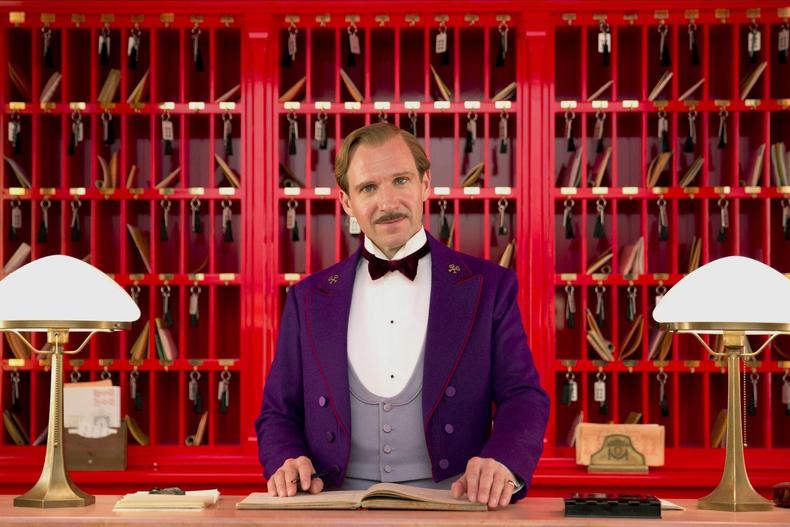
Anderson tends to place the camera perpendicular to the scene, also called planimetric composition. This means characters move horizontally or vertically across the frame, making his shots appear two-dimensional—like a stage play where audiences sit directly in front of the performers, or like an illustrated book held out in front of us.
This same type of formalism—the artistic approach that prioritizes visual structure, symmetry, and stylistic control—is the foundation of Anderson’s cinematic style. Unlike naturalism in film, which tends to hide the artifice of filmmaking, his formalism brings these elements to the forefront of the audience’s experience. His style keeps the world just curated and strange enough to create distance, but never so absurd that viewers lose the emotional thread of the story. Anderson has described his commitment to this style, telling NPR, “There were times when I thought I should change my approach, but in fact, this is what I like to do. It’s sort of like my handwriting as a movie director.”
Anderson shows us that the most important decision a filmmaker makes is choosing a philosophical perspective on how to use the language of cinema. That choice pulls from a spectrum. Filmmakers like Sean Baker, Terrence Malick, and Chloé Zhao lean toward naturalism, using the camera to capture performances and a world without (seemingly) much interference. Others like David Fincher, Stanley Kubrick, and Anderson lean toward formalism, deploying filmmaking techniques in overtly expressive and precise ways. Understanding where you fall on that spectrum (and what you are most interested in exploring!) is your starting point for finding your voice as a filmmaker.
“The Grand Budapest Hotel” Credit: AJ Pics/Alamy
2. World-building
To Anderson, production design is more than what falls within the camera’s frame; it is the foundation of the story itself. A set that photographs well is only one function of production design. The deeper function is creating a world tangible enough to bring out the best in every department, primarily the performances.
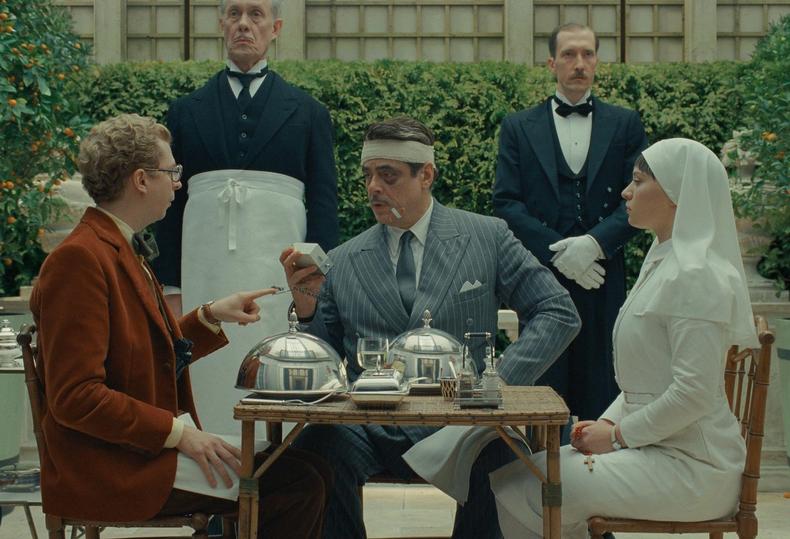
Perhaps the best example of this is when Anderson used actual art pieces as props on “The Phoenician Scheme.” Zsa-zsa, a ruthless, jet-setting European industrialist, collects famous paintings and fills his residence with them. The artworks that appear in the film—René Magritte’s “The Equator” (1942), Pierre-Auguste Renoir’s “Enfant Assis en Robe Bleue (Portrait d’Edmond Renoir Jr.)” (1889), and a 17th century still life by Floris Gerritsz van Schooten—are not reproductions. They are real, borrowed artifacts. Production designer Adam Stockhausen described the effect of having these on set, telling Focus Features, “Having a room full of real masterpieces changed the performances. It changed everything.”
The film’s art curator, Jasper Sharp, watched this happen in real time on set. During breaks in filming, he noticed that the actors gravitated toward the Renoir. When Sharp told Del Toro that the portrait had hung in Greta Garbo’s New York apartment for nearly five decades, the actor was so energized by the news that for two days straight—from action to cut—he treated it as his own.
Anderson had anticipated exactly this. “I thought it would mean something to the actors to be with these real objects,” he said to Galerie. “You can tell the difference, and it has an aura to it.”
That commitment went beyond the art. Sharp explained that the nightgown worn by Sister Liesl (Mia Threapleton) was designed by Milena Canonero and her mattress was stuffed with horsehair—a period-accurate detail for a wealthy Italian household in the 1950s. The linen on her bed was vintage French, sourced and hand-sewn by the production team. Her rosary was even made by Cartier. An audience may never notice these details, but all of them shaped how Threapleton moved and behaved in the space.
Anderson’s approach to production design shows filmmakers that a location or set should be designed to serve the shot plan and establish the world, but it can also build something deeper. Set design, props, and wardrobe can give actors something visceral and tangible to inhabit and perform from within.
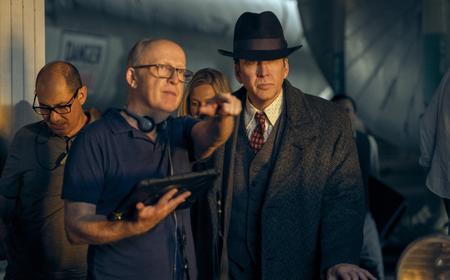
“The Phoenician Scheme” Credit: Capital Pictures/Alamy
3. Audience perspective
Most filmmakers treat the shot as a coverage problem: “From how many angles should we shoot this scene?” or “What angles and shot sizes will best capture the characters’ emotions?” Anderson’s approach to the shot, however, focuses more on establishing and reinforcing the audience’s formal perspective of the story.
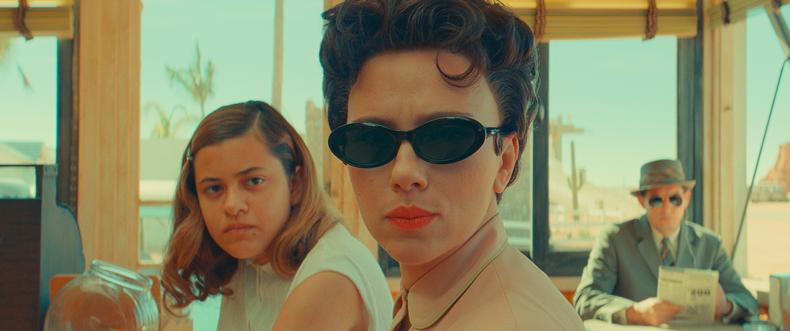
Tracking shots in Anderson’s films almost always move parallel to the action rather than pushing into it. Characters enter and exit the frame laterally, like actors crossing a stage. The camera observes the world from a theatrical distance, maintaining the planimetric plane.
Anderson is also a fan of the whip pan. Most directors cut between a shot and a reaction; Anderson often trades that cut for a quick pan connecting two locked-off shots, sweeping across the world in between before landing on another character or piece of information. The choice to keep the in-between reminds us that the story’s world exists beyond the frame—and that it is through filmmaking and camera movement that we are guided through it.
Cinematographer Robert Yeoman—who worked with Anderson on all his live-action films before “The Phoenician Scheme,” from “Bottle Rocket” (1996) to “Asteroid City” (2023)—captures all of the whip pans off a fluid head and has developed a reliable technique for executing them. “The secret,” he told Cooke Optics, “is you find a really comfortable position with your feet and body for the end position, and then you start in a really uncomfortable position and come to that comfortable one.”
Anderson’s camera movements operate within the restraint of his formalism. Over time, this has evolved into his signature aesthetic. These choices position the audience as observers of the story rather than as participants fully immersed within it.
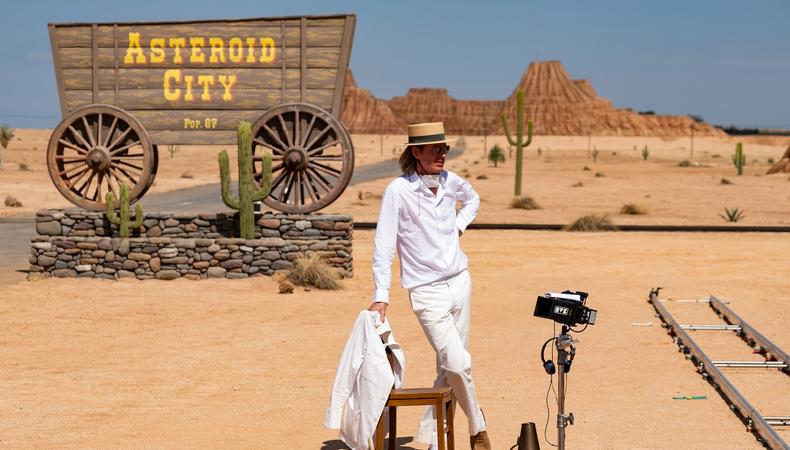
“Asteroid City” Courtesy Pop. 87 Productions/Focus Features
4. Directing tone
Anderson’s tone is as distinct as his visual aesthetic, and just as easy to misread. With the wrong direction, deadpan dialogue can land as flatness; and absurdity, played too broadly, can break the world his team works so hard to create. What makes his performances work is that each actor is directed to bring total commitment to the internal logic of the world.
The direction Anderson gives focuses primarily on register over emotion. Adults carry a child’s sincerity, while children speak like confident adults. In “Moonrise Kingdom” (2012), two 12-year-olds negotiate their relationship with the formality of a business transaction, and the planimetric framing treats them with the same flat objectivity as everything else in the film. The comedy and the melancholy depend on performances that wholly believe in this world and its social behavior, never winking at the audience or injecting meta self-awareness.
That register has to be established before production starts, built into the writing and understood by the director. By the time an actor arrives, the world already has a specific tonal frequency, and their aim—with proper direction—is to find their place within it.