You never know how an audience will respond to a work of art, but you can show them where to look. This is what’s at the heart of the compositional technique known as leading lines. Used across all visual mediums—including painting, photography, film, and television—this valuable tool can make your shot composition shine. Here, we’ve broken down leading lines, with advice from experts to arm you with everything you’ll need.
This is a compositional technique that uses line shapes to focus a viewer’s eye on the intended subject. This can be done in many ways, whether you use naturally occurring lines like tree branches or the horizon, pieces of a set like walls, shelves, and railings, or the perspective and position of the camera. For example, look at how this shot from Clint Bentley’s “Train Dreams” utilizes the railroad tracks to guide your attention to Joel Edgerton’s character in the foreground.

“Train Dreams” Courtesy Netflix
When you’re telling a story in a shot, be it a still or moving image, “you’re trying to transpose a three-dimensional space or object onto a two-dimensional plane, and with that comes a lot of challenges,” explains cinematographer Sean Conaty. “Leading lines are a byproduct of perspective. You’re trying to use a single-point perspective to say something subtly or overt.”
How are leading lines useful?
“[Leading lines] are about creating depth, as well as giving your audience a way to read a scene, painting, or photograph, showing the eye which way to go,” says Becky Sapp, a photographer, camera operator, and cinematographer.
Think of it as if you’re actively directing the audience with your image, which in turn allows you to emphasize whatever tone and emotion the scene calls for. What do you want the audience to see? What do you want them to not notice, until it’s too late? “The quintessential example of it is Stanley Kubrick,” says Conaty. “You look at his work and his biggest paintbrush is perspective and leading lines—to be able to focus you. He’s not doing it just to bring your eye along—he’s doing it from a storytelling perspective, full of compositional balance and symmetry. It all relates to the ordered way he tells the story.”
Watch this clip from Kubrick’s “Full Metal Jacket,” where a bulk of the leading lines are actually made up of the recruits themselves in perfect formation.
“Wes Anderson is sort of riffing on that idea, constantly breaking up those leading lines,” Conaty says. “So there’s an awareness of perspective as well as an interrupted flatness. He’s constantly working with perspective and broken perspective.”
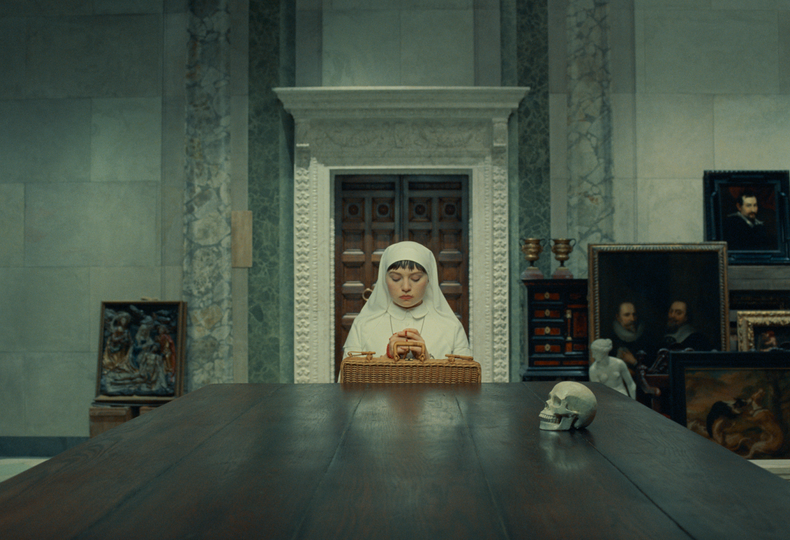
“The Phoenician Scheme,” Courtesy Focus Features
Simply put: Train yourself to always look for them or find ways to orchestrate leading lines through set design and framing. For Sapp, that’s where a lot of the fun comes in. “If you play with the perspectives and lines—be it through moving the characters or the camera—the leading lines created by those differences can add a whole other dimension to the scene. So take a moment, assess your surroundings, and see how that can be incorporated into the scene.”
Before you even turn the camera on, take the time to examine the space you’re shooting in and make note of every possible line you see. Countertops, window frames, tables, staircases, even shadows—the list goes on. Knowing the possibilities beforehand will also help you decide where (and why) to position the camera and subjects.
 What Is the Rule of Thirds? How to Use This Technique to Capture Dynamic Images
 It will be a challenge, but that’s how art works. “You might be using spaces you [don’t] have a lot of control over, so it may be tricky to compose images that will evoke the exact emotion” you are looking for, says Sapp. But it’s important to remember that “the audience will also put their own in there, as well. So there’s no hard-and-fast rule” as to which framing might evoke which emotional response.
In the end, if it feels hard, break your image or shot down into its most basic parts—subject, foreground, background—and see what sparks from there. “When I’m deconstructing an image,” Conaty says, “I’m always looking for what the skeleton is of it. When I’m making a composition on set, I’m trying to diagnose my intention versus my execution, and leading lines are one of the tools I use to do that. Are my leading lines heading in the right direction? Are my eyes getting confused? Is that a good thing? Do I want that? Because sometimes you do. Leading lines don’t always have to go towards the subject in order to make it about the subject.”