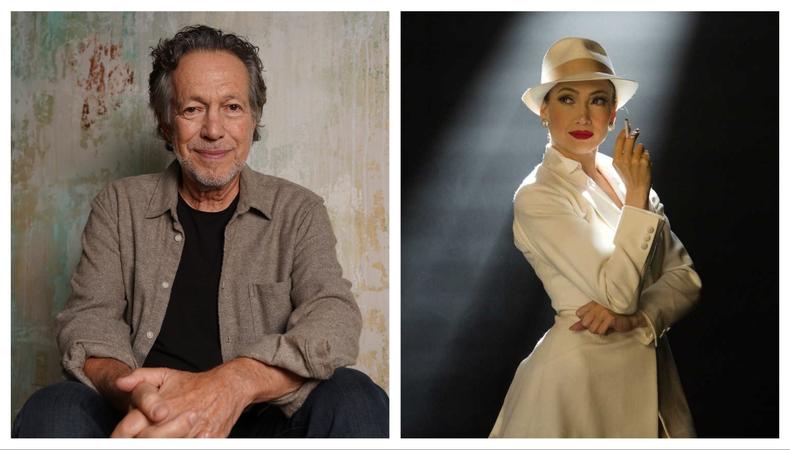
Aaron Speiser was only supposed to be an acting coach for a few months. But then his mentor, “Rhoda” star Kenneth McMillan, asked him to lend a hand teaching students at the new Los Angeles outpost of his HB Studio. “He said, ‘Just do it for a little while and let’s see what happens,’ ” Speiser says.
That was roughly 40 years ago. Speiser is now a preeminent educator who has co-led the Screen Acting Studio in L.A. with Kay Aston since 2022. His clients have included everyone from Will Smith to LL Cool J to new “Saturday Night Live” featured player Jeremy Culhane (who actually went from student to teacher at the Studio).
Most notably, he’s coached Jennifer Lopez ever since she was a Fly Girl dancer on the sketch show “In Living Color” in the early 1990s—and he raved to us about her performance as fictional screen star Ingrid Luna in Bill Condon’s adaptation of the Tony-winning musical “Kiss of the Spider Woman” (in theaters now). “She works so hard in her acting,” he says. “I don’t think she gets the credit she deserves.”
Here, Speiser discusses the character-mapping technique he used to guide Lopez, changes in the industry, and the no-nonsense advice he gives actors.
How did you prepare Jennifer for “Kiss of the Spider Woman”? This seems like a role already in her wheelhouse.
It is in her wheelhouse. But think about how even the best tennis and golf players in the world still have coaches because they want to be the best. For this role, she’s actually playing three different characters [in movies-within- the-movie]. So we created a gigantic corkboard and tracked these characters from the beginning to the end of the movie. They [shot] out of sequence, so we asked questions like: “Where am I now? Did this actor hurt me in this role? Am I playing her in a scene that takes place off-camera?” It got complicated.
Can you talk about a few other stars you’ve coached?
I met LL Cool J in the ’90s through Shawn and Marlon Wayans, who were two of my students. He said he really wanted to learn how to act. He loves art, and whenever he does anything, he wants to do it great. He hired me for 10 years. Gerard Butler had never been trained when I met him, and he and I had a fabulous 10-year run.
I also worked with Dwayne Johnson on the set of “Be Cool” [in 2005]. The director, F. Gary Gray, hired me to help him because he was playing this complicated character—a rough bodyguard hiding his sexuality. At the time, he had pretty much only worked within himself, like Arnold Schwarzenegger. So we worked every day together.
Why is being an educator still necessary in 2025?
It’s different from being an educator in history or mathematics, which I also respect. This is about making my students’ lives better. I’m teaching them how to have a peak experience and live in the present—and that’s a gift [in itself], because think about what it means to not be stuck in your head all the time.
How does that concept work in your class?
That’s done through improv. You don’t know what [will happen] in the scene, so you have to make yourself believe whatever [the other] actor tells you. We teach students you cannot anticipate feelings or emotions.
How has your teaching technique changed since you first started?
Forty years ago, every actor was focused on theater—I have a master’s degree in fine arts and theater [from Brandeis University]. So I’d do a lot of rehearse, rehearse, rehearse, and making sure they hear you in the back of the room. But I moved away from the theater and performance because you really can’t make a living that way unless you’re Denzel Washington doing “Othello.” Now I focus on film and television and being great in front of the camera. Instead of rehearsal, we’ll do 10 takes, because a director will take these little pieces and create your performance in the editing room. I also like it because we’re creating life in an imaginary world.
What’s been the most gratifying part of your career?
First of all, it’s so wonderful seeing my students make a living. But there’s another thing just as special: By learning acting, you’re given the gift of learning to listen, and that changes all your relationships. Talking is just speaking the lines the writers give you. Listening is behavior, and letting everything affect you, which is what happens in life. You’re just not conscious of it.
What’s your general advice to aspiring actors?
When a new student comes in, I want to make sure they understand what [they’re getting] into. The first thing I say is: This is a marathon; it’s not a 100-yard sprint. So you’re going to slow down, breathe, and get ready. The real people who love acting do it for their whole lives because they need to.
This interview has been edited for clarity and length.
This story originally appeared in the October 20 issue of Backstage Magazine.