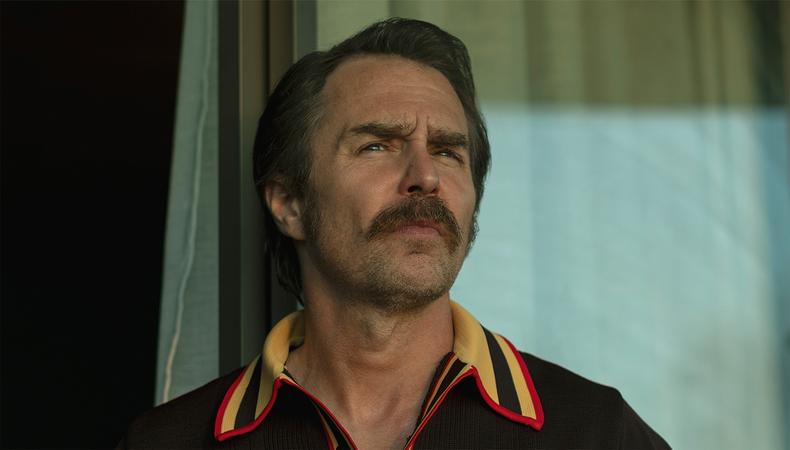
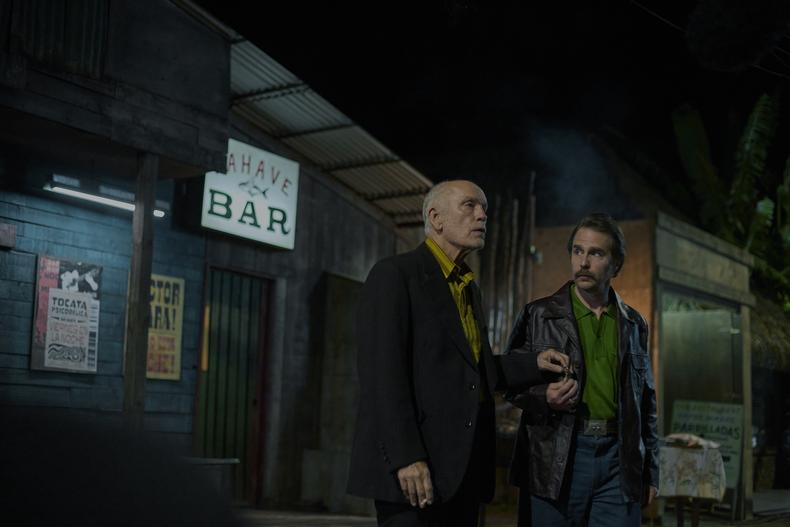
Martin McDonagh’s 1973-set black comedy–thriller “Wild Horse Nine” is one of the most impressive two-handers in recent memory. John Malkovich and Sam Rockwell star as CIA agents on a classified trip to the remote Easter Island—and their mission reveals secrets both political and personal as Malkovich’s Chris Carlisle contends with a terminal cancer diagnosis. In the video below, Rockwell sits down to discuss how he cultivates chemistry with his costars, his evolution as an actor since first collaborating with McDonagh in 2012, and the “only way” performers can learn to have range.
“Wild Horse Nine” received a 14-minute standing ovation at the Venice Film Festival. What runs through your head during a 14-minute ovation?
Well, you can’t really step out for a cigarette or a hamburger. Then you gotta go see your shrink to shrink your head. No, it’s very flattering and incredibly humbling. You’re kind of speechless.
I’ve seen you and several of your costars say this film is full of great “tennis partners.” What does that mean to you, exactly?
Did you study Meisner, by any chance? Meisner is kind of a tennis match, if it’s done well. Any kind of acting is. I don’t know a lot about tennis—I know more about boxing—but I think acting is more like tennis. Actors want to be pitched a hard ball or a curveball, because you have to constantly depend on that [other] person to raise your game.
Was there an aha moment in your career when you realized how important your scene partner was to your performance?
There are a lot of aha moments throughout your career. There are so many to go through, but I’ve had big ones with Gene Hackman, big ones in Meisner training with Bill Esper. I’m constantly learning from anybody, from Tom Hanks to Drew Barrymore to Frances McDormand to John Malkovich. It just goes on and on. It might not be necessarily an acting [lesson], per se. It could just be the way somebody handles themselves on a set. George Clooney comes on a set and he’s always got a smile for the crew, a “thank you” and a “please,” even if he’s not in a great mood or he hasn’t slept. That takes a lot of grace. You learn from people like that.
We talked to casting director Sarah Halley Finn, and she said she was particularly interested to see you act in this movie during moments of silence. What’s the challenge of that?
Oh, I love it. It’s great to listen and not say anything. You’re always saying something, even if you’re not talking. There’s always something going on, hopefully.
For you, specifically, what is going on in your head during moments of silence onscreen?
The word “subtext” is a valuable word. Michael Caine [told a story where] a director said to him, “What are you thinking?” And he said, “Well, I have no lines.” And the director says, “No, no, no, you have many, many lines. You have tons of lines. You have four pages of lines. You think of these lines to say, you think about saying them, and then you decide not to say them.” That’s kind of the best way to put it. You’re always about to say something, and then you don’t say it. Unlike me, who’s yammering.
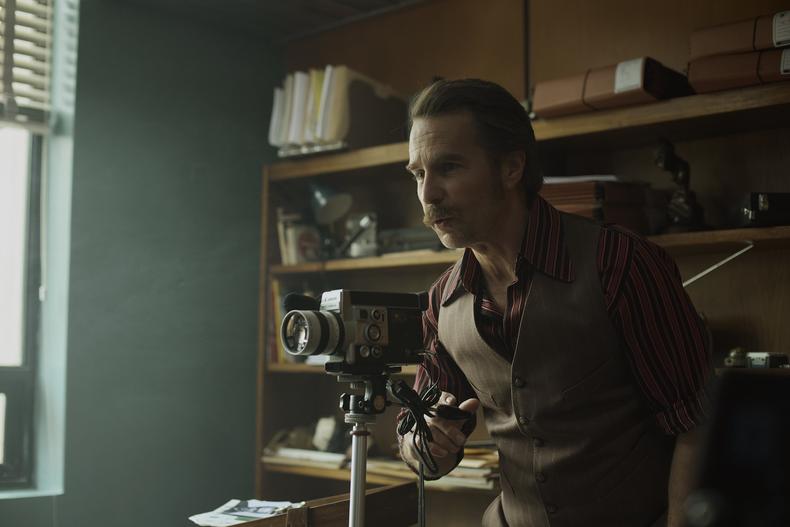
You first worked with Martin McDonagh 14 years ago on “Seven Psychopaths.” How would you compare yourself as an actor now to back then, and what does any difference say to you about the life of an actor?
Really, 14 years? That’s frightening. Fourteen years is a long time. You learn so much from other actors, from directors. Martin and I have both matured. I don’t think Martin and I could have made a movie like this, I don’t think I could have played a character like this even five years ago, let alone 14 years. Same for Martin. I think Martin’s filmmaking has matured, and he’s got great emotional depth. It keeps getting deeper and deeper.
This is a movie about a character choosing when and how he dies, where he bows out, basically. Have you ever thought about your ideal final role?
Gosh, I don’t know. I don’t know if I want to play King Lear… That’s an interesting question. Willy Loman, maybe, someday. It’s hard to know. You want to make God laugh, tell him your plans, you know? You can’t really plan anything. The only word you have is to say no to something. You don’t have control over the yeses as much. It just depends on what comes your way.
“Wild Horse Nine” is also a movie about regret. Is there a particular regret in your career that also taught you a valuable lesson?
The biggest thing is not to expend energy on set. You save that energy. If you’re frustrated, if you’re having a hard day, you should try to put it into the work. That takes years to learn. Because you can waste a lot of creative energy being tired, being grumpy. It’s not even about being happy. You could be putting that energy into the work. That’s more useful than complaining, for example.
You have tremendous range as an actor. Is that something anyone can learn to have?
I think the only way to have range is to do theater and play the great parts, whatever parts you can get your hands on. So if it’s Mercutio or Hamlet or Willy Loman or “The Cherry Orchard.” I’ve gotten to play Stanley Kowalski. I did “The Zoo Story.” I did “The Dumb Waiter.” I did “Fool for Love.” I did “American Buffalo.” I’m about to do “A View From the Bridge.” That’s the only way to really grow. If you’re lucky enough, like John and I, to play lead roles in films, especially ones written by Martin McDonagh, that can stretch you as well. Lead roles in films can stretch you. But theater stretches you probably even more.
Is there anything you took away from watching John Malkovich work?
John is a hero to a lot of actors, and I’m no exception. Watching him work and talking to him about acting—when we’re not goofing around with our friend Ben Schwartz… He would sometimes talk about acting like surfing on a wave. You have to trust the play. There’s a trust that the wave is going to take you, and you’re going to ride the wave, and let the play, let the story, take you. That’s what Bill Esper used to call great actors’ faith. That’s the thing I take from John. Now, John’s a very talented, skillful man. But I think he trusts the story.
What’s your advice for any actor struggling to keep that faith?
Well, I’m still trying to figure it out, to be honest with you. It’s a constant learning curve, and I’m still learning. John’s a very special actor. He’s kind of touched. There’s a thing about him. That’s a rarity. [Like] Philip Seymour Hoffman, Laurie Metcalf, Gene Hackman. They work hard at it, but it’s a gift. I keep trying to figure out how to do this, and it’s always challenging.
This interview has been edited for clarity and length.