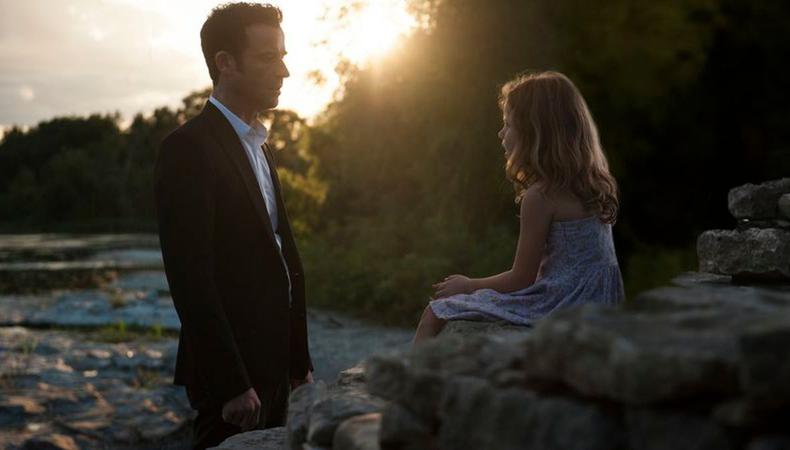
You may not know Max Richter’s name, but he’s been subliminally making you cry for years. Having composed or provided soundtrack for projects including “Arrival,” “My Brilliant Friend,” and, most indelibly, “The Leftovers,” his compositions can elevate an incredible moment in TV or film to a sublime one. He’s also a prolific writer of standalone albums, the newest of which, “Voices,” is based on the text of the Universal Declaration of Human Rights and interweaves spoken word from actor Kiki Layne as well as Eleanor Roosevelt. Here, Richter shares how that project came to be and why music can incite emotion in a way words alone cannot.
What was the inspiration behind “Voices”?
The starting point was around 2010, and the events of Guantanamo and that information that came out of the CIA. I just felt like we’d lost our way, in some way. I felt like something had gone missing about humanity. I read this piece called “Mercy,” a violin and piano piece, which is now at the end of the record. My partner and I started thinking about a bigger piece, a music and film piece. Over those next 10 years, I just started working on the material and trying to find a shape for it that made sense. And now we have “Voices.”
READ: Trent Reznor on Scoring ‘Watchmen’
Do you usually have an overarching story you want to tell with every record?
Yes. “Voices” is very much about trying to look at the world we’ve made, which, over the last 10 years, has become an increasingly challenging place. We have a lot of big questions facing us as a culture. And we’re trying to find a way to make hopeful material, a hopeful response to those questions. That’s what led me to the Universal Declaration of Human Rights, a document which comes out of a very difficult time, the second World War, but is kind of a blueprint for something better. And for me, that’s a very inspiring thought. So I wanted to put that into the center of the piece.
How different is a studio album like “Voices” compared to composing for film or TV?
It’s completely a different thing. Film and TV work is fundamentally collaborative and music is a small part of a bigger structure, bigger storytelling. It’s part of a world, in a way. Whereas with a record or a concert piece, the music is the whole thing. It has to do all the storytelling. And the process is very different. In the case of “Voices,” it’s just me sitting in a room writing on a piece of paper. Whereas TV and movies, it’s fundamentally collaborative.
How does the composing process for film and TV actually work? Do you do it all in postproduction?
It really depends on the project. It’s nice for me, personally, to get a sense of the world that is being built, that is being explored and described by the filmmakers at an earlier stage. Because then, music can feel more part of that world and become more fundamental to it. I often write a lot of material off the page or just from conversations [with the creative team]. It’s a very experimental process, but for me, that’s my strength.
How do you figure out what a project should sound like when you sign on?
It’s about trying to discover the kind of material which feels like it belongs in their world, like it could only be from there, that it feels inevitable. It’s a process of discovering what that is. Composing is a little bit of a mysterious process. It’s a mix between conceptualizing a lot of ideas and a lot of theory and then blind instinct. You have to be able to do both.
One of your best-known projects is “The Leftovers.” How did you find the aural themes for that show?
It’s just such a brilliant piece of TV. I hadn’t done any TV before “The Leftovers.” Damon [Lindelof] sent me the first script, the pilot, and the writing was just fantastic. I was just captivated by that world immediately so I set out to try and discover a musical language, which felt like the voice of that world. The themes of “The Leftovers” are obviously “the departure”: things going away, things disappearing. So I deliberately made a score which was mostly built out of instruments which don’t have the ability to sustain their sound, so they’re not like a violin or brass instruments. It’s pianos, it’s harps, it’s bells, where there is a decay in the sound. That image of disappearing into nothingness is deep into the music.
READ: Why Music Supervisors Want to Make You Cry
When you work on a long-term project like a TV show, does your work evolve along with the characters?
In a movie, you’ve got 90 minutes, 120 minutes, that’s it. You have to tell all of the story, you have to make all kinds of musical material work with the characters in that short space of time. In a TV show, you have many visits to those characters, many relationships with them, many chances to describe or respond to their world. You can go deeper.
How do you think music can help “land” a moment or a scene on-camera?
The simple way of describing the impact that music can have is that music starts where other things end. It occupies a space beyond language. Music is a way to talk about the things we can’t talk about with words. And that’s why it’s such a magical thing. That’s why we human creatures respond to it so strongly: It’s about something somehow beyond us. I think you feel that in movies and TV when it’s working well. It’s that other frame of reference that we can’t even really describe, but we know it when it’s there.
Looking for remote work? Backstage has got you covered! Click here for auditions you can do from home!