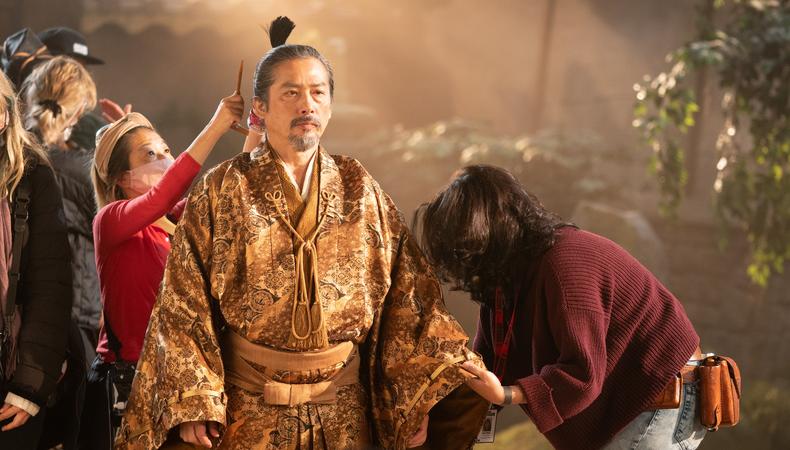
“When they say it takes a village to design a project like this—this was bigger than anything I’ve done before,” says “Shōgun” costume designer Carlos Rosario. Transforming Vancouver into Japan circa 1600 required a sizable team that rivals the powerful Lord Yoshii Toranaga’s (Hiroyuki Sanada) army, with nearly 300 people working globally.
Every costume piece in Rachel Kondo and Justin Marks’ historical epic, based on James Clavell’s 1975 novel, was painstakingly handmade—from Toda Mariko’s (Anna Sawai) hand-painted silk robes, called “uchikake,” to Kashigi Yabushige’s (Tadanobu Asano) armor and traditional samurai coat, or “jinbaori.” Here, Rosario shares how the team achieved this visual feast.
Where do you begin with a project this large?
Research has to be the first step toward designing a project of this magnitude…. [It] allows you to create a strong foundation. We did that by studying the paintings of [the] period, because it was about going straight to the source. I didn’t want to watch many Japanese movies because I felt [they were] the interpretation of the director or the costume designer, and I didn’t want to understand this period through their filters.
Through the paintings, we understood the colors and patterns…. Once we understood this period, we could get closer to the characters and try to understand who they are to bring more emotional and psychological aspects to the costumes they would be wearing.
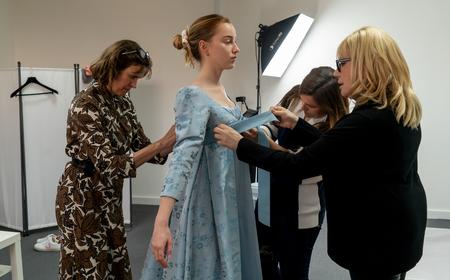 How to Become a Costume Designer
 Why is it important to differentiate between the groups and loyalties using color?
The research allowed us to create specific boundaries of what the rules of the clothes were at that point. It says in the first script and the novel— Clavell said that Ishido Kazunari’s [Takehiro Hira] army was gray and Toranaga’s army was brown. I thought, by extension, Ishido should be wearing gray, silver clothes. Then, for Toranaga, it’s the same thing; his color palettes should be rich chocolate browns, coppers, and golds. That gave me my first intuition of how I needed to design this show.
It was about creating very specific color palettes for each army and, by extension, their lords. That was very helpful because it simplified everything. This is such a big show, with so many costumes and characters, and the fact that I created a very strong color palette gave me clear boundaries for where I could design each character. Slowly, after that, I got closer and closer to the characters, and then analyzed them: What are the ranks? In which location are they? Things like that. Then, you start getting into the details of their costumes.
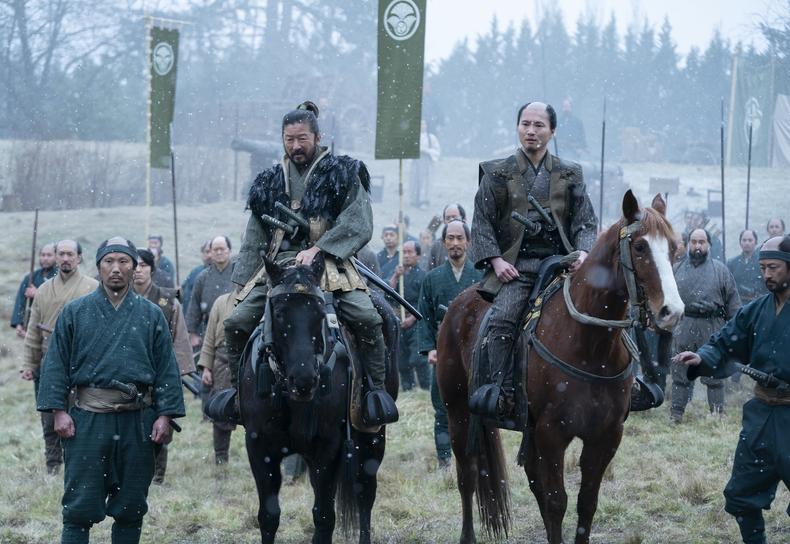
Did you find that people used natural elements like feathers and fur? Birds are also a theme throughout.
When I read the script for the first time, it [emphasized] colors and then textures. I saw [the] period as more organic, connected to the earth with natural elements. I studied a little bit [of] the Edo period [1603–1868], which is after the Sengoku period [1477–1573], and [the Edo period] is much more elaborate in terms of fabrics—much more wealthy. It’s a period of peace and abundance in Japan.
I wanted to make the distinctions between the two periods. That’s why I chose the black raven feathers for Yabushige and peacock feathers for the “jinbaori” for Toranaga. I created bark textures on certain pieces of the armor for [Yabushige’s] green army.
Ishido’s army’s concept was fire and ash—the ash represented through the silver, the metallic, the grays, and pops of oranges, which meant fire. Every lord had concepts related to natural elements—their armies, too. I used the feather because I wanted to design something more textural, organic, and in touch with nature.
What did you have in mind for Mariko’s color palette?
That concept started because the first time [Mariko’s husband] Buntaro [Shinnosuke Abe] speaks about her, he says he found her very icy. The way I interpret that is because of what happened to her family: being dishonored and her wanting to commit “seppuku” [the samurai ritual of cutting the belly to commit suicide] every year on her birthday—and she wasn’t allowed to. She was walking through life kind of dead.
Since we were shooting in Vancouver in the winter, her costumes needed to represent that season. I started creating patterns that meant her first “uchikake”—you see all the curves hand-painted that represent that period, [such as] the snow covering the grass and branches with old leaves. There was something very historical about it, but at the same time, very poetic that conveyed where she was emotionally—something very monochromatic without life.
Slowly, as she empowers herself and finds her path, as she meets John Blackthorne [Cosmo Jarvis], I started incorporating the red camellias in her costumes.
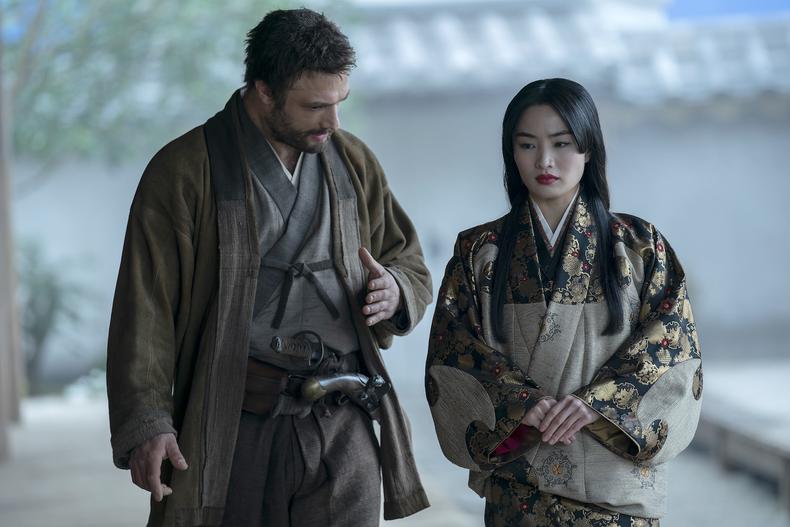
English navigator Blackthorne’s wardrobe is the simplest, but he has an evolution. What did you want to convey?
For Blackthorne, when they removed his britches and his blouse, I saw it symbolically as a way to remove his old identity and impose on him the Japanese culture. He starts with a very simple “kosode,” the ancestor to the kimono. I started adding elements to show the audience that he has slowly been more and more integrated into the Japanese culture. I kept everything very simple and very different from what Richard Chamberlain wore in the miniseries in the ’80s.
In the beginning, [Blackthorne] doesn’t speak Japanese, and he finds himself in the middle of all these power dynamics. He’s very powerless. I also kept him very muted and neutral in his color palette, without any patterns—something basic and clean because I wanted him to stand out next to the others, and be in contrast with the elegance and the beauty of the costumes of everybody else.
I think it kept him anchored in this position of “foreigner” from the beginning to the end, even though he starts incorporating more and more Japanese clothing into his wardrobe—all the way to the point [when] he actually wears a “kataginu” [a sleeveless robe with wide shoulders], which is very formal in Japanese culture. At that moment, he’s wearing that green “kataginu” with the gold stripes, [which] was an homage to Chamberlain because I love that outfit that Chamberlain wore. I went to showrunner Justin Marks and said, “We need to do something like that; it’s such a beautiful piece. It’s so iconic.”
How many people are in the “Shōgun” costume department?
We prepped and shot everything in Vancouver. I think my team in Vancouver was about 125 people. But, initially, it was a combination of the work of different countries. Pretty much everything you see on the screen for the main characters was made in Vancouver in our workshop with my team.
Initially, I had two people swatching fabrics for me in America, but I couldn’t find the right fabrics. I didn’t find anything that captured the essence of the Japanese culture. So I hired a team in Japan to find those Japanese fabrics, and those people in Japan worked the entire show.
Then, I had a couple of companies in Thailand creating a lot of background stock—for example, for the funeral, the wedding, and the peasants at Ajiro. Then, all the armor [was made] in China. We were about 300 people in total.
Costume designer Colleen Atwood was one of your first mentors on movies like Tim Burton’s “Sleepy Hollow.” What did you learn from her?
She is the one who showed me the infinite possibilities this job offers. She once told me, “Carlos, all ideas are good—you just have to pick one, and you have to make it work.” As artists, we tend to procrastinate and torture ourselves about this or that. At the end of the day, I believe that all ideas are good—you just have to make it work.
This story originally appeared in the June 6 issue of Backstage Magazine.