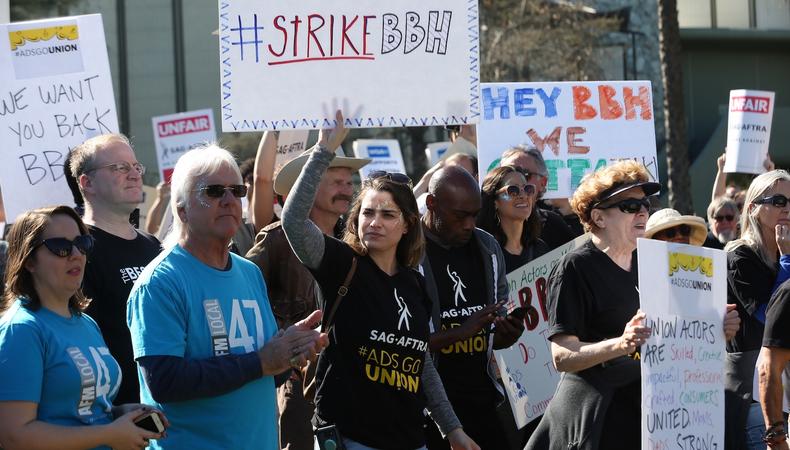
Since September, SAG-AFTRA—the nation’s union for professional screen talent—has been striking bicoastal ad agency Bartle Bogle Hegarty LLC (BBH) over the agency’s abandonment of a contract with the labor force. Yesterday, hundreds of members and supporters rallied in Los Angeles to add momentum to a prolonged (and some might say stagnated) strike campaign.
“I am amazed to stand here looking out at all of your faces,” union President Gabrielle Carteris told the crowd of supporters, “We are all here for the same purpose—to stand as one.”
While BBH is the only entity SAG-AFTRA is currently striking, it is the latest target in a string of strikes the union has lead in the past two years. The union—with a nationwide membership of roughly 160,000—has waged successful pressure campaigns against streaming providers, animation producers, and the video game industry. “Our members’ activism on their own behalf is a key component to further strengthening our contracts and building our union,” Carteris told Backstage earlier this year.
The strike against BBH appears to be a pilot for a looming larger-scale strike against commercial producers, which could hit in March. SAG-AFTRA has sent canvassing teams to nonunion commercial shoots (including an NBA shoot in Venice) and has been using its star-power to signal to the industry that they’re looking aggressively at conditions for their members on commercial shoots. Between faux bake sales, strike rats, and rallies—the union is aiming to send a message and whip up its pressure-power.
“Make no mistake, our strike against BBH is one of the most important strikes taking place today for our union,” Carteris told the rally attendees in Los Angeles. “We must stand strong for fair wages and for our future.”
Currently, the union has contracts with over 600 ad agencies, but an ever-changing media landscape with the rise of digital entertainment has created tension between the union and producers. The union has aimed to tamper tensions and negotiate protocols ahead of the innovation curve. In 2017, the union approved a special waiver for smaller digital commercials with budgets of $50,000 or less.
“While a waiver of this scope is rare, the union and the JPC felt it necessary to create this waiver mid-contract to offer relief to ad agencies that are losing clients to non-signatory ad agencies on digital work. Our hope is that they will now be able to retain this work and maintain those highly creative and productive relationships with advertisers,” said a joint statement between the union and the Association of National Advertisers (ANA) Joint Policy Committee on Broadcast Television (JPC).
However, this degree of collaboration has been infused with tension as of late, with ANA’s JPC advising its constituency of producers to wrap union commercials before March when the two negotiating teams meet around a table to hammer out a new Commercials Contract. Currently, both parties have agreed to a media blackout and are withholding comments on the matter.
Union strikes have significant impacts—not only for targeted organizations and union members but also for nonunion members as well. And with the BBH strike in its fifth month and the potential of a larger scale shutout in March, the industry is watching this strike and gearing up for the potential of a broader labor battle in the spring.