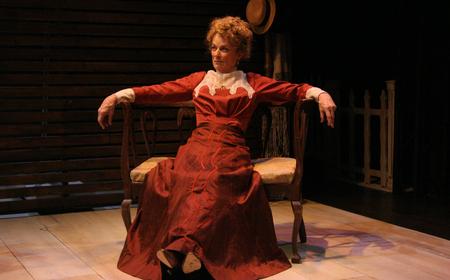
Director Darin Anthony somehow spins a few bright and shiny moments out of the dross of this Richard Greenberg script. Bad exposition in the first act, a bloated look into the characters' futures that reveals nothing to us in the second, and self-conscious commentary about what makes scripts bad give the audience not much of a ride. One glamorous and truthful performance, directorial whimsy, and an evocative sound design rise above this chatty production.
Setting the play in April 1919, between the armistice and the treaty ending World War I, Greenberg deals in a precarious period. But most of the characters are unsympathetic and reveal little of the universal human condition. We catch the probable protagonist, soon-to-be book publisher John, in a lie early in the first act, so why would we trust anything he says later? His assistant Gidger is a hyperactive and hypereducated buffoon. Only the black Jesse—a talented songstress with a promising autobiography—merits our admiration for so graciously rising above the taunting racial slurs.
Jesse is played by Karole Foreman, who walks and sits period-correctly, has a melodious speaking voice, yet brings realism to her work. Travis Schuldt gives John youthful bravery, though the character remains unappealing. Buck Zachary fits the physical bill of Gidger, including vocal work that must, speaking of old times, go from Curly Howard to Howard Keel. As John's friend, Peter Larney's reactions seem plotted rather than felt. As the fiancée, Lisa Valerie Morgan displays a self-conscious physicality and lacks vocal chops.
Fortunately, the sound design of Doug Newell includes a gentle metallic old-fashioned ticking of the time machine, an old phone that rings correctly and not from offstage, and the simple but effective matter of letting us know an actor has walked down a hallway and shut a door. The "miles and miles" of paper involved in John's publishing business grow into magical stacks that drift upward during a scene or two, then plummet when "reality" sets in. And, lastly, the violet charmingly escapes from the costumes when the violet hour is over.
On a side note, the world is a better place for fewer smokers, but actors should at least include it as a skill to be studied.
Presented by Hollywood Food Chain Productions and Elephant Stageworks at the Lillian Theatre, 6322 Santa Monica Blvd., Hollywood. Feb. 12–Mar. 13. Thu.–Sat., 8 p.m.; Sun., 3 p.m. (323) 960-1054. www.plays411.com/violethour.