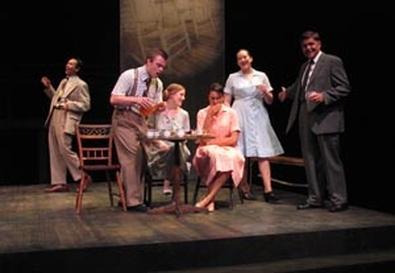
Photo Source: Clarissa Marzan
The story is suggested by the 1955 Mississippi murder of teenager Emmett Till for allegedly whistling at a white woman, but as the play's dedication "to the memory of Medgar Evers, and his widow and children, and to the memory of the dead children of Birmingham" indicates, Baldwin was writing about contemporary America, not the recent past, and doing so with unmitigated honesty. Richard Henry, a pastor's son, has returned to his rural Southern hometown after a promising career in New York City as a musician was derailed by a heroin addiction. Richard has gotten clean and reconnected with a former girlfriend, the still single Juanita, a civil-rights activist. But Richard's experience of greater freedom in the North has made him vow never again to act in a subservient way to anyone. The attitude ends up getting him killed, shot in cold blood by a poor shop owner, Lyle Britten, for being insolent to Britten's wife. The standard Southern show trial is held; perjury is committed all around; Britten is acquitted by an all-male, all-white jury; and the vise of racism is wrenched tighter on a society soon to explode.
Baldwin employs novelistic devices in telling his story, such as poetic direct-address monologues, a multiplicity of locations, and a casual mingling of past and present, and he's not bothered a bit by ignoring such niceties as correct courtroom procedure. The play has an illusory realism while working mostly on a plane of heightened naturalism, which makes it a creature of mercurial, constantly shifting moods that's hard to get right. The original production had Burgess Meredith as director, a powerhouse cast that included Al Freeman Jr., Diana Sands, Rip Torn, Ralph Waite, Rosetta LeNoire, Pat Hingle, and Ann Wedgeworth, and was produced on Broadway by Lee Strasberg's legendary Actors Studio. New Haarlem's youthful cast works with vigor and commitment, but only a few performances really rise to meet the material's challenges. Fortunately, they include the play's protagonist and antagonist: Reginald L. Wilson's cocky yet chastened Richard is a seething mass of conflicting desires and nascent manhood, and Stephen Macari's nicely shaded Britten is appalling in part because of his recognizable human decency. As the town's newspaper editor, the one white man with genuine friends in the black community, Dennis Jordan is confident, commanding, and increasingly torn as his character struggles to thread that needle. Johnnie Mae, as Richard's concerned grandmother, also registers strongly, while Tiffany Warren, as Juanita, compensates for her inexperience with a glowing honesty. (Warren alternates in the role with Franceli Chapman.)
Nesmith's direction is hampered by the barebones physical production, which cannot accommodate some of Baldwin's tone-enhancing staging requests, and he paces the show too slowly (the nearly three-hour running time could be considerably shortened simply by speeding things up). Still, Nesmith's work keeps a complicated construction clear at all times.
"Mister Charlie" is the African-American community's epithet for the white man, and as the title suggests, Baldwin is much concerned with his white characters, writing them with full dimensionality. Indeed, one of the play's urgent messages is that racism must end because of the moral damage it inflicts on those harboring it. But "Blues" is also notable for its then-rare unvarnished depiction of Southern blacks and the horrifying realities they faced in the segregated South. Its power at the time to disturb is evident in a comment in Howard Taubman's generally favorable New York Times review of the original production. "Baldwin knows how the Negroes think and feel, but his inflexible, Negro-hating Southerners are stereotypes. Southerners may talk and behave as he suggests, but in the theater they are caricatures." In other words, they're real, but they can't be. Wow. Thanks to New Haarlem Arts Theatre, that disturbing power is on welcome display at Aaron Davis Hall.
Presented by New Haarlem Arts Theatre at Aaron Davis Hall, 160 Convent Ave., NYC. June 25–July 17. Thu.–Sat., 7 p.m.; Sat. and Sun., 2 p.m. (212) 868-4444 or www.smarttix.com.