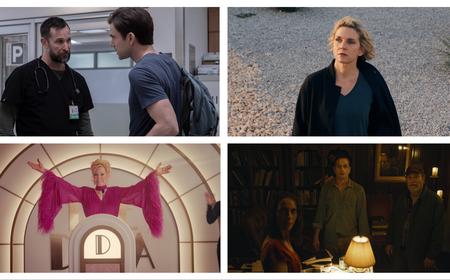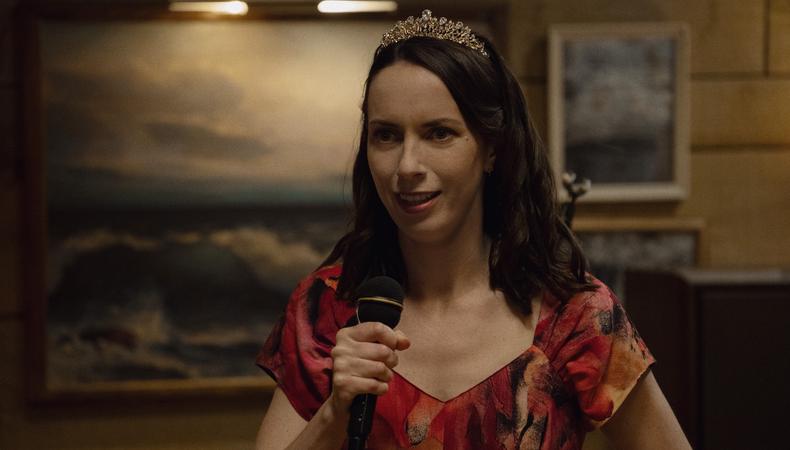
A seagull hurls itself at a glass phone booth in Alfred Hitchcock’s “The Birds,” and you find yourself bracing for the moment it finally breaks through. A tiara comes out at Patricia’s sunset cocktails on “Widow’s Bay,” and you know—somehow—that the punch bowl is a bad idea. We all know suspense when we see it (or feel it). But it should come as no surprise that well-executed suspense doesn’t happen by accident. If you want to master its elements, all you have to do is…read the rest of this article. If the wait is killing you, don’t worry: This will only take a few minutes.
At its core, suspense is the art of making the audience anticipate that something is about to happen. Beyond that, it can take on many different forms. Suspense doesn’t have a set duration: It can be built and resolved in a matter of minutes, or it can be sustained across an entire piece. And while the tension usually leaves audiences afraid that something negative (scary, stressful, or shocking) will occur, the payoff can be something else entirely. Suspense can also work as a misdirect—if you lead viewers to anticipate one thing, you can shock them with something else entirely. Although it’s a hallmark of the thriller and horror genres (and is sometimes considered a genre of its own), suspense can be found anywhere.
Key elements of successful suspense
- Exposition: To create suspense, you first have to establish a norm to deviate from. Once the audience is aware of the status quo, viewers can more easily identify what falls outside the ordinary.
- An unusual thing: Once you’ve established the world of the show or play, it’s time to introduce a disruption: anything mysterious, unexplained, potentially dangerous, or otherwise out of place. This can be achieved two ways—either by telegraphing to the audience that something is coming, unbeknownst to the characters, or by using the characters as stand-ins for the audience and revealing information to both simultaneously.
- Duration: Tension works best as a slow burn, so introduce these elements gradually. When ambiguity is paired with high stakes for the characters, it leaves audiences on the edges of their seats waiting to see what happens next.
- Resolution: If suspense isn’t resolved, the audience will feel confused at best and cheated at worst. The payoff usually arrives as a big reveal, where characters and viewers alike finally understand what’s going on and how it will be dealt with. To be clear, resolution doesn’t have to mean a happy ending. The tension simply needs to give way to some kind of conclusion, joyful or otherwise.
- Writers: Creating suspense is truly a group effort, but it’s hard to build any if the script doesn’t call for it. Writers looking to add suspense to their work should make sure the script includes all four of the elements listed above.
- Actors: Performance choices can make or break the illusion, though maybe not in the way you’d assume. Suspense always implies a high-stakes scenario for the character—but that doesn’t mean the character is always aware of it. The best thing performers can do is fully commit to their given circumstances, regardless of whether they’re generating the tension or existing outside of it.
- Directors: It’s a director’s job to oversee how the acting and writing come together, then adjust blocking, cinematography, and performance to strike the balance between revealing too much and too little—either of which can deflate the whole enterprise. Good directors know that audiences are smart: They read into everything, so every decision must be intentional.
- Designers: Intentional acting, writing, and directing form the foundation, but a talented design team can elevate it further. Dramatic lighting, atmospheric music, and unnerving sound effects all raise the temperature.
Alfred Hitchcock has often been called the master of suspense, so what better way to learn how all of the above comes together than from a film made by the master himself?
Consider the infamous shower scene from “Psycho” (1960).
Before it even begins, Hitchcock has worked hard to get the audience on edge: Marion Crane (Janet Leigh) is forced to stop at an isolated motel (the seediest of overnight options) because of a rainstorm (the most ominous of weather events), and she’s met the owner, Norman Bates (Anthony Perkins), a guy with a propensity for taxidermy (the creepiest of hobbies). Despite all that, the scene opens perfectly normally: Stripped of context, Marion is just taking a shower. Hitchcock cleverly lets the water run for the better part of a minute without a single unusual element—and when you know you’re watching a Hitchcock film, and therefore that something is bound to happen any second, that stretch of nothing multiplies the dread tenfold. The choice to withhold music from the top of the scene both accentuates the normalcy and somehow makes it creepier.
The second brilliant move comes shortly before the attack, when Hitchcock frames the closed shower curtain with Crane pushed to the far-right edge of the screen. The unusual composition catches the audience’s eye—but there’s nothing there. Then viewers are forced to watch the door open as someone walks painstakingly slowly toward the curtain, toward a blissfully unaware Crane. The longer it goes on, the tighter the screw turns. Suddenly, in a complete change of tempo, the curtain is flung back to reveal a figure with a knife. For the first time in the scene, music plays: the sound of shrieking violins.
Finally, the tension gives way to a horrific resolution as Crane is stabbed repeatedly by the mysterious figure. That moment is finished: We know somebody has killed her. But the overarching mystery of the film is still very much in progress. Who killed Crane? And why? And what exactly is going on at the Bates Motel?
Knowing what suspense is made of is one thing; building it yourself is another. Here’s how to put the pieces together, whether you’re writing the scene, staging it, or standing in it.
1. Establish the normal first.
Before you can break a pattern, the audience has to know there is one. Spend real time on the ordinary: the commute, the dinner, the small talk. Hitchcock gives us Marion Crane packing a suitcase and haggling over a room rate long before anyone picks up a knife. Resist the urge to signal that something’s coming—the mundane stretch should be doing structural work, not stalling.
2. Put the bomb under the table.
This is Hitchcock’s most quoted lesson, from his interviews with François Truffaut: Two people chat at a table. If a bomb goes off, you’ve given the audience a few seconds of shock. But if you show the audience the bomb first—and put a clock on the wall—that same dull conversation becomes unbearable for 15 minutes. Ask yourself what your audience knows that your characters don’t, then let viewers sit with it. Surprise is a moment; suspense is a state.
3. Stretch the wait past what’s comfortable.
Whatever length feels right, try going a little bit longer. In “No Country for Old Men” (2007), Anton Chigurh (Javier Bardem) spends several minutes at a Texaco counter needling a gas station proprietor (Gene Jones) about the weather, his bedtime, and a coin from 1958. No weapon is drawn, and no voice is raised, but the scene is agonizing precisely because the Coen brothers refuse to hurry it.
4. Play the scene, not the suspense.
In that same gas station coin-flip scene, Jones portrays a man trying to be polite to a difficult customer, not a man wracked by terror. Viewers supply the horror because they know what he doesn’t. If your character has no idea the stakes are life and death, then neither do you. Chase the objective in front of you and let the camera, the cut, and the score handle the rest.
5. Take something away.
Dread lives in the gap. When the mechanical shark on “Jaws” (1975) kept breaking down, Steven Spielberg was forced to suggest the animal instead of showing it: a POV shot skimming under a swimmer’s legs, a yellow barrel scudding across the surface, and composer John Williams’ iconic two-note theme. We don’t fully see the shark until well past the hour mark, and Spielberg has said the malfunction made the film. Let viewers fill the hole themselves; with proper setup, they’ll always build something worse.
6. Land the reveal—then decide what stays open.
Every stretch of tension has to break somewhere, or the audience feels cheated. But a resolution can close one question while opening a bigger one: The shower scene tells us Crane is dead and leaves us with who. Decide, deliberately, which thread you’re tying off and which one you’re handing the audience to carry into the next scene.