Learning how to perform the Swan of Avon is a skill in and of itself—just ask the likes of iconic Shakespearean actors like Anna Friel or Patrick Stewart. That's why finding the perfect comedic Shakespeare monologue for an audition is often a challenge, but a worthy one. If you want to find some of the Bard’s best banter and bawdiness, this guide has you covered.
JUMP TO
If you’ve already read our tips on how to perform a monologue by William Shakespeare, you know there’s a lot of humor to be mined from Will’s particular linguistic stylings. Being able to perform a Shakespearean monologue is an asset for any actor, because performing it well implies a deep understanding of complex material—something all directors and casting people are looking for in a performer.
It shows your range: Performing Shakespeare can sometimes feel like a rite of passage for actors. With the amount of contemporary monologues and options available, it’s easy to overlook classics—but doing so can be at your career’s peril. Being able to parse through Shakespearean English and get to the heart of its humor shows off skills that exist outside of the performance, such as research and emotional understanding. Context clues and nuance are easy to miss in Shakespeare, but when you nail it, it feels and looks so easy—and if you can make Shakespeare look easy, especially his comedy, you’re making a good impression.
They’re surprisingly malleable: Yes, they were written hundreds of years ago, but there’s something elemental at the heart of everything Shakespeare does that makes them ripe for reinterpretation and adaptation in different settings and time periods. Name a Shakespeare play, and you can probably find at least six different iterations that look wildly different from anything he and his acting company could have ever imagined. But that’s what makes Shakespeare so appealing, challenging, and beautiful to see performed well, particularly in a comedic context.

Christian Bertrand/Shutterstock
“As You Like It,” Act 3, Scene 5: Phoebe is insulted
Phoebe is perhaps a bit too proud (for a lowly shepherdess!) but completely relatable in her indignation. In this scene she is wrestling with the mixed feelings she has for “Ganymede” after he (aka Rosalind, who is dressed up/playing Ganymede) has insulted her, and the whole thing can be played to great comedic effect.
PHOEBE: Think not I love him, though I ask for him;
’Tis but a peevish boy; yet he talks well.
But what care I for words? Yet words do well
When he that speaks them pleases those that hear.
It is a pretty youth; not very pretty;
But sure he’s proud; and yet his pride becomes him.
He’ll make a proper man. The best thing in him
Is his complexion; and faster than his tongue
Did make offense, his eye did heal it up.
He is not very tall; yet for his year’s he’s tall.
His leg is but so so; and yet ’tis well.
There was a pretty redness in his lip,
A little riper and more lusty red
Than that mixed in his cheek; ’twas just the difference
Betwixt the constant red and mingled damask.
There be some women, Silvius, had they marked him
In parcels as I did, would have gone near
To fall in love with him; but, for my part,
I love him not nor hate him not; and yet
I have more cause to hate him than to love him;
For what had he to do to chide at me?
He said mine eyes were black and my hair black;
And, now I am rememb’red, scorned at me.
I marvel why I answered not again.
But that’s all one; omittance is no quittance.
I’ll write to him a very taunting letter,
And thou shalt bear it. Wilt thou, Silvius?
“A Midsummer Night’s Dream,” Act 3, Scene 2: Hermia’s quarrel
Hermia is in love with Lysander, but she’s being pursued by Demetrius, much to her friend Helena’s chagrin. In this scene, the lovers’ quarrel is getting increasingly tenuous—particularly between the two women—and as Hermia and Helena trade comedic barbs, you learn a ton about their characters and about the expectations placed upon women at the time (which is same as it ever was, it turns out).
HERMIA: Puppet? Why so? ay, that way goes the game.
Now I perceive that she hath made compare
Between our statures; she hath urged her height;
And with her personage, her tall personage,
Her height, forsooth, she hath prevail’d with him.
And are you grown so high in his esteem;
Because I am so dwarfish and so low?
How low am I, thou painted maypole? speak;
How low am I? I am not yet so low
But that my nails can reach unto thine eyes.
“The Taming of the Shrew,” Act 5, Scene 2: Is the shrew tamed?
This monologue has been interpreted in many different ways. It’s also angered many for what it seems to imply on the surface—namely that women must find happiness in obedience and acquiescence to men and husbands. However controversial its various interpretations can be, there’s plenty of humor to be mined in the way it is said—and the irony that comes upon realizing Katherine and Petruchio actually worked together to win the prize and that she hasn’t been “tamed” at all. This is the beauty of Shakespeare, is it not?
KATHERINE: Fie, fie! Unknit that threat’ning unkind brow
And dart not scornful glances from those eyes
To wound thy lord, thy king, thy governor.
It blots thy beauty as frosts do bite the meads,
Confounds thy fame as whirlwinds shake fair buds,
And in no sense is meet or amiable.
A woman moved is like a fountain troubled,
Muddy, ill-seeming, thick, bereft of beauty,
And while it is so, none so dry or thirsty
Will deign to sip or touch one drop of it.
Thy husband is thy lord, thy life, thy keeper,
Thy head, thy sovereign, one that cares for thee,
And for thy maintenance commits his body
To painful labor both by sea and land,
To watch the night in storms, the day in cold,
Whilst thou liest warm at home, secure and safe,
And craves no other tribute at thy hands
But love, fair looks and true obedience—
Too little payment for so great a debt.
Such duty as the subject owes the prince,
Even such a woman oweth to her husband.
And when she is froward, peevish, sullen, sour,
And not obedient to his honest will,
What is she but a foul contending rebel
And graceless traitor to her loving lord?
I am ashamed that women are so simple
To offer war where they should kneel for peace;
Or seek for rule, supremacy and sway
When they are bound to serve, love, and obey.
Why are our bodies soft and weak and smooth,
Unapt to toil and trouble in the world,
But that our soft conditions and our hearts
Should well agree with our external parts?
Come, come, you froward and unable worms!
My mind hath been as big as one of yours,
My heart as great, my reason haply more,
To bandy word for word and frown for frown.
But now I see our lances are but straws,
Our strength as weak, our weakness past compare,
That seeming to be most which we indeed least are.
Then vail your stomachs, for it is no boot,
And place your hands below your husband’s foot:
In token of which duty, if he please,
My hand is ready, may it do him ease.

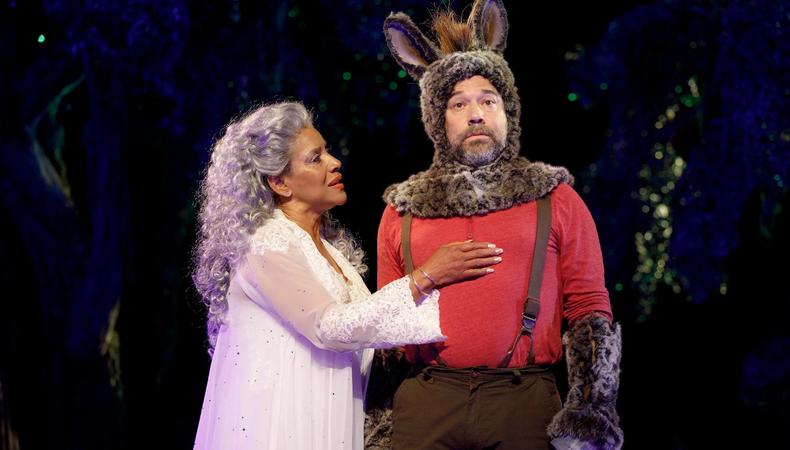
“Love’s Labor’s Lost” Credit: Brittany Diliberto/Folger Theatre
“A Midsummer Night’s Dream,” Act 2, Scene 1: Puck’s jest
When Robin Goodfellow—aka Puck—and the fairy meet, we are introduced to the humor and complexity of Puck, which can be expressed physically for comedic effect. Puck is a mischievous sprite with a playfully chaotic energy, which can be well performed in this monologue.
PUCK: Thou speak’st aright;
I am that merry wanderer of the night.
I jest to Oberon and make him smile
When I a fat and bean-fed horse beguile,
Neighing in likeness of a filly foal:
And sometime lurk I in a gossip’s bowl,
In very likeness of a roasted crab,
And when she drinks, against her lips I bob
And on her wither’d dewlap pour the ale.
The wisest aunt, telling the saddest tale,
Sometime for three-foot stool mistaketh me;
Then slip I from her bum, down topples she,
And ‘tailor’ cries, and falls into a cough;
And then the whole quire hold their hips and laugh,
And waxen in their mirth and neeze and swear
A merrier hour was never wasted there.
But, room, fairy! here comes Oberon.
“Much Ado About Nothing,” Act 4, Scene 2: Dogberry is an ass
Dogberry is a completely incompetent embarrassment to the profession of keeping the peace and upholding the law. In this speech, he’s realized that no one is there to write down that he’s an ass—something he’d just been called after barely getting confessions out of Borachio and Conrade. The speech is a great bit of comedy because it could be played physically large and camp, or completely grounded in his incompetent frustration.
DOGBERRY: Dost thou not suspect my place? dost thou not
suspect my years? O that he were here to write me
down an ass! But, masters, remember that I am an
ass; though it be not written down, yet forget not
that I am an ass. No, thou villain, thou art full of
piety, as shall be proved upon thee by good witness.
I am a wise fellow, and, which is more, an officer,
and, which is more, a householder, and, which is
more, as pretty a piece of flesh as any is in
Messina, and one that knows the law, go to; and a
rich fellow enough, go to; and a fellow that hath
had losses, and one that hath two gowns and every
thing handsome about him. Bring him away. O that
I had been writ down an ass!!
“Love’s Labour’s Lost,” Act 3, Scene 1: Moth’s romantic advice
Oh, Moth: What a pesky little thing you are! A member of the court and a page to Don Armado, Moth is an intelligent rapscallion who pokes fun and manipulates language to fantastically comedic effect. In this monologue, he explains to Don what it means to be a lover and how to get a woman to fall in love with him. The suggestions are, as one might expect, not exactly true.
MOTH: No, my complete master: but to jig off a tune at
the tongue’s end, canary to it with your feet, humour
it with turning up your eyelids, sigh a note and
sing a note, sometime through the throat, as if you
swallowed love with singing love, sometime through
the nose, as if you snuffed up love by smelling
love; with your hat penthouse-like o’er the shop of
your eyes; with your arms crossed on your thin-belly
doublet like a rabbit on a spit; or your hands in
your pocket like a man after the old painting; and
keep not too long in one tune, but a snip and away .
These are complements, these are humours; these
betray nice wenches, that would be betrayed without
these; and make them men of note—do you note
me?—that most are affected to these.