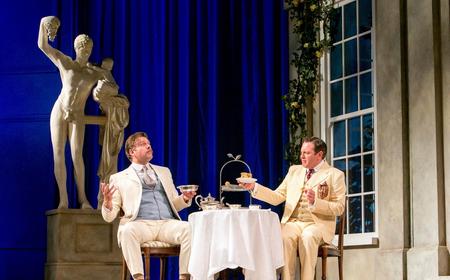
"Getting and Spending" a Lifetime
Actor David Rasche comes from a long line of ministers; indeed, he attended divinity school himself. So the religious calling his character Richard O'Neill experiences in "Getting and Spending" is almost in his genes, he admits.
"I can tap into it, but I don't think you need that [theological] background. Many people understand that to find your life you have to give it up. Actors understand it. Acting is not about gritting your teeth, but relaxing and letting it happen. And, like prayer, acting is a leap of faith. Actors have to believe that what they're doing is going to make life better, not just for themselves, but for those who come to the theatre."
"Getting and Spending," slated to open on Broadway at the Helen Hayes Theatre on Oct. 25, is a light-hearted morality tale, examining the complicated interconnection between good deeds and self-serving ploys. The story centers on a clash (translation: romance) between an investment banker (Linda Purl) accused of insider trading and the high-powered attorney (Rasche) who defends her. The catch: He has already turned his back on law to live in a monastery when she surfaces, seducing him into representing her. Torn, he leaves the brotherhood to take on the case, which in turn becomes a multi-leveled test for both characters as they battle the prosecution, each other, and their own inner demons.
"The title of Michael J. Chepiga's play, taken from the Wordsworth poem, says it all," Rasche says, pointing to the work's theme. "In "getting and spending we lay waste to our powers.' Richard is a successful man, but something is missing. Yes, he's constantly fighting injustice, but his actions are in large part based on the needs of his ego. At the end he says, "I didn't do anything for truth and justice.' That's not entirely true, but in some ways he's like Jimmy Carter who does a lot of good, but he's irked when he doesn't get the Nobel Prize. Richard's decision to reenter the monastery is prompted by his desire to be in a place where his ego won't ruin him."
The likeable 50-something St. Louis native with whom we met in his dressing room, is a veteran actor in all media. He is best known for his portrayal of the jerk cop "Sledge Hammer," ABC's 1987 sitcom that sent up TV detective shows of an earlier era. Rasche has a host of movie credits under his belt and was most recently seen in New York theatre as the title character in David Mamet's "Edmund." Like the part of Richard O'Neill, Edmund takes a spiritual journey, although it's more harrowing, depicting a man's moral and emotional disintegration, followed by his spiritual redemption.
Playing Edmond was the most daunting role he ever tackled, Rasche says. The character's depth and especially David Mamet's language‹abrupt stops, starts, and repetitions‹required special skills. "Whenever I work on a Mamet play, I learn the lines at least a month before rehearsal. Mamet's language is not about sense, but rather sound. You can't think when you're speaking his lines. You just have to go with it."
Very much "an actor's actor," Rasche is eager to talk about a play's demands. Of "Getting and Spending," he says, "The dialogue is spare and moves quickly. In one speech, there are blowups and prayers. And understanding what this man does‹gives up the only woman he ever loved‹is not simple to nail down."
Rasche is easygoing. He has no philosophical or esthetic axes to grind; he makes it clear he'll cheerfully perform wherever. And he's refreshingly modest, noting the element of "coincidence" in an actor's life. "You don't ask why. There are no whys."
Looking for Answers
Rasche was brought up in Belleville, Ill., the son of‹as noted‹a minister. "My childhood was as normal as can be," he recalls. "Except that my father was God!" Deadpan delivery punctuated by a chortle. Rasche graduated from Elmhurst College, affiliated with the United Church of Christ, in Illinois, and then earned a Masters degree in English from the University of Chicago, briefly serving as an English teacher at Gustavus Adolphus College in St. Peter, Minn. A stint at the University of Chicago Divinity School was next. "I was looking for a retreat, a place to figure out what I wanted. Divinity school was the wrong place for that. They're teaching those who believe, not those who are still questioning." Indeed, two years into the program he was politely told by the administration, ""We think you'd be happier someplace else.' And they were right."
What changed the course of Rasche's life was listening to Nichols and May records, which were hot at the time. "I wanted to be Mike Nichols. I felt if only I could do that..." his voice trails off. Within short order, Rasche had hooked up with Second City and was an active member of the touring company for two years. Later, in New York, he honed his skills further, studying with Wynn Handman, William Esper, and Stella Adler.
"All of the training was useful," he maintains. "Wynn taught me how to handle a written text and what it meant to be successful as an actor. When you got it right, he'd say, "That's it. Now remember what that feels like.' Bill Esper, who used a Meisner approach, emphasized the importance of listening on stage. Both Esper and Adler talked about the value of knowing the character's daydreams. Stella had us do an exercise, "Men in White.' We'd play doctors and have to imagine and describe 25 things on our desk.
"Yes, I do find that kind of exercise useful," Rasche stresses, "It's grounding. That doesn't mean it's good for everybody. As Wynn use to say, "Whatever works. If singing the "Star Spangled Banner' before you go on helps, do it. If it's figuring out what the character had for breakfast, then that's what you should do.' "
Rasche concedes that there are still acting problems he has not yet mastered. "A common pitfall is self-pity. I don't mean for myself, but for the character I'm playing. It's the first emotion many of us go to."
He has penned two one-act plays, both centering on agents. "I find them a curiosity. They're in this funny middle position. They don't write, direct, or produce, yet they're an important part of the industry. For some agents, many of whom are very isolated, clients are their family."
"Jackie," Rasche's first play, details the unraveling of a talkative‹non-stop chattering‹agent. His second, "The Meeting," focuses on an encounter between an agent and his unemployed actor client. "It deals with that inexplicable theatre situation where some actors work and others don't and nobody can really say why." (Check out Rasche's comment above on actors asking why?)
Currently, Rasche's attention is on "Getting and Spending" and the human conundrums the play brings to light. "You have two people who love each other so much they are willing to say goodbye for a greater good. Interestingly, Victoria [Purl] doesn't have to give Richard up. He says, "I will go with you if you want me to.' I don't think he's taking the burden off himself, secretly hoping she'll say, "Come!' He wants her to see that going their separate ways is the best thing for them to do."
Still, these are debatable questions, Rasche says, remarking, "If you accept the idea that theatre is about what it means to be human, then surely this play is part of that discussion. " q
PULL-QUOTE: "Like prayer, acting is a leap of faith."