From the Danish prince’s existential philosophizing to Ophelia’s devastating break from reality, Shakespeare’s “Hamlet” is a gold mine of powerful speeches—the brooding titular character alone gives seven soliloquies. We rounded up 10 of the play’s very best monologues and soliloquies on drama, vengeance, and mayhem that make it a dream (ay, there’s the rub!) for audition material.
1. The Ghost: Act 1, Scene 5
It doesn’t take long for the plot of “Hamlet” to get wild. We’re teased about the existence of Hamlet’s father’s ghost throughout the beginning of the play—a supernatural presence made even spookier when he starts demanding retribution. He appears at the end of the first act, revealing that he died not from natural causes but from murder (by his own brother!), and he begs Hamlet to avenge his death.
This speech is commanding, foreboding, and crucial, setting the entire plot of the play in motion. It also gives the actor a lot of agency: How ghost-like do they want to go? Is Hamlet’s father a literal chain-rattling ghost or more akin to a figment of Hamlet’s troubled and grieving imagination? Though we’ve listed a manageable portion here, the entire speech is quite long, spoken in its entirety in the play with only a few brief interjections from Hamlet. If you ever find yourself needing to take on a ghastly (get it?) long speech, this one may prove both rewarding and impressive.
I am thy father’s spirit,
Doom’d for a certain term to walk the night,
And for the day confin’d to fast in fires,
Till the foul crimes done in my days of nature
Are burnt and purg’d away. But that I am forbid
To tell the secrets of my prison house,
I could a tale unfold whose lightest word
Would harrow up thy soul, freeze thy young blood,
Make thy two eyes, like stars, start from their spheres,
Thy knotted and combined locks to part,
And each particular hair to stand on end
Like quills upon the fretful porcupine.
But this eternal blazon must not be
To ears of flesh and blood. List, list, O, list!
If thou didst ever thy dear father love—
Revenge his foul and most unnatural murther.
Murther most foul, as in the best it is;
But this most foul, strange, and unnatural.
I find thee apt;
And duller shouldst thou be than the fat weed
That rots itself in ease on Lethe wharf,
Wouldst thou not stir in this. Now, Hamlet, hear.
’Tis given out that, sleeping in my orchard,
A serpent stung me. So the whole ear of Denmark
Is by a forged process of my death
Rankly abus’d. But know, thou noble youth,
The serpent that did sting thy father’s life
Now wears his crown.
2. Ophelia: Act 2, Scene 1
In this monologue, a frantic Ophelia describes Hamlet’s odd behavior to her father. In the contemporary acting world, we’re usually told to avoid story monologues—but in the land of Shakespeare, a lot of the action happens offstage. Ophelia’s speech gives an actor the opportunity to use Shakespeare’s words to paint a vivid picture of a disheveled Hamlet who, essentially, appears, grabs her, studies her, and leaves.
O my lord, my lord, I have been so affrighted!
My lord, as I was sewing in my closet,
Lord Hamlet, with his doublet all unbrac’d,
No hat upon his head, his stockings foul’d,
Ungart’red, and down-gyved to his ankle;
Pale as his shirt, his knees knocking each other,
And with a look so piteous in purport
As if he had been loosed out of hell
To speak of horrors—he comes before me.
He took me by the wrist and held me hard;
Then goes he to the length of all his arm,
And, with his other hand thus o’er his brow,
He falls to such perusal of my face
As he would draw it. Long stay’d he so.
At last, a little shaking of mine arm,
And thrice his head thus waving up and down,
He rais’d a sigh so piteous and profound
As it did seem to shatter all his bulk
And end his being. That done, he lets me go,
And with his head over his shoulder turn’d
He seem’d to find his way without his eyes,
For out o’ doors he went without their help
And to the last bended their light on me.
3. Hamlet: Act 2, Scene 2
Here, Hamlet explains (or attempts to explain) his feelings to his friends Rosencrantz and Guildenstern, who have just admitted they were summoned by the king and queen to check on him. It’s a bit of a spiritual precursor to the more well-known “To be, or not to be” speech (but more on that later). Hamlet wrestles with his attitude toward the world. He’s depressed and disillusioned, and though we as an audience know why that might be, his friends certainly don’t. This is a good pick if you want to explore Shakespeare’s flowery language without the confines of prose, and take on a speech with relatively lower stakes—it’s merely a confession between friends. Also, if you’re in a pinch for a memorized piece, fans of the musical “Hair” may realize that they already know most of the words to this one.
I will tell you why. So shall my anticipation
prevent your discovery, and your secrecy to the king
and queen moult no feather. I have of late—but
wherefore I know not—lost all my mirth, forgone all
custom of exercises; and indeed it goes so heavily
with my disposition that this goodly frame, the
earth, seems to me a sterile promontory, this most
excellent canopy, the air, look you, this brave
o'erhanging firmament, this majestical roof fretted
with golden fire—why, it appeareth no other thing to
me than a foul and pestilent congregation of vapours.
What a piece of work is a man! how noble in reason!
how infinite in faculties! in form and moving how
express and admirable! in action how like an angel!
in apprehension how like a god! the beauty of the
world, the paragon of animals! And yet, to me,
what is this quintessence of dust? Man delights not
me—no, nor woman neither, though by your smiling
you seem to say so.
4. Hamlet: Act 3, Scene 1
It’s impossible to talk about “Hamlet” monologues (or, let’s be honest, Shakespeare monologues) without bringing up “To be, or not to be,” easily the play’s most famous. It’s prominent for a reason: In the memorable and powerful speech, Hamlet debates his own will to live, pondering whether or not the unknowns of death are scarier than the realities of living. It can be rewarding to take on some of Shakespeare’s best work, but with great recognizability comes great responsibility. You’ll have to find a way to make your interpretation stand out among dozens of brilliant takes, including from Kenneth Branagh, Richard Burton, Andrew Scott, and David Tennant.
To be, or not to be—that is the question:
Whether ’tis nobler in the mind to suffer
The slings and arrows of outrageous fortune
Or to take arms against a sea of troubles,
And by opposing end them. To die—to sleep—
No more; and by a sleep to say we end
The heartache, and the thousand natural shocks
That flesh is heir to. ’Tis a consummation
Devoutly to be wish’d. To die—to sleep.
To sleep—perchance to dream: ay, there’s the rub!
For in that sleep of death what dreams may come
When we have shuffled off this mortal coil,
Must give us pause. There’s the respect
That makes calamity of so long life.
For who would bear the whips and scorns of time,
Th’ oppressor’s wrong, the proud man’s contumely,
The pangs of despis’d love, the law’s delay,
The insolence of office, and the spurns
That patient merit of th’ unworthy takes,
When he himself might his quietus make
With a bare bodkin? Who would these fardels bear,
To grunt and sweat under a weary life,
But that the dread of something after death—
The undiscover’d country, from whose bournNo traveller returns—puzzles the will,
And makes us rather bear those ills we have
Than fly to others that we know not of?
Thus conscience does make cowards of us all,
And thus the native hue of resolution
Is sicklied o’er with the pale cast of thought,
And enterprises of great pith and moment
With this regard their currents turn awry
And lose the name of action.—Soft you now!
The fair Ophelia!—Nymph, in thy orisons
Be all my sins rememb’red.
5. Hamlet: Act 3, Scene 1
This scene is full of monologues that practically appear back to back to back. After Hamlet delivers his “To be, or not to be” speech, Ophelia appears, attempting to return several gifts Hamlet has given her. This enrages him, and he tells her he never loved her. He then unleashes this speech, insulting her, her entire gender, and eventually the concept of marriage and childbearing as a whole. If you’re looking for a fiery Shakespeare monologue, this is it. Side note: The use of “nunnery” here appears to be a double entendre, as in Shakespeare’s time it could be in reference to a convent or a brothel. Either way…ouch.
Get thee to a nunnery! Why wouldst thou be
a breeder of sinners? I am myself indifferent honest,
but yet I could accuse me of such things that it
were better my mother had not borne me. I am
very proud, revengeful, ambitious; with more offenses
at my beck than I have thoughts to put them
in, imagination to give them shape, or time to act
them in. What should such fellows as I do crawling
between earth and heaven? We are arrant knaves
all; believe none of us. Go thy ways to a nunnery.
If thou dost marry, I’ll give thee this plague
for thy dowry: be thou as chaste as ice, as pure as
snow, thou shalt not escape calumny. Get thee to a
nunnery. Go, farewell. Or if thou wilt needs marry,
marry a fool; for wise men know well enough what
monsters you make of them. To a nunnery, go; and
quickly too. Farewell.
I have heard of your paintings too, well
enough. God hath given you one face, and you
make yourselves another. You jig, you amble, and
you lisp; you nickname God’s creatures and make
your wantonness your ignorance. Go to, I’ll no
more on’t. It hath made me mad. I say we will have
no more marriage. Those that are married already—
all but one—shall live. The rest shall keep as they are.
To a nunnery, go.
6. Ophelia: Act 3, Scene 1
The third of the Act 3, Scene 1 monologues on this list comes directly after the second. Ophelia opines the sudden change in Hamlet, as the man who she once considered intelligent and caring has callously insulted and disregarded her. Another of Shakespeare’s more famous monologues, this one can pack a lot of range into a short and sweet package, allowing an actor to explore Ophelia’s conflicted feelings as she compares the man she believed Hamlet to be with the one standing in front of her.
O, what a noble mind is here o’erthrown!
The courtier’s, scholar’s, soldier’s, eye, tongue, sword,
Th’ expectancy and rose of the fair state,
The glass of fashion and the mould of form,
Th’ observ’d of all observers—quite, quite down!
And I, of ladies most deject and wretched,
That suck’d the honey of his music vows,
Now see that noble and most sovereign reason,
Like sweet bells jangled, out of tune and harsh;
That unmatch’d form and feature of blown youth
Blasted with ecstasy. O, woe is me
T’ have seen what I have seen, see what I see!
7. Claudius: Act 3, Scene 3
For the first time, King Claudius expresses deep remorse for slaying his brother. He appears consumed by guilt—although is it true guilt or simply grief at the prospect of harm due to Hamlet’s madness? This delicate balance makes it a potent choice for anyone who wants to explore anguish and regret within the world of Shakespeare.
O, my offence is rank, it smells to heaven;
It hath the primal eldest curse upon’t,
A brother’s murther! Pray can I not,
Though inclination be as sharp as will.
My stronger guilt defeats my strong intent,
And, like a man to double business bound,
I stand in pause where I shall first begin,
And both neglect. What if this cursed hand
Were thicker than itself with brother’s blood,
Is there not rain enough in the sweet heavens
To wash it white as snow? Whereto serves mercy
But to confront the visage of offence?
And what’s in prayer but this twofold force,
To be forestalled ere we come to fall,
Or pardon’d being down? Then I’ll look up;
My fault is past. But, O, what form of prayer
Can serve my turn? ’Forgive me my foul murther’?
That cannot be; since I am still possess’d
Of those effects for which I did the murther—
My crown, mine own ambition, and my queen.
May one be pardon’d and retain th’ offence?
In the corrupted currents of this world
Offence’s gilded hand may shove by justice,
And oft ’tis seen the wicked prize itself
Buys out the law; but ’tis not so above.
There is no shuffling; there the action lies
In his true nature, and we ourselves compell’d,
Even to the teeth and forehead of our faults,
To give in evidence. What then? What rests?
Try what repentance can. What can it not?
Yet what can it when one cannot repent?
O wretched state! O bosom black as death!
O limed soul, that, struggling to be free,
Art more engag’d! Help, angels! Make assay.
Bow, stubborn knees; and heart with strings of steel,
Be soft as sinews of the new-born babe!
All may be well.
8. Ophelia: Act 4, Scene 5
Even if you’ve never read or seen “Hamlet,” you likely know that Ophelia loses her mind before her untimely end. In this monologue, a bereaved Ophelia—traumatized by Hamlet and mourning the death of her father—passes out imaginary flowers as her horrified brother, Laertes, looks on. While actors should take care to keep things grounded and not too cartoon-y or broad, it can be a fun challenge to take on a character described by others as “mad,” and can be captivating and heartbreaking if well-executed.
There’s rosemary, that’s for remembrance. Pray you, love, remember. And there is pansies, that’s for thoughts. There’s fennel for you, and columbines. There’s rue for you, and here’s some for me. We may call it herb of grace o’ Sundays. O, you must wear your rue with a difference! There’s a daisy. I would give you some violets, but they wither’d all when my father died. They say he made a good end.
[Sings]
For bonny sweet Robin is all my joy.
And will he not come again?
And will he not come again?
No, no, he is dead;
Go to thy deathbed;
He never will come again.
His beard was as white as snow,
All flaxen was his poll.
He is gone, he is gone,
And we cast away moan.
God ’a’mercy on his soul!
And of all Christian souls, I pray God. God b’ wi’ you.
9. Gertrude: Act 4, Scene 7
Though Ophelia’s death is…iconic, for lack of a better word, we never actually see it onstage; instead it’s described vividly in this monologue from Queen Gertrude. It’s heartbreakingly beautiful, with vivid imagery and Shakespeare’s signature illustrative prose. Though anyone could feasibly take this one on, it’s also worth noting that this is the sole inclusion on this list written for a mature female character; these roles are generally outnumbered by ingenues in Shakespeare’s works.
One woe doth tread upon another’s heel,
So fast they follow. Your sister’s drown’d, Laertes.
There is a willow grows aslant a brook,
That shows his hoar leaves in the glassy stream.
There with fantastic garlands did she come
Of crowflowers, nettles, daisies, and long purples,
That liberal shepherds give a grosser name,
But our cold maids do dead men’s fingers call them.
There on the pendant boughs her coronet weeds
Clamb’ring to hang, an envious sliver broke,
When down her weedy trophies and herself
Fell in the weeping brook. Her clothes spread wide
And, mermaid-like, awhile they bore her up;
Which time she chaunted snatches of old tunes,
As one incapable of her own distress,
Or like a creature native and indued
Unto that element; but long it could not be
Till that her garments, heavy with their drink,
Pull’d the poor wretch from her melodious lay
To muddy death.
10. Hamlet: Act 5, Scene 1
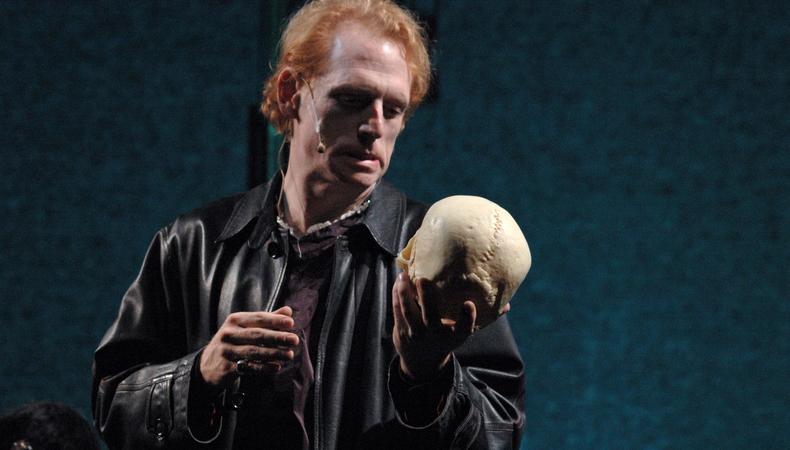
In the final act of the play, Hamlet comes across a gravedigger. One of the skulls he’s uncovered during his dig is that of Yorick, a man who was the court jester when Hamlet was a child. In this monologue, Hamlet reflects on his once-jolly friend who has become (literally) a shell of his former self. Aside from “To be, or not to be,” this has to be the play’s most iconic sequence (again, even if you don’t know the Danish prince, you’ve surely seen images of him pondering a skull). It’s a great choice if you want something a little less intimidating than the former, but just as deep: It drives home similar themes of life versus death and what it means to have been alive.
Alas, poor Yorick! I knew him, Horatio. A fellow
of infinite jest, of most excellent fancy. He hath
borne me on his back a thousand times. And now how
abhorred in my imagination it is! My gorge rises at
it. Here hung those lips that I have kiss’d I know
not how oft. Where be your gibes now? your
gambols? your songs? your flashes of merriment
that were wont to set the table on a roar? Not one
now, to mock your own grinning? Quite chap—fallen.
Now get you to my lady’s chamber, and tell her, let
her paint an inch thick, to this favour she must
come. Make her laugh at that.