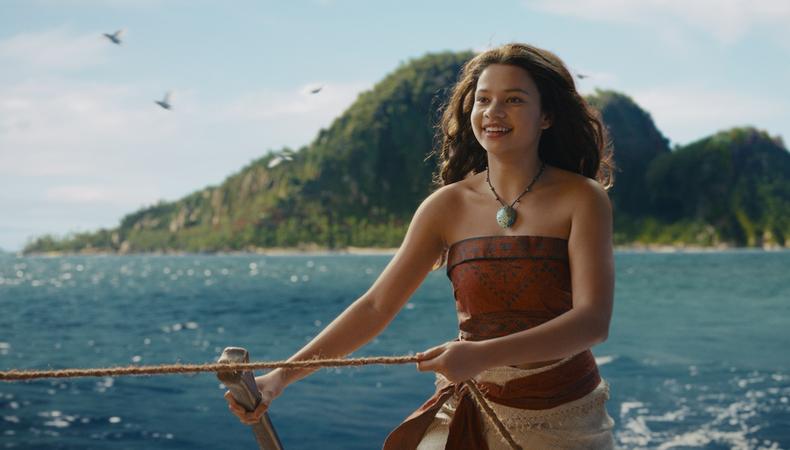
A decade after Auli’i Cravalho answered the ocean’s call to voice the titular Polynesian protagonist in Disney’s animated film “Moana” (2016), newcomer Catherine Laga’aia stepped—or shall we say rowed—into the role for Thomas Kail’s live-action adaptation, out July 10.
Laga’aia, an Australian actor of Samoan descent, sat down with us to talk about honoring Cravalho’s performance and their shared Pacific Islander heritage, retaining humanity in the face of fame, and the silliest moments on set.
How did you balance adapting a beloved character while still making the role your own?
Auli’i created such a strong character in what she developed in 2016 that there’s no way you can really shake that up and change it heaps, because it’s so embedded into the way the character acts and what motivates her. Something great about our story is that we haven’t changed any of that—it’s all been maintained. So our two characters are hopefully quite alike. I hope people can see a lot of similarities between what I did and what she did, because that truly was my inspiration. I used to watch the film, and I’d watch the pieces we were going to shoot the night before and think, “OK, that’s a good baseline to work off of.”
What was your emotional throughline into the character?
I related to her a lot, in the sense that she was in a situation she’d never been in before, working with all these people she’d never met—especially this elusive demigod she’s heard stories about her whole life but never thought she’d interact with. And all in a new setting, far from home. That resonated with me a lot, being so far from Australia.
What did you learn from working with such an iconic cast?
I learned a lot from Frankie [Adams, who portrays Moana’s mother, Sina]. I’d played the younger version of her on a show before [2023’s “The Lost Flowers of Alice Hart”], and on this one we played mother and daughter. [Director] Tommy [Kail] was like, “I found these two people who look exactly alike. It’s crazy.” Then we met each other and went, “Oh no, somebody’s thought of this before—this is old news that we look so similar.” I learned a lot from her on how to be myself on set and not change for anything. She’s so unapologetically herself, and that’s what really draws people to her. She’s so funny and light that I looked toward her like an older sister.
Do any behind-the-scenes moments particularly stand out to you?
Tommy was always trying to keep the set light. When you finish a shot, you bring in the VFX balls and charts, and the villagers figured out that meant the shot was done and they didn’t have to do anything anymore, so they’d start clapping and get really into it. You’d hear, “Calling balls and charts,” and the whole village would go crazy because they thought they were done for the day—even though there were shots left. In true Tommy Kail fashion, that turned into musical theater songs. We started adapting all these different songs—not even just musical theater, but old pop and rock hits—into numbers about Moana, about balls and charts, and they would play at the end of each shot. I was so in my own head most of the time that I’d think, “I recognize this is funny, but I’m really locked in right now, guys.”
What was your vocal training like?
The singing was very intense. I grew up singing in choirs, but I was never the biggest fan; my siblings were better than me, so I kind of took a back seat. Stepping into Moana, I was in singing lessons every two days, and it got more rigorous once I got to the States in May 2024, when I was doing them pretty much every day, drilling these songs, because they’re not easy. I was just with [Cravalho] the other day, and she agreed that they were not easy, and I was like, “Thank you. You’re the only other person who can be with me on this.”
How about the physical demands of the role?
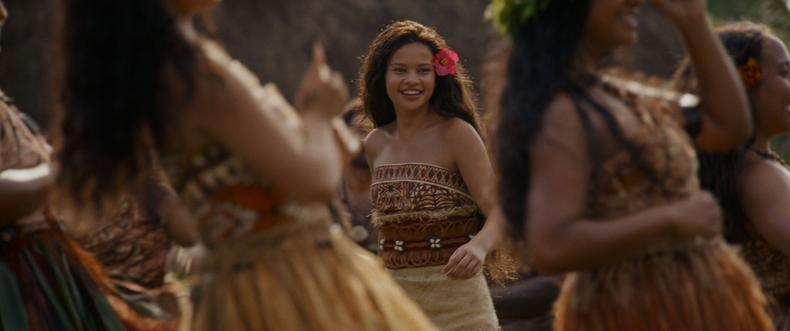
It was stunting, sailing, dancing, all packed into one. Tommy told me multiple times, “This is the hardest thing you’ll probably do; after this, everything else will be a piece of cake.” I did a lot of underwater and swimming training, and I learned how to use a sail and row the traditional va‘a canoes. I spent three days in an actual canoe in Hawaii with the [Polynesian] Voyaging Society, out on the water learning to sail it. I learned a lot of different styles of dance, too, with our choreographers. Everything was thrown at me.
What was it like working with your stunt doubles?
I had a couple, and I was obsessed with them—again, like cool older sisters. It was so funny because they truly looked exactly like me from the back; then you turn around and we’re three different ethnicities. I also got very close to my stand-in. All of the Moanas [being] on set was the best time for me. I watch bits of the movie and go, “I know that’s not me, because that person is ripped.”
What did a typical shoot day look like?
Some ridiculously early pickup—maybe 6 a.m. I’d roll out of bed, get in the car, and be in hair and makeup for about two hours to get the wig on. Then the costume would go on, and we’d usually shoot anything that was solo Moana in the morning. I’d shoot something, go to school for 30 minutes, shoot something, go to school for 30 minutes. Then we’d have lunch, and I’d work with [Dwayne Johnson, who plays Maui] for the rest of the day. Because of how the movie is, about 90% of it was just on a boat, staring at this nothingness of blue with this beautiful, completely finished canoe.
You come from a family of performers. Did they give you advice that stuck with you?
A big one from my dad [actor Jay Laga‘aia] was just to say hello and good morning to everyone. It’s such a simple thing, but you have to put yourself on the same level as everyone else. He was adamant: “You’re not better than anybody else. Who are you to think you’re bigger than anybody else?” When people are doing so many things for you, and you’re getting all this smoke blown at you, the last mentality you want to pick up is that you’re the greatest who ever lived, because then you lose all sense of being a person. How would I ever play a character who’s so down-to-earth if I was so unbelievably up myself?
You’ve spoken about how important your heritage is to you. How did that connection inform your choices day to day?
I stressed a lot about hoping it was a genuine, accurate representation of my culture and where I come from. One of the coolest things about Moana is that she isn’t from anywhere specific—she’s not Samoan [like me]; she’s not Hawaiian like [Cravalho]. She just represents the Pacific Islands. We do so many different styles of dance, and so many aspects of different cultures are woven into the village. But the key parts of growing up Pacific Islander are your family and where you come from. So a big thing that sat on Moana’s chest was leaving her family behind, disobeying her father, going out on a limb not knowing what she was heading into—leaving her island, her home, everything she’s ever known. Constantly feeling the weight of that, and knowing what you’re sacrificing if you don’t succeed, was a big thing I was thinking about.
What was the most challenging scene to film?
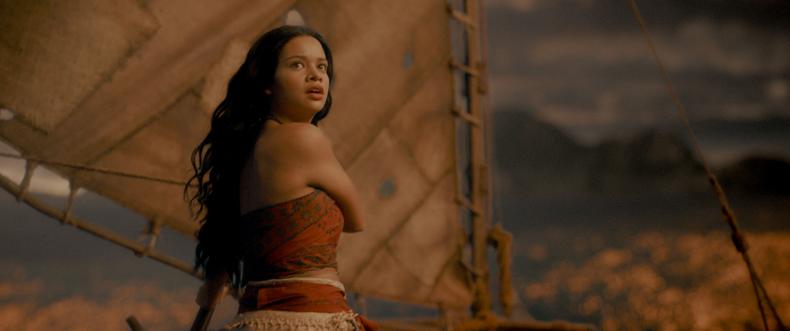
The most challenging was when Maui leaves Moana, right as she thinks they’ve got it. She goes from 100 to 0—knocked off that pedestal, falling so far. You don’t see that with her often; she’s usually upbeat and knows what she needs to do. But in that moment she has absolutely nothing to stand on. We shot it so many times—take after take of this release of energy, with her screaming. That was at the end of the day, so it was physically tiring. That one was probably the hardest to film.
A lot of your scenes are solo. What is that like as an actor?
It makes you feel a little crazy, because you’re having these huge conversations. Especially when [Moana] is talking to the chicken or fighting the Kakamora, who aren’t really there, so you’re doing your big monologue to almost nothing. The weirdest ones are anything with Heihei, because you get nothing back except somebody in the background making a chicken noise. By the time we shot the scenes, I’d been staring at the blue [screen] for so long that I’d lost all concept that it was just a shade of fabric. I daydream heaps. I zone my eyes out and feel like I’m in a different place, which really helps you separate where you are from where Moana would really be looking.
Did you find yourself talking to yourself more after filming?
Oh, yeah. I’d go home and have full conversations with myself. What I really picked up was that I now narrate everything I do: “All right, I’ll probably stand up in 10 minutes, then go to the kitchen.” No one’s there, just me running it through in my head. I’m dictating my own life, and nobody cares, and I’m probably not going to do the things I’m saying, but I’m putting them out there in the world.
What’s your best advice for someone hoping to follow a path like yours?
I feel like I’m [standing] in their shoes a little, because I feel so brand new to all of this. There’s a lot of pressure to adapt into something else, to change yourself. I have no proof of this, but I feel it in my soul: Being myself and bringing my own version of Moana is what got me the job. I see clips of Tommy talking about the casting process, and the way they describe it is that I felt real. That’s the feeling I’m trying to emulate—not creating this huge distance between me and my character, but trying to meld us as one, because the easiest person to be is yourself. That’s when it comes the most naturally.
Do you have any guardrails for staying true to yourself?
People around me will let me know. Especially when you come off set, you go, “How much have I changed?” I’ve adapted this idea of combining myself with my characters. But there are situations where you need to be totally different, so I guess it depends on what you’re looking at.
Last one—what are you watching right now?
What I’m hanging out for is “The Testaments.” I’m obsessed with that show. All of those girls are incredible in it, and there’s such a cool, powerful message behind it. It’s led me back to “The Handmaid’s Tale,” too. Those two are running on repeat in my brain.
This interview has been edited for clarity and length.