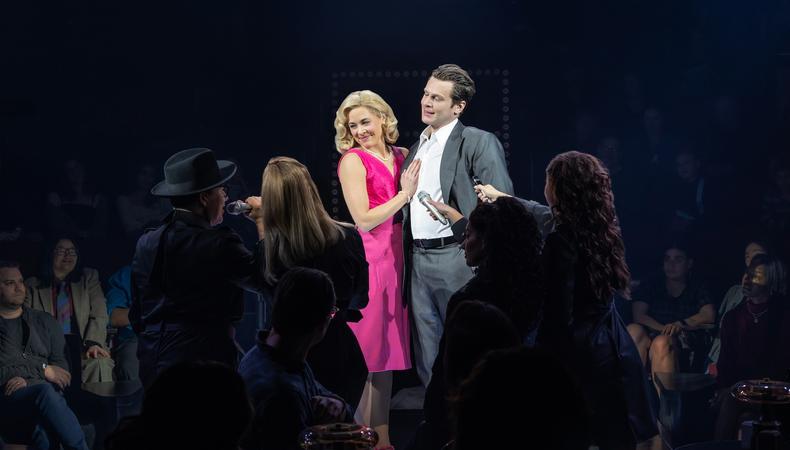
In Warren Leight and Isaac Oliver’s new Broadway musical “Just in Time,” Jonathan Groff portrays famed ’50s crooner Bobby Darin—but the Tony Award–winning actor doesn’t just perform at the audience seated cabaret-style in Circle in the Square Theatre. Just like the “Dream Lover” singer himself, Groff interacts with members of his crowd, twirling, dipping, and even offering a peck on the hand. In other words, he’s performing acts of intimacy—which is why director Alex Timbers and production enlisted intimacy director Leigh Zimmerman.
Here, 35-year stage veteran Zimmerman discusses the ways she helps empower actors physically. Whether you’re working on Broadway or in your local theme park, her advice can help you never fear the words “audience participation” again.
How did you come to work on “Just in Time,” and what do you do for the show?
“Just in Time” involves a lot of audience interaction. Having danced my whole life, I understand the power of body language and eye contact—core elements of intimacy work. The team brought me on to help navigate this immersive experience and ensure the actors felt confident. I try to avoid the word “safe,” because safety is subjective. Instead, we aim to create a brave space where everyone feels empowered to engage with the audience.
Can you walk through the specifics of how you work with the cast?
Once hired, I went through the script and created a spreadsheet of moments that might need support. Unlike traditional scenes with clear intimacy direction—like kisses, embraces, and slaps—this show also involved the cast moving through the audience, the aisles, exiting and entering among them. So I sat in rehearsal, imagining the audience experience. I noticed things like chair placement, table spacing, and what happens when a prop is on someone’s table. Eye contact is powerful. That’s an intimate moment. And in this immersive setting, it becomes even more crucial. We worked on how to physically cue the audience: “May I take your hand?” without saying a word. Sometimes people say no—and that’s OK. Jonathan is great at adapting. He’ll just say, “Great, I’ll sing to you instead.”
Many actors will eventually find themselves in a job that involves some form of audience interaction. What are a few of your general tips?
First, command your own body language and eye contact. Remember: You’re in control. The audience doesn’t know what’s coming—you do. You can signal how much engagement you want through physical cues. I also talk to actors about reading body language. If someone’s leaning forward eagerly and you’re not feeling up to that level of interaction tonight, skip them. Go to someone who’s more neutral. We’re always scanning for safety and cues, consciously or not. You can also signal: “We’re starting now,” “This moment is ending now.” Build a little playbook of physical vocabulary.
Did you work with Jonathan on a playbook for “Just in Time”?
Yes and no. Jonathan is a great example—he’s very open, but he still has his own boundaries. He reads the audience in the moment and decides what he’s comfortable with that day. Some actors can take on a lot of interaction, others prefer less. That’s why I always encourage actors to check in with themselves over time. If the interaction starts to feel like a burden—or if it energizes them—that matters. I check in with Jonathan all the time, and he’s like, “I love this.”
What is the No. 1 piece of advice you’d give actors when it comes to intimacy direction?
Intimacy work is about more than physicality. It’s emotional. It’s about checking in with yourself: “Does this still feel right?” If it doesn’t, speak up. That’s not being needy—that’s being responsible. Creative teams can’t read your mind. We want to help you perform at your peak. So take stock, and advocate for what you need.