If you’ve never heard the word peripeteia, don’t stress—you’re not the only one who missed that vocab day in English class. That said, just because you’re unfamiliar with the word doesn’t mean you’re not familiar with the concept.
Peripeteia (say that three times fast) is everywhere once you know where to look for it. Here’s what you need to know about this literary device and how to play it as an actor.
The word peripeteia comes from a Greek word meaning “to change suddenly.” In the literary world, it refers to a plot device in which a main character experiences a sudden and usually drastic change of fate. In the ancient Greek tradition, peripeteia (as first described by Aristotle) was a reversal of fortune for the worst, coming in the eleventh hour of the story and leading to the plot’s denouement. It was considered a crucial part of tragedy.
In modern playwriting, however, peripeteia can be used to describe any sudden about-face of circumstances—characters who find themselves better off can also be examples of the phenomenon. It can technically occur at any point in the story, though it’s often at the beginning, as an inciting incident, or in its original spot as a last-minute final twist.
When diving into the concept of peripeteia, you may also stumble upon the term anagnorisis. While peripeteia and anagnorisis often go hand and hand, they are not the same thing.
Anagnorisis is not a change in fate but rather a moment of clarity about circumstances (think of the moment Luke Skywalker learns that Darth Vader is actually his father). This means that anagnorisis usually directly precedes peripeteia. For example, in the ancient Greek Orpheus myth, Orpheus realizing that Eurydice was still following behind him is anagnorisis, and his new reality of having to live without her after she’s sucked back into the underworld would be peripeteia.
 Anagnorisis for Actors: How to Make a Revelation Believable
Jay Gatsby, “The Great Gatsby”
The beloved 1925 F. Scott Fitzgerald novel has been adapted multiple times, including two major films and two musical adaptations in recent years, and with good reason: It’s the perfect American tragedy. The titular Gatsby is the story’s tragic hero, whose moment of peripeteia comes the moment that the object of his infatuation, Daisy, strikes and kills her husband’s mistress, Myrtle—all while he’s riding in the car. While this moment doesn’t impact him directly, what follows does. He takes the blame for the accident, ultimately leading to him being murdered by Myrtle’s husband. In Baz Luhrmann’s 2013 adaptation, Leonardo DiCaprio depicts Gatsby’s reversal of fortune by turning his customary poise into agitated gestures and raising his voice to a manic pitch, allowing his carefully maintained accent to slip. Just watch how wide his eyes get as he tries to defend Daisy’s actions—and the subsequent switch into pure defeat.
Giselle, “Enchanted”
The 2007 film “Enchanted” begins like most Disney princess films: Drawn in the studio’s signature 2D animation, the doe-eyed Giselle (Amy Adams) spends her time singing to her animal friends and dreaming of meeting her true love. The movie’s entire setting experiences a moment of peripeteia when only about 10 minutes into its run time, heroine Giselle is pushed down a well by the evil Queen…and ends up in the middle of New York City’s Times Square as a real, live-action human. Though her naiveté prevents her from totally realizing it at first, Giselle is totally unequipped to handle the real world, setting off the events of the rest of the film. As Giselle, Adams portrays the dramatic shift from animated fairyland to grimy reality with a magical blend of physical comedy, bewilderment, and facial expressions that move from wide-eyed optimism to genuine uncertainty as the princess realizes that New York is much harsher than the world she’s used to.
Lady Edith Crawley, “Downton Abbey”
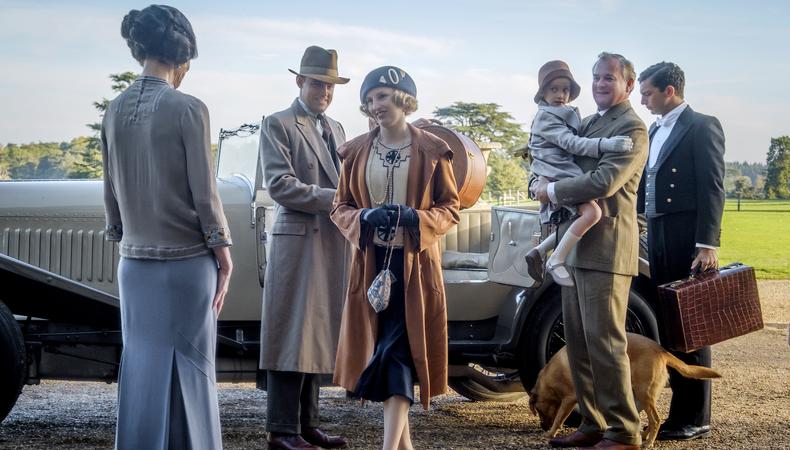
Lady Edith (Laura Carmichael) is the stereotypical forgotten middle child on Julian Fellowes’ “Downton Abbey” (2010–2015). She’s deeply unlucky in love—one suitor leaves her at the altar, another is killed by Nazis—and is constantly at odds with her more confident and collected older sister, Mary (Michelle Dockery). In the penultimate episode of the show’s six-season run, however, Edith has the last laugh when it’s revealed that her fiancé has inherited the title of Marquess, meaning she will outrank her entire family. This is a real upgrade, not just in status but in respect, for a character who is often referred to on the show as “poor Edith”—especially as compared to her sister Sybil, who at this point in the show is engaged to a used-car salesman. In the moment all is revealed, Carmichael conveys Edith’s newfound status through a subtle yet potent newfound confidence in her bearing, delivering her lines with a hint of breathless wonder and hope tempered by a lifetime of vulnerability.
So you know your character is going to find themselves in the middle of a life altering event—now what? Here are a few elements to keep in mind.
1. Raise the stakes.
Good or bad, peripeteia is a moment of profound, life-altering change for a character, so allow those stakes to be as high as the plot requires them to be. This may take a little bit of imagination on your part, since most real people don’t encounter many moments of peripeteia-sized sudden change in their lives. You may need to dig into your actor toolbox instead of relying on lived experience.
2. Decide how your character would handle a life-changing experience.
Fully understanding your character’s motivations and desires will help you comprehend how much this plot twist will rock their world, and knowing a bit about their temperament will help you determine how much of that deep emotion (whatever it may be) will be outwardly expressed.
3. Don’t anticipate the switch-up.
At the end of the day, peripeteia is a plot twist, both to the audience and the character. Be careful to avoid telegraphing the coming switch-up, both for the integrity of the character and the audience’s suspension of disbelief.