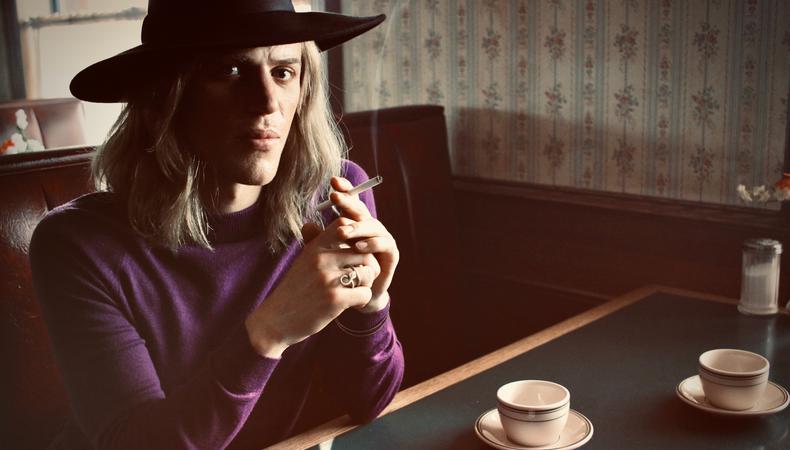
When Johnny Flynn was shooting his role of Mr Knightley in Autumn de Wilde’s adaptation of Emma, he was feeling somewhat resentful. Not about the role, or his castmates or his director, but rather the task of prepping for his next major role – David Bowie in the biopic Stardust, which involved losing a considerable amount of weight. Actors often find themselves prepping for a new production while in the middle of one, of course, and Flynn is certainly not the first actor to endure a dramatic weight transformation for a role. Plenty have earned Oscars, at least in part, for committing to such an arduous and unhealthy endeavour. Nonetheless, it was a “hard” crossover for the British star, but one he eventually managed to his creative advantage.
“Sometimes, when you’re so blinkered in the project that you’re doing, you lose your critical faculties to perceive the objective truth of what you’re doing, and lose an audience’s eye on what you’re doing, too,” Flynn tells Backstage over Zoom. “It was a way of stepping out of the character, having a bit of perspective, and thinking maybe there was a bit of David that could come into Knightley, a bit of playfulness and some of that energy. It’s quite good to be doing lots of different things.”
The 37-year-old has been doing lots of different things since his childhood move from Johannesburg, South Africa, to rural Suffolk, where he landed a music scholarship to attend Pilgrims’ School a few hours away in Winchester. At the private institution, Flynn not only sang choir but learned to play the violin and the trumpet as a requirement for his attendance. The guitar was soon added to his wheelhouse and he was awarded another music scholarship to attend a different private school, Bedales, which was famously attended by Daniel Day-Lewis and Minnie Driver. But after several years learning his musical craft, and being kicked out of the prestigious school for rambunctious tomfoolery, the then-18-year-old switched lanes to pursue acting at London’s Webber Douglas Academy of Dramatic Art (now a part of the Central School of Speech and Drama). There, the stage was set for Flynn to discover who he was and wanted to be.
“Drama school, more than anything, is getting on with people and working in a social dynamic and asking questions of yourself,” he says. “The acting classes are about trying to figure out who you are, what your feelings were about things, exploring your own heart, and looking people in the eyes. For somebody who was as shy and unworldly as me, it was a really important thing.”
As was the influence of his parents, the musical theatre actor Eric Flynn and singer Caroline Forbes, and siblings including half-brother Jerome Flynn, best known for his role as Bronn in Game of Thrones. Flynn doesn’t believe his family lineage opened many professional doors but their collective experience gave him a valuable understanding of the industry and the uncertainty of the career path he was about to embark on. “I grew up going to see my brothers and my dad in plays and I knew what their lifestyle was like,” he explains. “I loved the atmosphere of what it was to be a storyteller, so it made me excited about that but also, we were very hard up as kids because it’s a hard life being an actor. When I was growing up, my dad wasn’t working so much so I was fully aware of the risks.”
 Fourteen years since his big break in the 2006 Dutch film Crusade in Jeans, the risks seem to have paid off and seen Flynn carve out an eclectic career on stage and screen. He trod the boards at Shakespeare’s Globe theatre opposite Mark Rylance in Richard III and Twelfth Night, played the young Hugh Grant-esque romantic lead in Netflix comedy series Lovesick, an accused serial killer in the electric 2017 psychological thriller Beast, and continues to perform as the frontman of the folk-rock band Johnny Flynn and The Sussex Wit. Flynn has refused to narrow his playing field to focus on music or acting but rather allow the different facets of his artistry to inform one other.
“There’s a complicated and nuanced relationship between those two aspects of what I do,” he muses. “There’s a spirit of being a songwriter that comes into the way that I engage with scripts and try and work out the themes, spiritually, and what universe this story is in. At the moment, I’m working on a record, and [I’m] back in that mindset of what’s going to make these lyrics land. Often, it’s the same sort of antenna that’s thinking about that stuff on set when you’re filming a scene – what energy do I need to make this scene land, this character communicate with people? – which is kind of an abstract sense of things.”
This method came in handy when taking on the role of a rock icon like Bowie. The film, directed and co-written by Gabriel Range, sees Flynn play a 24-year-old Bowie going out on an American promotional tour in 1971 while trying to avoid thinking about and discussing the mental health demons that would eventually inspire the creation of his Ziggy Stardust persona. The actor is the first to admit that he doesn’t look or sound like the late British singer-songwriter; and without the go-ahead to use the back-catalogue in the film, there was no desire for him to attempt an impression. Instead, he took a healthy dose of introspection and explored his own memories of being a struggling 24-year-old artist turning up in rooms where nobody knew who he was and trying to impress strangers, to inform his performance.
“I found that it’s sometimes quite hard to be a young person playing a young person because you don’t have that objective eye on what being young is; you’re just caught up in the experience of it,” the actor says. “It’s hard to remember David before he was mega-successful but he was failing in lots of ways at this point, so I was remembering what that experience was for me as a musician, of being unknown and turning up in places and feeling very insecure.
“And then I was channelling his essence more than doing an impersonation because I’m never going to get away from the fact that I’m not David Bowie,” Flynn adds. “When you’re sitting in a cinema or sitting in front of a TV, you know that you’re watching an actor play Bowie. To engage the audience, you have hints of the character and you tell people that this is the circumstances that they’re in. That’s the magic of theatre or storytelling – you’re engaging people’s imagination.”
It’s part of why the actor has increasingly avoided films or TV shows that require a significant reliance on CGI. He doesn’t want people to watch his films and think it looks “fake.” Instead, he’s opted for more grounded, human narratives like his two upcoming period outings The Dig, co-starring Carey Mulligan and Ralph Fiennes, about the 1939 excavation of an Anglo-Saxon ship at Sutton Hoo in Suffolk; and Operation Mincemeat, a World War 2 story detailing the deception effort to keep the Allied invasion of Sicily hidden in 1943. He’s also just finished working on a romantic musical heist film called The Score, but the most appealing type of project is one that gives him the opportunity to reunite with his favorite artists again and again.
 How to Become a Top Director’s Favourite Actor
 “There have been a few theatre directors and filmmakers who I did something with and they’ve asked me to be in their next thing because we’ve developed a relationship and a shorthand, and that’s invaluable,” Flynn says. “I’ve just done my third job with somebody who’s one of my best friends and we knew how to be in that space with each other even though the characters were completely different.
“One of the perks of sticking it out,” he adds, “is developing relationships with people and having that confidence to use it.”
Stardust is available on digital platforms from 15th January
More industry advice for UK actors? Click here.