What is prestige television? Everywhere you look these days, in our ongoing era of peak TV, there are examples of storytelling that combines top-notch writing, acting, directing, and more. We here at Backstage have, once again, pinpointed those precise snapshot-moments where the stars aligned on our small screens.
If you don’t have time to check out a whole TV season, just visit these single moments on the scripted series below (and you’ll be hooked). For your consideration, Television Academy voters: these shows are all up for honors at the 73rd Primetime Emmy Awards Sept. 19.
“Lovecraft Country”: Tic and Leti “catch the fire”
Every fan of good TV knows this unspoken rule: the penultimate episode of a season must be the most exhilarating one. This of course holds true for Misha Green’s “Lovecraft Country,” where the episode titled “Rewind 1921” follows our heroes Tic (Jonathan Majors), Leti (Jurnee Smollett), and Montrose (Michael K. Williams) as they visit Tulsa, Oklahoma—in the year 1921. There’s a lot to explain here, so here’s the abridged version: Our characters realize they need to time-travel back to one of the darkest moments in American history, the Tulsa Race Massacre, to retrieve an old family spellbook.
In the episode’s climax, the massacre is already well underway, houses burning, businesses destroyed, people brutally murdered in the streets. Tic protects young versions of Montrose and his parents from a group of white attackers while Leti stays with Tic’s great-grandmother Hattie (in an elegant performance from Regina Taylor) in her devastating last moments as she is engulfed in flames and perishes.
Both sequences play out at the same time, and to the score of a poem by writer and Black Arts Movement activist Sonia Sanchez titled “Catch the Fire,” a poem that charges Black people to keep the fire inside them alive even while facing formidable tragedies. The scene beautifully invokes juxtaposing emotions: a crowd-pleasing feeling of empowerment as we cheer on Tic the same way we would for Captain America, as he protects his parents from their attackers; and excruciating agony as Leti watches Hattie and the rest of Tic’s family burn in their house. It's unlike anything I’ve ever seen on TV, and I can’t help but think two things—that time travel isn’t always as nostalgic as “Back to the Future” suggests, and that HBO really missed out on something great by not renewing this masterful series. —Jalen Michael
 Jurnee Smollett’s Storied Road to ‘Lovecraft Country’ + Making Art With a Message
 “Mare of Easttown”: Mare remembers the day Kevin died
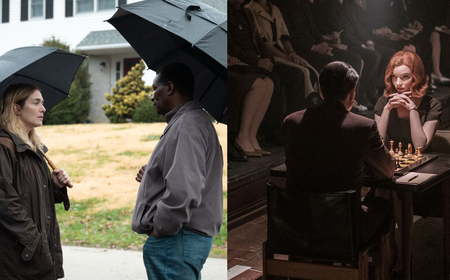
As a diehard, my-life-has-been-upended-by-this-show fan of HBO’s limited series “Mare of Easttown,” I had every intent to choose a subtle moment as the one to exemplify why Kate Winslet as the titular sad detective is one of the greatest performances ever committed to celluloid: the grace she gives Mr. Carroll as she slides a rotting plate of food away so as not to embarrass him; her can’t-be-suppressed smirk when Evan Peters’ Colin asks her on a maybe-date; the way you watch her gears turn deciding whether to reveal to Guy Pearce’s Richard that her son passed away. Clearly, I could go on.
But when push comes to shove and the Rolling Rocks are down, there is a single moment that stands as the one which, if watched on its own without any context whatsoever, would give you all the proof you need that Winslet as Mare will live in infamy—and, I do believe, Emmy-winning glory. In Episode 6, Mare’s therapist (played beautifully in all of the duo’s two-hander scenes by Eisa Davis) asks our Mare to recall the day her son Kevin took his life. I am not going to describe the ensuing three and a half minutes, told through Mare’s narration and an onscreen flashback, because my lil’ prose could never do it justice. But needless to say it’s horrific and wrenching and all those similar adjectives.
I will, however, recount the scene’s final exchange. When Mare, defeated, almost ashamed, reveals she still lives in that same house, she’s then asked whether anyone goes up to the attic (where Kevin died). “No, we don’t—,” she says, unable to finish the sentence. “No, no. No one goes up there.” She can’t even make eye contact as she says it, but it’s ultimately her first real step on a path to mercy. And at the end of the day, that’s all Mare and “Mare” were desperate to attain. We’ve all got proverbial attics, don’t we? That we were rooting for Mare to ascend the ladder to hers, despite her imperfect pursuit, is a testament to Winslet’s commitment to Mare and her journey. That’s more than awards-worthy; it’s fearless. —Casey Mink
“PEN15”: “Opening Night”
Any former theater kid knows the agony and the ecstasy of performing in front of an audience of parents, friends, and enemies while hopped up on stage fright and preteen hormones. In its second season, Hulu’s “PEN15” gave viewers the distinct pleasure of watching the show’s central BFFs get caught up in the fraught world of middle school theater—Maya (Maya Erskine) as an actor and Anna (Anna Konkle) as a stage manager. Their respective positions (not to mention a heap of other strife in their lives) put the two at odds, which leads to a sublime moment of reconciliation in the midseason finale, “Opening Night.”
While performing in a hilariously overwrought two-hander written by the school’s drama teacher, Maya suffers the profoundest of seventh-grade embarrassments: Her scene partner-cum-boyfriend, Gabe (Dylan Gage), dodges their big stage kiss, and the audience responds with nervous laughter.
And this is when Anna and Maya lovingly reconcile, in a moment that reveals the sweetness at the heart of “PEN15,” under all the (painfully relatable) cringe comedy. From the top of the backdrop, Anna sees her friend suffering, pulls a vial of glitter from her toolbelt, and sprinkles it on Maya. The two lock eyes, and Anna whispers the line Maya needs to keep the scene going.
Then, the episode takes a turn for the sublime. Drifting glitter transitions us into an “Oklahoma”-style dream ballet, as an operatic aria plays and a spotlight leads us from character to character in the little school auditorium, taking the viewer from the actors onstage to the crew behind the scenes to the parents watching in the audience. (In one particularly tragic moment, the closeted Gabe’s mom and dad simply stare at him with blank faces.)
It’s both a generous, stylistically daring scene that reminds us of the season’s intermeshed interpersonal dramas and a funny, moving tribute to the profound sense of belonging that manifests itself the first time a play comes together. It encapsulates what makes “PEN15” one of the greatest shows on our screens right now, taking what could seem like a trivial, low-stakes moment and imbuing it with all the heightened emotions of being 13 years old in a body you can’t make sense of, desperately searching for your place in the world. And vitally, it brings us back around to the show’s central platonic love story, as the curtain closes and Anna and Maya share a relieved smile.
(And, man, would we love to see the rest of that terrible play.) —Jenna Scherer
“The Queen’s Gambit”: Mr. Scheibel mentors Beth
I managed to whittle down my list of this year’s Emmy-worthy TV moments by considering which was the most microscopic, yet most seismic in dramatic impact. In that category, no one beats Bill Camp, whose SAG Award–nominated performance as Mr. Scheibel on Netflix’s “The Queen’s Gambit” is featured mostly in the limited series’ introductory episode. Attention, actors: This is a masterclass in the idea that there are “no small parts.”
A solitary custodian at the Methuen Home for Girls and at-first-reluctant chess coach to Isla Johnston’s young Beth, Mr. Scheibel is a man of few words. So a scene in which he gifts Beth a book on chess moves, and finally shows the slightest chink in his armor, feels all the more momentous—even though Camp delivers it as simply as humanly possible. “Am I good enough now?” asks Beth, furrowing a brow at her unlikely mentor. “To tell you the truth of it, child,” he says, gazing at her, “you’re astounding.” On that last word, he shakes his head infinitesimally, both affirming and resigned—like a chess player congratulating an opponent on their checkmate.
OK, I’m cheating and picking another moment. Bookending the childhood years at the orphanage is the series’ final episode, in which Anya Taylor-Joy’s adult Beth returns to pay her respects at Mr. Scheibel’s funeral. Upon wandering down to the custodian basement, Beth finds her old teacher has hoarded every article and news clipping about her chess victories. She collapses into tears seeing the photograph of the two of them posing, her hand awkwardly on Mr. Scheibel’s shoulder. The fact that Camp looms large enough to conclude this story’s entire emotional arc—without even appearing in the climactic scene!—is proof that scant dialogue and the subtlest stillness can become a symphony.
Camp has said if Mr. Scheibel were a chess piece, he’d be a knight “because he leads the way” for Beth. What a terrific example of an actor’s bone-deep understanding of their role in a story, and how to make a little go a long way. —Jack Smart
 Bill Camp’s Notes on How to Become a Great Supporting Actor
 “Saturday Night Live”: Bowen Yang as iceberg
Between runaway viral hits like Harry Styles decrying “must get rid of toxic in community” and Anya Taylor-Joy belting out a satirical “Pride Month Song,” there’s no doubt that Bowen Yang is in part to thank for NBC’s “Saturday Night Live” queering things up like never before. And while that alone is reason enough for me to celebrate, I think having a notoriously under-appreciated pop diva on his Emmys reel is what sent Yang on his way to his first nomination this year. I’m talking, of course, about his portrayal of the Iceberg That Sank the Titanic.
Donning a powdered blue mug that gives “RuPaul’s Drag Race UK” star Blue Hydrangea a run for her money, Yang snidely recounts the “Irish cacophony” of that fateful April night that ultimately led to the Titanic cracking away his best feature: his ass. Just his delivery of, “They bumped into me, and I said, ‘Oh, I’m sorry’—which is insane, but whatever,” makes this iceberg not only one of the funniest “SNL” characters of recent memory, but one of its most relatable. And the cherry on top of it all is when “Weekend Update” host Colin Jost closes the segment by letting the iceberg preview his forthcoming album, a hyper-pop, EDM, nue-disco fantasia called “Music.” We had an early lunch, but we’re hungry for you, Bowen Yang! —Benjamin Lindsay
“Ted Lasso”: Ted forgives Rebecca
Right off the bat, let’s acknowledge the obvious: “Ted Lasso” Season 1 is a retelling of the 1980s classic film “Major League.” Hear me out. Like in “Major League”, “Lasso” tells the story of a club owner who sets her sights on destroying a team for personal gain. Both stories include a down-on-their-luck, nearing-retirement legacy player, an up-and-coming all-star, and a group of incredibly frustrated fans. Both team owners hire “incompetent” managers and scheme behind the scenes to prevent them from succeeding.
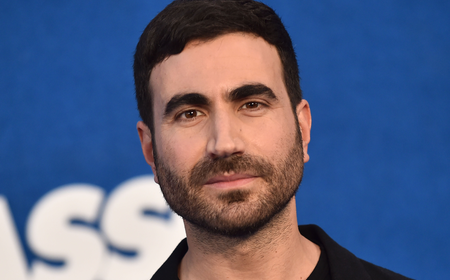
Still, “Lasso” is a league above, in large part to creator-star Jason Sudekis’ flawless execution of Ted and his unwavering optimism and idealistic tendencies. His everyman lays the groundwork for the rest of the ensemble cast to shine. Brendan Hunt (as Coach Beard), Nick Mohammed (Nate), Jeremy Swift (Higgins), Brett Goldstein (Roy Kent), and Juno Temple (Keeley) all play their parts to a tee—and have the Emmy nominations to prove it.
A true standout is Hannah Waddingham as team owner Rebecca. Perhaps best known for her work in West End musical theater (it’s no accident that her character ends up in front of a mic at karaoke night) or as Septa Unella in “Game of Thrones” (famously crying “shame” during Cersei’s walk of atonement), Waddingham expertly navigates between “good Rebecca,” who yearns for friendship and acceptance, and “scorned Rebecca,” who seeks revenge against her cheating, narcissistic ex-husband. Her character is complicated and wounded and undergoes the most satisfying emotional arc on the show. Take, for instance, the moment Rebecca finally admits to sabotaging Ted’s success. In true “Lasso” form, his reaction is quick and measured…he forgives her. Not only is that moment transformational for Rebecca, it is a reminder to us all of the power of forgiveness.
The fact is this was the show we needed, appearing at a time we needed it most. When the world was in chaos, “Lasso” delighted with humor, warmth, and a feeling that everything was going to be okay...no matter what. —Stephanie Snipes
“WandaVision”: It was Agatha all along
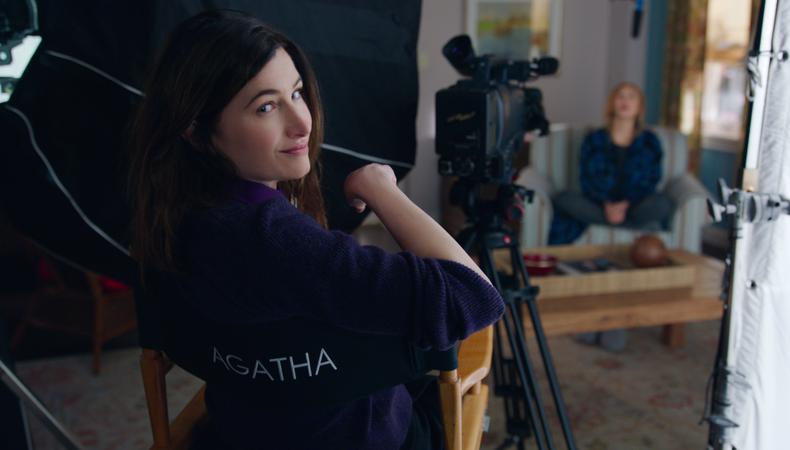
In what has now become arguably the most iconic scene of the 2021 TV season, Marvel’s “WandaVision” reveals its greatest plot twist via the catchy tune “Agatha All Along”: it was, indeed, Emmy nominee Kathryn Hahn’s conspiratorial Agatha née Agnes all along.
The scene arrives in the limited series’ seventh episode after Wanda (Elizabeth Olsen) has her ultimate mental breakdown and asks her neighbor Agnes to take care of her children. But when Wanda goes to the basement to look for the missing twins, she is greeted with a frizzy-haired, bunny-stroking Hahn, who informs Wanda she is not the only magical woman in town. Her eyes flash purple and Kristen Anderson-Lopez and Robert Lopez’s delightful musical number commences. Apart from revealing the show’s central villain, the montage marks a pivotal turning point as the audience begins to understand the context of this story. The show’s play on classic TV shows spanning every decade comes to an end here: we are at the endgame, as it were.
“WandaVision” couldn’t just do any normal plot twist-reveal-moment, though. For a character as witty and tricky as Agatha, she had to be exposed in the most fitting way possible, in keeping with the style of the show. This gave us a number so catchy it has over 9 million streams on Spotify and 6 million views on YouTube.
“Agatha All Along” left us wanting more of Agatha, despite the witch’s final comment that, oh, she killed Wanda’s dog, Sparky, too. Her cackle to end all cackles is haunting and, frankly, should earn Hahn well-deserved accolades. “Oh, and an Emmy too!” —Rebecca Aizin
Check out Backstage’s TV audition listings!