Before Marlon Brando mumbled an offer you couldn’t refuse, Anthony Hopkins hissed through a prison cell door, and Vivien Leigh swore to God she’d never go hungry again, they were just words on a page. Brilliant writing can only take a character so far—it’s up to the actor who plays them to transform a two-dimensional concept into a three-dimensional human being. Every once in a while, those two elements combine to create a truly unforgettable performance. Here are just 10 of the world’s most memorable movie characters and the actors who brought them to life.
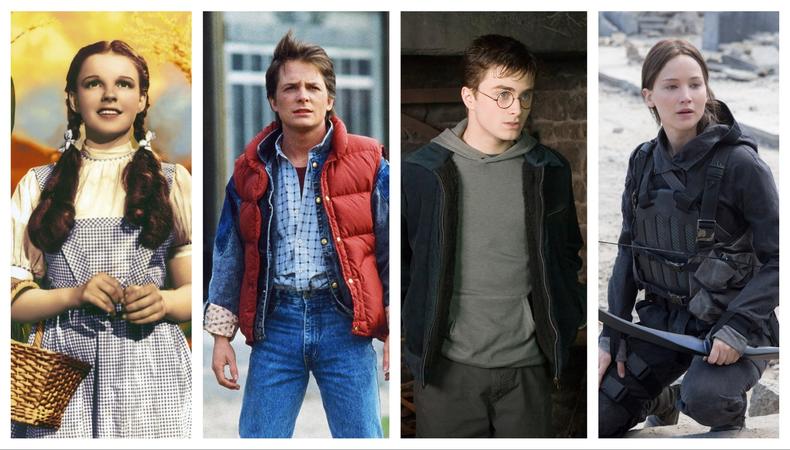
1. Dorothy Gale, “The Wizard of Oz” (1939), played by Judy Garland
Many actors wait decades to deliver a career-defining performance, but Garland finished filming hers at 16. Against all odds, she took the role of Dorothy, a lost farmgirl who on paper should have been far less interesting than the fantastical citizens of Oz surrounding her, and turned it into one of the most enduring performances of all time. Garland brought youthful earnestness to a role that in other hands might have become grating, saccharine, or just plain boring. She also gave Dorothy an element of spunk at a time when roles for young women weren’t being written that way. While that’s thankfully no longer a novel character trait for female protagonists in film, Garland’s performance continues to delight audiences nearly 90 years later.
2. George Bailey, “It’s a Wonderful Life” (1946), played by James Stewart
“It’s a Wonderful Life” is a perennial holiday favorite, and its face is George Bailey, a downtrodden family man who gets a new lease on life after wishing he had never been born. What elevates Stewart’s performance from great to truly legendary is his mid-film speech to Potter, when he defends his father’s honor and laments just how unaffordable life has become—a sentiment that still feels painfully relevant today. You can feel George’s frustration through the screen as a man who knows he cannot win. His voice cracks toward the end in a way that would be nearly impossible to replicate if Stewart weren’t genuinely feeling it.
3. Atticus Finch, “To Kill a Mockingbird” (1962), played by Gregory Peck
The film adaptation of Harper Lee’s novel stars Peck as Atticus Finch, the lawyer father of young protagonist Scout, who is appointed to defend a Black man falsely accused of assaulting a white woman in 1930s Alabama. The film culminates in a lengthy courtroom closing argument by Peck so expertly rendered it’s hard to believe you aren’t watching footage of a real trial. This isn’t by happenstance: A peek at Peck’s script reveals he wrote extensive, detailed notes all over it. Peck, who won a well-deserved Oscar for the role, so thoroughly embodies the noble, ethical Atticus that he is remembered as one of the all-time great onscreen fathers—and, perhaps surprisingly, something of a sex symbol.
4. Maria von Trapp, “The Sound of Music” (1965), played by Julie Andrews
Few opening sequences are more iconic than Andrews as Maria twirling and singing in the Alps, and few movie characters are more beloved than the former nun who becomes governess to seven overdisciplined children. There’s something almost subversive about Andrews’ interpretation of Maria: She’s kind, fun, and extraordinarily talented, but she’s also strong-willed, sharp-tongued, and at times completely defiant. Andrews’ energy is so infectious it’s no wonder audiences (not to mention Captain von Trapp) fell in love with her.
5. Luke Skywalker, the “Star Wars” series beginning with “Star Wars” (1977), played by Mark Hamill
Apart from being the hero of the original film and a part of one of cinema’s most famous plot twists (who is his father?), audiences immediately connected with Luke Skywalker, charmed by his general naivety and thirst for adventure. While there’s certainly something satisfying about watching a character evolve over literal decades, Hamill’s performance was captivating from the start—and he managed to stand out in a cast packed with current and future stars. Luke could easily have become a surface-level character, but Hamill played him with the depth necessary to sustain multiple sequels; his reaction to the Darth Vader reveal carries more weight than you’d expect from a 1970s sci-fi film. Hamill recently disclosed to “People” that he had pushed to take the inner struggles of his character further, remembering a discussion he had with Lucas back in the day: “Luke has lost his hand, he’s got the black glove—shouldn’t it be about Luke struggling with turning to the dark side?’ And George said, ‘Mark, it’s for children.’ ”
6. Indiana Jones, the “Indiana Jones” series beginning with “Raiders of the Lost Ark” (1981), played by Harrison Ford
For an action hero, Indiana Jones is surprisingly complicated: On one hand, he’s an overeducated professor; on the other, a rugged adventurer who can’t help but court danger. It’s that unlikely combination that has endeared the character to generations of fans. And there’s something deeply satisfying about the fact that no situation is so dire that Indy can’t think his way out (often both to dramatic and comedic effect). Despite being best remembered for action scenes and sarcastic quips, Ford infuses Jones with real depth when given the chance. Jones has become so beloved that Ford is practically synonymous with the character—and the actor himself has leaned into that view. In a 2019 interview on NBC’s “Today” show, when asked who he’d like to see take on the role after him, Ford responded: “Nobody else is going to be Indiana Jones…. Don’t you get it? I’m Indiana Jones. When I’m gone, he’s gone.”
7. Marty McFly, the “Back to the Future” trilogy (1985–1990), played by Michael J. Fox
When you think about “Back to the Future,” three things likely come to mind: the DeLorean, Christopher Lloyd’s emphatic “Great Scott!”, and unlikely hero Marty McFly. In a performance that was, at the time, an honest depiction of a teenage boy—and now feels undeniably, delightfully ‘80s—Fox can’t help but be magnetic. It’s a deceptively difficult role: Marty has to play straight man to the film’s many “modern guy doesn’t understand the 1950s” jokes while still seeming cool and heroic, a thin line Fox navigates expertly. He’s so at home in the role that it’s hard to imagine he was actually a last-minute replacement.
8. Ferris Bueller, “Ferris Bueller’s Day Off” (1986), played by Matthew Broderick
It’s hard to pick just one iconic John Hughes character—in fact, it’d probably take less time to list the uniconic ones—but if pressed, no small number might go with Ferris Bueller (Bueller…? Bueller…?). Broderick brought an everyman quality to the teenage truant role (no doubt aided by his direct addresses to the audience), while simultaneously seeming effortlessly cool. Ferris might be something of a menace on paper (how much destruction can one kid pack into a single day?), but Broderick plays him with such boyish charm that audiences can’t help but love him.
9. Harry Potter, the “Harry Potter” film series beginning with “Harry Potter and the Sorcerer’s Stone” (2001), played by Daniel Radcliffe
Child actors are always a gamble, since many kids are adorable onscreen but struggle to connect with more complex material as they move into adulthood. That was decidedly not the case with Radcliffe, who remained consistently compelling across all eight films in the “Harry Potter” series as the titular boy wizard. It seems remarkable that an 11-year-old could hold his own opposite legendary actors like Maggie Smith and Richard Harris, but the young Radcliffe pulls it off, commanding the screen with a loaded glance. In addition to his undeniable star quality, the Harry Potter character and the films as a whole resonated with fans in part because audiences were able to literally grow up alongside him.
10. Katniss Everdeen, the “Hunger Games” series beginning with “The Hunger Games” (2012), played by Jennifer Lawrence
Suzanne Collins’ dystopian young adult novel already had a dedicated following, but it was clear the success of its film adaptation would depend in large part on the actor cast to play protagonist Katniss Everdeen. And Lawrence delivered. The plot demanded a strong-willed lead, but Lawrence also gives Katniss an undeniable fervor. She taps into an earned, primal rage and is raw in a way that might deter a more image-conscious actor. Yet Lawrence remains keenly aware that Katniss is still a teenage girl, and for every moment of strength, there’s another of moody defiance.
Ready to book your own unforgettable character? Check out our latest casting calls.