From Wes Anderson’s symmetrical dollhouse frames to Quentin Tarantino’s dialogue-drenched set pieces, some filmmakers practically brand every shot—but David Fincher isn’t so easily pinned down. So what makes a Fincher movie a Fincher movie? Here are seven of his defining works that reveal the director’s signature approach to craft and control.
1. “Seven” (1995)
“Seven” is often cited as one of the defining films of the 1990s, and for good reason. Rather than presenting violence in a sensational way, Fincher uses atmosphere to create dread. The film’s grimy, rain-soaked world feels oppressive and almost suffocating. The city itself becomes a character: anonymous, decaying, and morally ambiguous. What really makes the film stand out is how it’s delivered, with deliberate pacing and restrained camera work. The “What’s in the box?” scene alone showcases Fincher’s uncanny ability to allow horror to emerge through implication rather than spectacle.
Influence on film
- Popularized the “dark procedural” tone now common in crime dramas
- Demonstrated how production design and color grading can shape emotional experience
- Reinforced the idea that less explicit violence can feel more disturbing
2. “Fight Club” (1999)
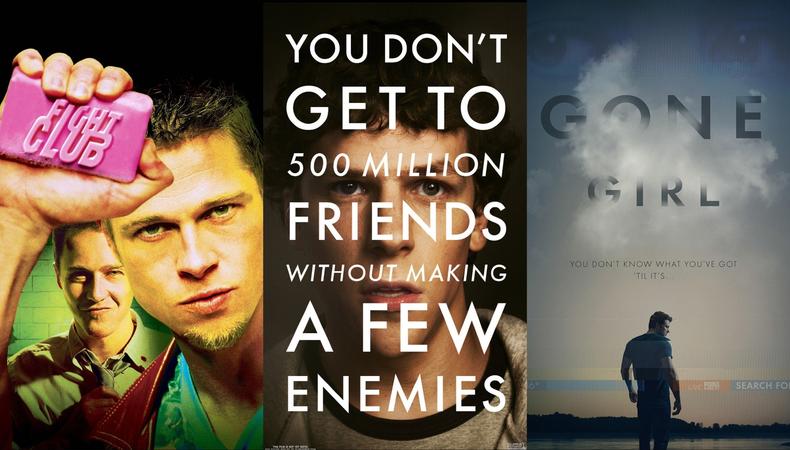
Speaking of defining films of the 1990s, perhaps no movie reflected the sentiment of a certain type of Gen X male more than “Fight Club.” This film is a master class in controlled chaos, blending voiceover, nonlinear storytelling, visual effects, and meta-commentary into something that feels anarchic but is actually meticulously constructed. The tightly calibrated performances, particularly from Edward Norton and Brad Pitt, reflect Fincher’s insistence on precision and reinforce the idea that performance can be shaped extensively in postproduction. And the digital effects used in “Fight Club” were groundbreaking at the time: The camera moves through impossible spaces, transitions feel seamless, and visual tricks enhance the theme rather than distract from it. Many techniques from “Fight Club,” like glitchy inserts, fourth-wall-adjacent narration, and identity twists, have since become familiar—even overused.
Influence on film
- Helped normalize unreliable narrators in mainstream cinema
- Expanded how voiceover can be used as a storytelling device
- Pushed the boundaries of digital cinematography and editing
3. “Zodiac” (2007)
With “Zodiac,” Fincher took a risk by creating a procedural that resists traditional resolution. Instead of focusing on a climactic capture, the film emphasizes the obsessive process of investigation. Time stretches, leads go cold, and characters become consumed by the search. “Zodiac” was one of the first major studio features shot and produced entirely in a digital, tapeless workflow, inspiring countless filmmakers to follow in Fincher’s steps. The film’s clean, controlled visual style contrasts with the murky uncertainty of the narrative.
Influence on film
- Redefined the true-crime genre as process-driven rather than resolution-driven
- Demonstrated how digital tools can enhance realism rather than spectacle
- Influenced the tone and structure of later investigative films and series
4. “The Social Network” (2010)
Fincher is such a visual director that pairing him with a dialogue-heavy writer like Aaron Sorkin might seem counterintuitive. And yet, “The Social Network” is considered one of Fincher’s crowning achievements, making a defining statement on social media just as it was entering everyone’s lives. Fincher transforms dialogue into action through pacing, editing, and performance. Scenes are cut with precision, often interweaving timelines to build momentum. Conversations feel like confrontations. The film’s clean, controlled aesthetic mirrors its subject: ambition, intellect, and emotional detachment.
Influence on film
- Elevated fast-paced, dialogue-driven storytelling in mainstream cinema
- Demonstrated how editing can create tension without physical stakes
- Reinforced the importance of rhythm in dialogue scenes
5. “Gone Girl” (2014)
In “Gone Girl,” Fincher combines his technical precision with a sharp critique of media narratives and public perception. The film plays with structure, shifting perspectives and reframing events midway through. It manipulates audience alignment, forcing viewers to reconsider their assumptions. Visually, the film is sleek and controlled, reflecting the constructed personas of its characters.
Influence on film
- Reinforced the use of mid-film perspective shifts in thrillers
- Explored how media framing shapes narrative truth
- Influenced the tone of modern psychological thrillers
6. “The Girl With the Dragon Tattoo” (2011)
Fincher’s adaptation of Stieg Larsson’s 2005 novel, “The Girl With the Dragon Tattoo,” showcases his ability to blend atmosphere with procedural storytelling. The film’s visual style is stark and icy, with meticulous attention to texture—snow, metal, glass, and shadow all contribute to the tone. Fincher isn’t known as the warmest filmmaker, and “The Girl With the Dragon Tattoo” represents him at his coldest. The pacing is deliberate and mechanical, allowing the investigation to unfold methodically. The collaboration between performance and editing is key here. Actors had to deliver subtle, controlled performances that could withstand Fincher’s exacting editorial process.
Influence on film
- Reinforced the viability of slow-burn, detail-oriented thrillers
- Influenced the visual language of modern noir
- Demonstrated how tone can unify complex narratives
7. “Mank” (2020)
With “Mank,” Fincher turned his precision toward recreating the aesthetic of classic Hollywood. Shot digitally by Erik Messerschmidt but designed to evoke 1940s cinema, the film demonstrates how modern tools can replicate—and reinterpret—historical styles. Every element, from lighting to sound design, is carefully calibrated. Actors in “Mank,” including Gary Oldman, had to adapt to a stylized performance mode that aligned with the film’s aesthetic goals.
Influence on film
- Showcased how digital filmmaking can emulate analog aesthetics
- Reinforced the role of craft in shaping historical narratives
- Highlighted the intersection of technology and storytelling
Going through his work, certain stylistic traits become evident across the David Fincher filmography:
- Controlled, often desaturated color palettes
- Precise camera movement
- Emphasis on multiple takes to refine performance
- Clean, deliberate blocking and composition
- Use of digital filmmaking tools for subtle perfection
- Dialogue-driven tension rather than spectacle
- Themes of obsession, control, and moral ambiguity
These elements combine to create a tone that feels both grounded and heightened—realistic in behavior, but stylized in execution. More importantly, Fincher shows that control can be expressive. His films demonstrate that style is not just aesthetic; it’s structural. It shapes how stories are told, how performances are delivered, and how audiences experience narrative. Precision, when used thoughtfully, doesn’t limit creativity. That’s why his work continues to influence not just directors, but actors, editors, and entire production teams. It’s also why, even as trends shift, the DNA of David Fincher movies remains embedded in the films being made today.