“If it ain’t on the page, it ain’t on the stage,” goes the old showbiz adage. A great movie doesn’t exist without the script. At the same time, people have to say all those witty, cutting, and/or devastating lines, and that’s where the magic of collaboration comes in.
These 15 lines have become baked into our popular culture. Written out without context, however, it can be hard to tell why. Let’s dig into the brilliant deliveries that etched each one into cinema history.
“Frankly, my dear, I don’t give a damn.” —Clark Gable, “Gone With the Wind” (1939)
At the end of this epic romance, Scarlett O’Hara (Vivien Leigh) tearfully begs Rhett Butler (Gable) to stay after a feature-length relationship full of tumult. Gable delivers this line—a very pointed, even mean line—with barely any stink, instead offering it as a kind of tired and bemused point of fact. The line is about not caring anymore, so one shouldn’t “care” as an actor.
“Toto, I’ve a feeling we’re not in Kansas anymore.” —Judy Garland, “The Wizard of Oz” (1939)
As Dorothy Gale (Garland) takes in the wonderful world of Oz, she delivers this line to her dog, Toto, with equal parts intrigue, fear, and pragmatic preparation, avoiding the pitfall of the line feeling too saccharine.
“Alright, Mr. DeMille, I’m ready for my close-up.” —Gloria Swanson, “Sunset Boulevard” (1950)
As the maddened, washed-up silent film star Norma Desmond, Swanson correctly gives this final scene a lot of mustard, using every part of her face as an instrument. But she almost drops to a whisper for the last line, understanding one needs peaks and valleys even when playing “big.”
“A boy’s best friend is his mother.” —Anthony Perkins, “Psycho” (1960)
We know that Perkins’ Norman Bates is, well, a psycho. But the audiences in 1960 didn’t, meaning Perkins couldn’t reveal his hand. Instead, his character exhibits mannerisms we associate as “normal,” such as stammering and repeated idioms. Even on rewatch, putting on this artificial mask tells us more about Norman than if he stated the blunt truth.
“They call me Mister Tibbs.” —Sidney Poitier, “In the Heat of the Night” (1967)
Philadelphia police detective Virgil Tibbs (Poitier) is getting a face full of racism from local police chief Bill Gillespie (Rod Steiger) in a small Mississippi town. When it’s time for this classic retort, Poitier filters it through a few layers of need: He needs to express himself, but he needs to not get killed, and he needs to solve a murder with Gillespie. All of this communicated with small facial gestures; all of this brilliant.
“I’m gonna make him an offer he can’t refuse.” —Marlon Brando, “The Godfather” (1972)
Don Vito Corleone (Brando) looks down on the withering man, Johnny Fontane (Al Martino), who’s begging him for a favor. So when he asserts the problem is taken care of, it’s not with any hint of malice or foreshadowing. Brando plays it like a stern father talking to a whining son, an impatient rendering of a fact.
“You know… morons.” —Gene Wilder, “Blazing Saddles” (1974)
Wilder delivers one of the all-time great comedy line readings here, proving there are two qualities about comedy—misdirection and timing—that can make even your scene partner putty in your hands.
“You’re gonna need a bigger boat.” —Roy Scheider, “Jaws” (1975)
If an actual person saw a vicious shark emerge from the water, they probably wouldn’t deliver this pithy one-liner (even if it was ad-libbed, as the legend says). So how does Scheider find its truth? When playing a high-stress scene, look to your classic responses to trauma: fight, flight, freeze, or fawn. Here, Scheider’s Chief Brody freezes, making cinema history.
“There’s no crying in baseball!” —Tom Hanks, “A League of Their Own” (1992)
As a male-presenting comedy performer, it can be hard to play “angry” and stay “funny,” especially if the scene requires you to be angry at a female-presenting performer. Here, Hanks takes a simple hop from “angry” to “frustrated,” allowing his sudden high speech to get the best of him and lowering his status enough to make it both startling yet strangely endearing.
“You had me at hello.” —Renée Zellweger, “Jerry Maguire” (1996)
People generally don’t like crying in front of other people, even for something positive like love. Zellweger clobbers this line out of the park by adhering to this principle and playing against the tears; they fight and sneak their way out despite her attempt to hide them with a laugh.
“What, like it’s hard?” —Reese Witherspoon, “Legally Blonde” (2001)
Elle Woods, one of our great movie characters, is not a one-note, pink-hued dullard. In this line reading, Witherspoon weaponizes ditziness, sarcasm, and, somehow, earnest wholesomeness. It’s a mini master class in playing multiple intentions at once without selling out any of them.
“I wish I knew how to quit you.” —Jake Gyllenhaal, “Brokeback Mountain” (2005)
Gyllenhaal’s Jack Twist gives everything he’s got to Heath Ledger’s Ennis Del Mar, screaming and swearing about their abandoned, white-hot love. But then, for the big thesis statement, he turns away from his scene partner and basically mumbles it to himself. He makes this moment of discovery an internal one, shifting the entire exchange into a quieter, but more compelling gear.
“This is how I win.” —Adam Sandler, “Uncut Gems” (2019)
Here’s another big character thesis moment, this time from the versatile Sandler. Sandler’s Howard Ratner is used to flashing a false smile to hustle his way through everything. But, here, the actor lets a little more truth eke out from behind his sunglasses, his voice dipping into the genuine as Howard’s driving force—an addiction to the possibility of winning, more than the results a win might bring—is revealed.
“In another life, I would have really liked just doing laundry and taxes with you.” —Ke Huy Quan, “Everything Everywhere All at Once” (2022)
In this scene, Quan is playing a genre-tinged, multiversal variant of a real person—a copy of a copy. How do you do that while still being relatable and delivering such a poetic line? Well, Quan won the Oscar for this role, and here we see why: He toes the line between movie star gravitas and aching vulnerability. It’s a smart, not sweet, line reading.
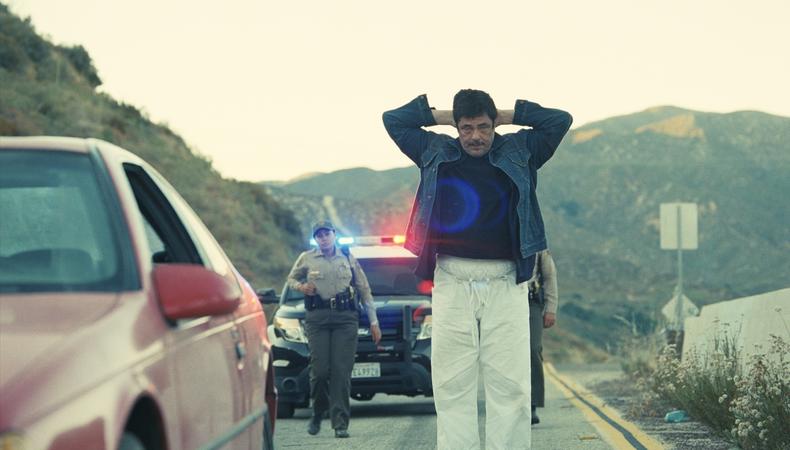
“A few small beers.” —Benicio Del Toro, “One Battle After Another” (2025)
Del Toro is doing many things in this deceptively simple comedy scene, all splintering from what his character needs and wants. He needs to distract the cops to protect Bob (Leonardo DiCaprio). But he wants to be an antiauthoritarian thorn in the side of society. Hence, this gorgeously small, poky, and mischievous line reading, just four words long.