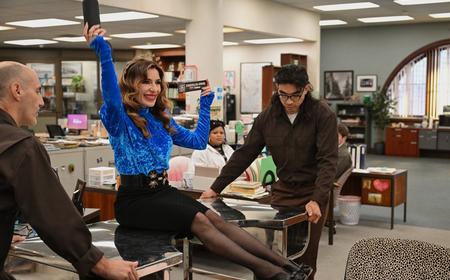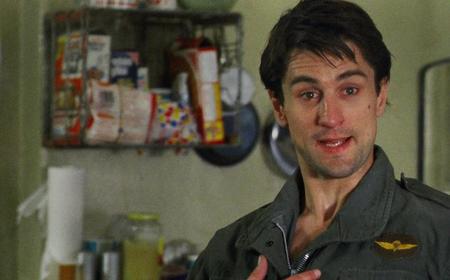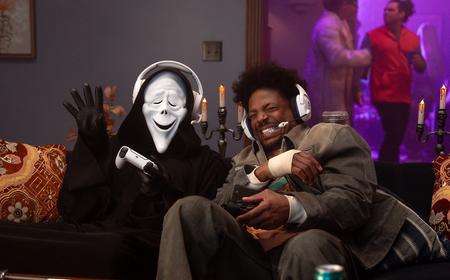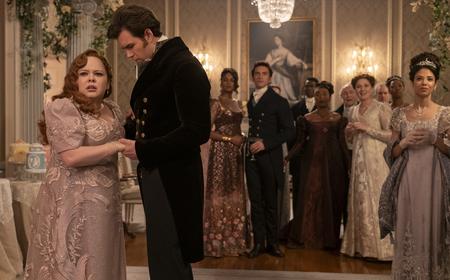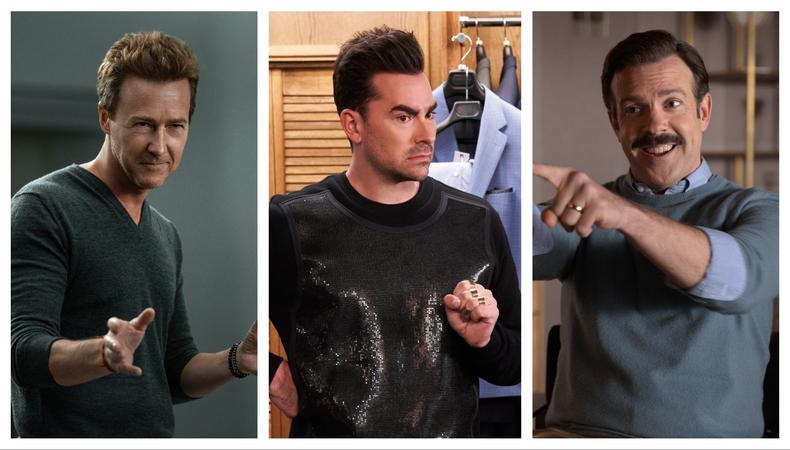
While Dan Levy may be capable of both writing and performing hilarious, histrionic pieces as David on “Schitt’s Creek,” most actors find that there’s nothing humorous about trying to find a comedic monologue. Keep in mind that there’s a universal truth working in your favor: Everyone likes to laugh. If you’re looking to tickle some funny bones, check out these monologues written for male-identifying performers.
“Glass Onion: A Knives Out Mystery” (film, 2022) by Rian Johnson: Miles Bron
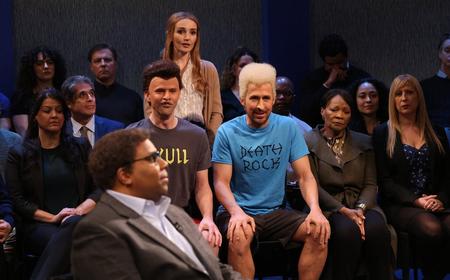
Tech billionaire Miles Bron (Edward Norton) explains his theory of disruption to a room of people who owe him everything: Start by breaking something small that nobody liked anyway, then keep escalating until you’re breaking things the world actively wants left alone. The comedy here is entirely structural, as Miles never says anything he thinks is funny. He’s delivering what he believes is a stirring speech about vision and courage, and the joke is the gap between his self-image and the sycophancy in the room. Play it with total sincerity to show you have the discipline to let an audience laugh at a character who would be humiliated to know it.
Okay. If you want to shake things up, you start with something small. You break a norm or an idea or a convention, some little business model, but you go with things that people are kind of tired of anyway. Everybody gets excited because you’re busting up something that everyone wanted broken in the first place. That’s the infraction point. That’s the place where you have to look within yourself and ask: Am I the kind of person who will keep going? Will you break more things? Break bigger things? Be willing to break the thing that nobody wants you to break? Because at that point, people are not going to be on your side. They’re going to call you crazy. They’re gonna say you’re a bully. They’re gonna tell you to stop. Even your partner will say you need to stop. Because as it turns out, nobody wants you to break the system itself. But that is what true disruption is, and that is what unites all of us. We all got to that line, and crossed it.
“Palm Springs” (film, 2020) by Andy Siara: Nyles
Nyles (Andy Samberg) grabs the mic at a wedding reception nobody asked him to speak at and improvises a toast that is somehow both hollow and moving. It works as an audition piece because the actor gets to play two things at once: a man performing sincerity and a man who has done this exact toast a hundred times before. That double awareness is catnip for casting directors looking for range inside comedy.
We are born lost. Then we’re found, but we’re all just lost, am I right? However, in the darkness comes light. Tala Anne Wilder and Abraham Eugene Trent Schlieffen, who do not look like siblings. You see, their optimism, their selflessness—it’s in their blood. And Tala, there’s something that a lot of people here don’t know about you, but they should. I hope you don’t mind. It’s not just time and money that Tala has given to so many charitable causes. She has also donated of herself. Bone marrow. That’s right. She gave hers to her baby brother Nico, saving his life. But now it’s time for us to give to you. Here you are standing on the precipice of something so much bigger than anyone here. And it may be frightening and filled with doubt. But always remember: You are not alone. Everyone here is your family. We are your world. And we will cheer you on with delight in our eyes as you achieve your wildest dreams. So raise a glass. We may be born lost, but now you are found. Cheers.

“Palm Springs” Credit: Jessica Perez/Hulu
“Ted Lasso” (television, 2020) by Jason Sudeikis and Bill Lawrence: Ted
Ted’s introductory press conference at AFC Richmond in Season 1 makes an excellent cutting: A room of hostile British reporters wants blood, and Ted answers every barbed question with folksy warmth and a joke. The humor lives in the gap between what the room wants and what Ted gives it, which means you have a scene partner to play even when nobody else is in the room.
[Sits down, opens water, chokes] Did not expect fizzy water. Okay, so why don’t we just jump on in. Anybody got any questions? [Every arm shoots up] Yup. Shoulda seen that comin’. You know what? Put your hands down real quick. How ’bout I go ahead and address the larger-than-average elephant in the room. No, I have never coached the sport that you folks call “football,” at any level. And, yes, I got a whole lot to learn. Heck, you could fill two internets with what I don’t know about football. But I’ll tell you what I do know: I know that AFC Richmond, like any team I’ve ever coached, is gonna go out there and give ya everything they got, for all four quarters. [Reporter: “Halves”] What’s that? [Reporter: “Two halves”] Yeah, sorry. They’re gonna give you everythin’ they got for two halves. Win or lose. [Reporter: “Or tie”] Oh right, y’all do ties here. Back where I’m from, y’all try to end a game in a tie, that’d be the first sign of the apocalypse.
“Fleabag” (television, 2016) by Phoebe Waller-Bridge: Martin
In the Season 2 finale, Martin (Brett Gelman) makes his case—quite poorly, we might add—for why his estranged wife shouldn’t leave him. He’s self-pitying, manipulative, and correct about several things at once, which gives an actor a real problem to solve rather than a caricature to perform. The comedy comes from the escalating specificity of his grievances and from how badly he misreads the room, and the speech turns on a dime from bluster to something like naked hurt and then back again. Bring it in if you want to show a casting director that you can be funny and genuinely unlikable in the same 90 seconds.
Listen to me. I just, I have a little speech that’s building here. Now, I know you look at me and you see a bad man with a big beard. Fine. I tried to kiss your sister on her birthday. Fine! I mix up birthdays and I have an alcohol problem just like everyone else in this fucking country, but I am here and I do things. I pick up Jake from shit. I make dessert for Easter. I organized the downstairs toilet. I fired the humming cleaner. I hoovered the car. I put up all your certificates, and I don’t make you feel guilty for not having sex with me. I am not a bad guy! I just have a bad personality. It’s not my fault. Some people are born with fucked personalities. Look at Jake. He is so creepy. It’s not his fault! Why the bassoon? You want to know what the bassoon is!? It’s a cry for help! The main fucking problem here is that you don’t like me. And that has been breaking my fucking heart for 11 years. I love you. I make you laugh. I’m a douche, but I make you laugh. You said that that was the most important thing! I think the thing that you hate the most about yourself is that you actually love me. So, I am not going to leave you until you are down on your knees begging me. [Claire gets down on her knees: “Please leave me!”] Oh man… I didn’t think you’d do that in that dress. Right. Well, I guess the only thing left for me to say is… Fuck you.
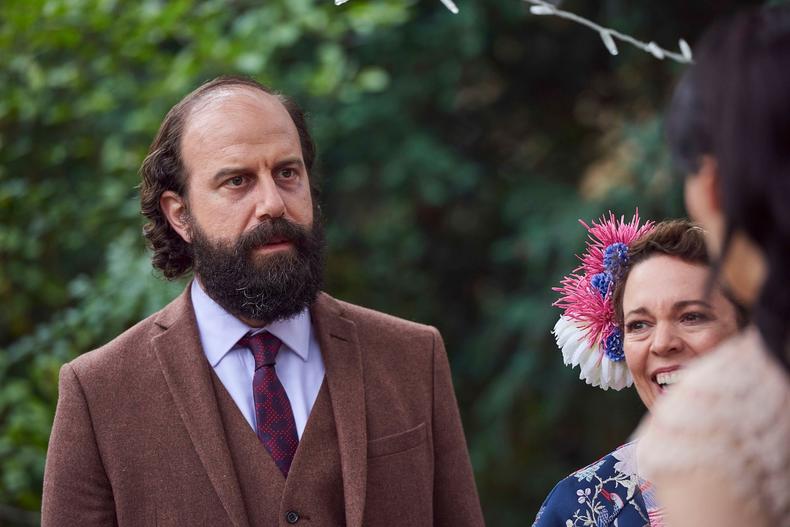
“Fleabag” Courtesy MovieStillsDB
“Schitt’s Creek” (television, 2015) by Kevin White: David
The voicemail sequence from Season 3 has Dan Levy’s David Rose leaving future boyfriend Patrick an escalating series of messages about his general store. The scene is a master class in playing a character who is losing an argument with himself, and the repeated hang-ups give an actor built-in beats and resets. Several other moments in the episode can be cobbled together if you need a longer cutting.
[Leaving a voicemail] Hi, David, it’s Patrick. I, um, was just calling to run my business plan, uh, by you in a little more detail. So, feel free to give me a call back, and I will be happy to walk you through it. OK, ciao! [Hangs up] “Ciao.” I said “ciao” to that person. [Calls again to leave another voicemail] Hi, Patrick. Yeah, I think I...I think I called you David. Which that’s not...that’s not your name. You can just delete that text...the mess—uh, the voicemail that I left you. Um, just thought it might be a good idea to give you some background information about...the store. It’s basically a general store, um, that will support local artists under the brand of the store, which...which would also be my brand. [Phone dings] Sorry, I just got a text. Oh, God. [Hangs up, then calls voicemail again] Yeah, the text cut us off…
“Unbearable Hotness” (theater, 2014) by Gabriel Davis: Brandon
In this monologue, Brandon opens by announcing that he has just killed a guy named Chuck, then walks backward through the house-party disaster that led to it. It’s a sharp choice for contemporary auditions because it hands the actor a confession, a rising panic, and a punchline that recontextualizes everything before it. Fair warning: The language is explicit, so read the room before you bring it in.
I just fuckin’ killed Chuck. I think. I mean, he’s just laying out there. He’s not moving. I don’t think he’s breathing. I mean, there I was just up on the roof with Marissa—talking, laughing, having a great time. I tell her she reminds me of Sandra Bullock. I tell her I loved “Hope Floats.” Who knew those would be the magic words? Next thing I know her clothes are off and we’re loosening roof shingles like there’s no tomorrow. And then there’s biting and kissing and touching and suddenly someone starts beating on me. I mean, just pounding on me and growling. Yeah, growling. And I look up and there’s Chuck. And I’m like, “What’s the problem?” and he says, “The problem is, dude, you’re fucking my girlfriend.” So I look at Marissa and I’m like, “You’re someone’s girlfriend?” And she says, “No.” Then it comes out Chuck just wishes she’s his girlfriend but actually she’s his cousin or something, so he’s got these feelings of guilt about wanting her...and then he starts crying. So that ruined the mood. Marissa puts her clothes on, and she goes back down through the window, back into the party. And I’m left with Chuck. Blubbering, whining, crying Chuck. And he starts in on how he’s just this total fuckup and maybe he should just throw himself off the roof. And for a split second I’m thinking, “Yes! Throw yourself off the roof! Do it!” But I don’t say that. I say, “You’re gonna get a girl, buddy, just maybe not your cousin, huh?” And then I give him a friendly pat on the back. A nice manly slap on the back. And he looked heavy. I mean, who knew he’d go flying? Who knew he’d go flying right off the roof?
“New Girl” (television, 2011) by Josh Malmuth: Winston
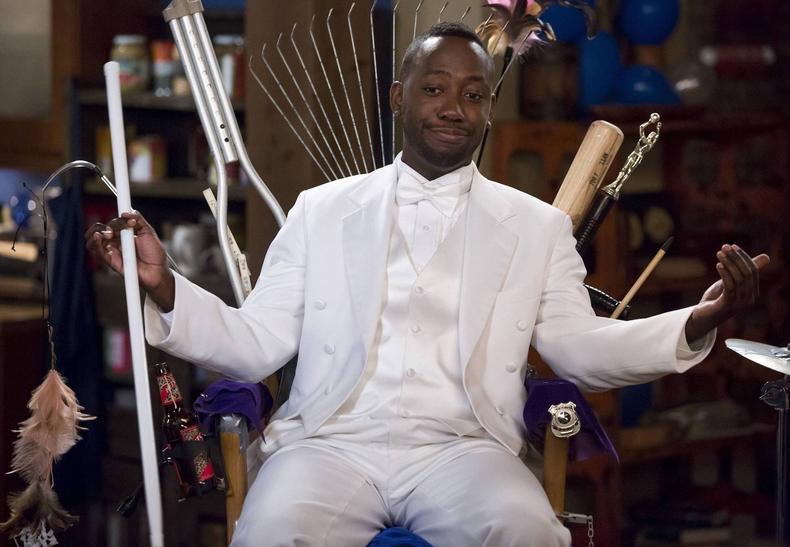
In Lamorne Morris’ Saturday morning rant from Season 1, which Winston detonates after his roommates wake him too early. The piece careens through half a dozen tones in about a minute, from righteous fury to a fully committed bit involving an invented alter ego. Choose it if you want to show a reader that you can turn on a dime and commit to an absurd choice without winking at it.
All right, everybody, stop! Wherever you are right now, just sit down. OK, now, Saturday is a day for sleeping. And damn it, you do not take that away from me! You—give her her scarf back! Finders keepers is not a thing. You—get out of my house! [Woman: “Who are you?”] Who am I? Who am I? Well, I am Theodore K. Mullins, and Nick is my lover on the down low. Tell her, Nick. Tell her how it really does down in apartment 4D. Oh, great Negro spiritual, please come down and loose these chains on this woman! Flesh on flesh. When the lights are off, we are all the same. Dear lord, help me, Father! Get out of my house. Get out of my house!
“New Girl” Courtesy MovieStillsDB
“City Slickers” (film, 1991) by Lowell Ganz and Babaloo Mandel: Mitch
Mitch (Billy Crystal) delivers a midlife crisis ramble to his son’s elementary school class on career day. What starts as a favor to a teacher spirals into a decade-by-decade accounting of physical decline, delivered to a room full of 9-year-olds. It earns a spot here because the comedy comes entirely from escalation: Mitch cannot stop, and every decade he adds digs the hole deeper. That structure gives an actor a clean, rising arc to play in under 90 seconds.
Value this time in your life, kids, because this is the time in your life when you still have your choices, and it goes by so fast. When you’re a teenager, you think you can do anything, and you do. Your twenties are a blur. Your thirties, you raise your family, you make a little money, and you think to yourself, “What happened to my twenties?” Your forties, you grow a little pot belly; you grow another chin. The music starts to get too loud and one of your old girlfriends from high school becomes a grandmother. Your fifties, you have a minor surgery. You’ll call it a procedure, but it’s a surgery. Your sixties, you have a major surgery. The music is still loud, but it doesn’t matter because you can’t hear it anyway. Seventies, you and the wife retire to Fort Lauderdale, you start eating dinner at two in the afternoon, lunch around ten, breakfast the night before. And you spend most of your time wandering around malls looking for the ultimate in soft yogurt and muttering, “How come the kids don’t call? How come the kids don’t call?” By the eighties, you’ve had a major stroke, and you end up babbling to some Jamaican nurse who your wife can’t stand but who you call mama. Any questions?