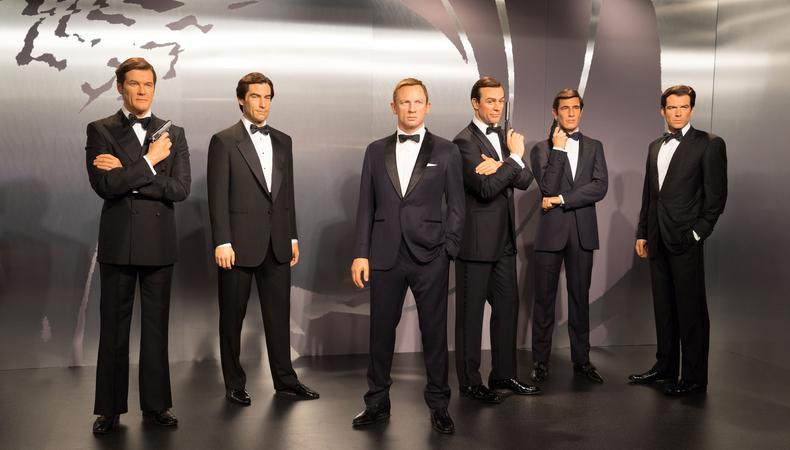
At this point, James Bond doesn’t have to clarify who he is by saying, “Bond. James Bond.” There is only one Bond, and he’s persevered on the silver screen for over 60 years with a franchise that any studio would envy. Despite all the changes in cinema and geopolitics since 1962, there’s always been 007, a man with a license to kill who prefers his martini shaken, not stirred.
That’s not to say that Bond himself hasn’t had to change with the times. The series is a study in adapting and readapting author Ian Fleming’s famous character to meet the audience where they are while still retaining the identifiers of Britain’s most famous secret agent. Part of that transformation comes from casting and recasting, finding actors who not only embody the role but also leave their mark on it.
RELATED: Daniel Craig on Why Actors Need to Let Go of Ego: ‘I’ve Won Many Oscars in the Bath’
Over the course of the official franchise run by Eon until 2025 (which excludes the 1967 comedy “Casino Royale,” in which multiple actors play Bond, and the 1983 “Thunderball” remake “Never Say Never Again”), six actors have sat in the Aston Martin driver’s seat: Sean Connery, George Lazenby, Roger Moore, Timothy Dalton, Pierce Brosnan, and Daniel Craig. Each performer highlights not only a distinctive take but also represents where the franchise was at that point in time.
Sean Connery (1962–1967, 1971): The Original
Even though Connery had a long and varied career, won an Oscar for Brian De Palma’s “The Untouchables,” and worked with acclaimed directors like Steven Spielberg and Sidney Lumet, he is most synonymous with James Bond. He not only originated the role on the silver screen in “Dr. No” (1962), but helped launch it to popularity. The Scotsman set the bar against which all other Bonds would be judged by authoring the character’s signature onscreen blend of sardonic charm, action chops, and wry humor.
Part of the fun of Connery’s Bond movies (aside from having characters with names like “Pussy Galore” or a villain so obsessed with gold he’s literally called “Auric Goldfinger”) is that Connery seems like he’s enjoying himself. He let the male audience of the time engage in the wish fulfillment of a globetrotting agent who never even has to woo a beautiful woman because she wants him the moment he walks in the room. As the Cold War began, Connery’s Bond greeted it with a smirk and a raised martini glass.
George Lazenby (1969): The “What If”?
Lazenby, even by his own account, seemed to stumble into the role of James Bond and then just as easily stumbled right out of it. The actor recounts the bizarre career machinations that led to his quick entrance and exit in Josh Greenbaum’s delightful 2017 documentary “Becoming Bond.” But what are we to make of an actor who only played the role once and never really resurfaced in any other major film?
Looking only at Lazenby’s performance in Peter R. Hunt’s “On Her Majesty’s Secret Service,” you can see that the Australian actor could have been a great Bond if things had gone differently and he’d had the space to grow. Granted, he benefits from an above-average script, acting opposite the legendary Diana Rigg, and a surprisingly emotional ending. But Lazenby acquits himself well at following in Connery’s footsteps while adding his own little wry touches. Watching Lazenby is more about the potential of a Bond we never really got to see rather than a body of work that cemented its place in the series.
Roger Moore (1973–1985): The Goofball
Moore’s tenure as Bond is arguably the most divisive, because it’s most emblematic of the series’ tendency to chase after trends. Moore, to his credit, is always game, but his movies become oddly interchangeable beyond the weirdest swings, like “Moonraker” (an attempt to capitalize on the popularity of “Star Wars”) or “Live and Let Die” (which tries to meld Bond with a Blaxploitation flick).
For some, it’s delightful to watch James Bond run across the heads of alligators or disguise himself as a circus clown. But for others, the movies can feel like a bizarre mishmash of concepts where Bond has no central identity; instead, the character is merely a template for any major stakeholder who wanted to contribute to paste their ideas in. The only thing that unites these films is how Moore takes the carefree attitude of Connery’s approach and cranks it until the knob breaks off.
Timothy Dalton (1987–1989): The Grit
As action movies became more violent and graphic, Bond attempted to follow suit. While the franchise has never produced an R-rated project, Dalton’s two-film turn as Bond is what we’d label today a “hard PG-13.” It gets as close to the line as it can, making Bond bloodier and more vengeful, which is an interesting color on the character (and some would argue closer to Fleming’s novels).
If anything, these two movies are at least more concerned with Bond as a character, although “The Living Daylights” puts more investment into that identity than “Licence to Kill.” You can see Dalton’s performance as a hint of what’s to come in the Craig era, his delivery more barbed and his attitude closer to losing his cool. And, like with Lazenby, there’s a desire to see how far Dalton could have taken that new approach with more movies.
Pierce Brosnan (1995–2002): The Adrift
Brosnan helped relaunch Bond after a six-year absence with one of the best movies in the series, Martin Campbell’s “GoldenEye.” Part of what makes his intro click so well is not only Brosnan’s clear ease and comfort with the character, but that the film is eager to wrestle with what 007’s role should be in a post–Cold War world. And yet, after that stunning debut, all of Brosnan’s subsequent features as Bond are disappointments. It’s not even a Moore situation where the movies are silly. Instead, it feels like Brosnan is uniquely suited to combine Connery’s seductiveness, Moore’s winking, and Dalton’s edge, but he never got any stories that allowed him to shine. There’s a glimpse of a darker Bond in “The World Is Not Enough,” but more often than not, the films exist in an uneasy place between echoing Connery’s original Bond and trying to find a place in a blockbuster landscape that sees the character as a dusty relic.
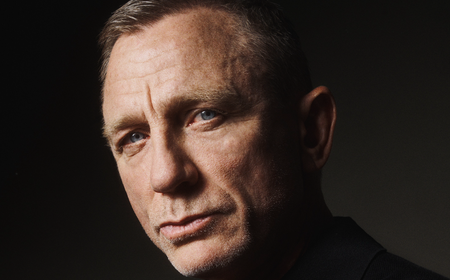
Daniel Craig (2006–2021): The Soul
Perhaps the best thing to happen to James Bond was Jason Bourne. The Matt Damon–led spy series showed there was still an appetite for espionage thrillers, but they needed to be more grounded and human. Enter Craig as the first actor to try and treat James Bond as a person rather than an indestructible spy.
While Craig’s full tenure is uneven as far as the films are concerned (you have some of the best entries with “Casino Royale” and “Skyfall” and then complete whiffs like “Quantum of Solace” and “Spectre”), the actor was able to drag Bond into the 21st century by instilling a real sense of steeliness into the character—you believe he can be hurt physically and he has been hurt emotionally. The tradeoff was the wish fulfillment of the earlier Bond movies, but in its place, Craig forced 007 to grow up. Whoever gets handed the mantle of James Bond after Craig will have a tall task ahead of them.