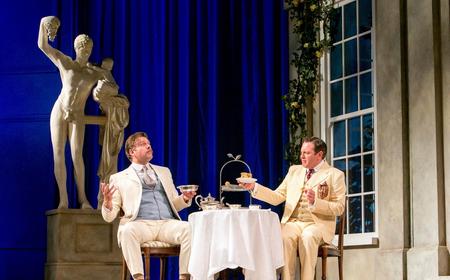
Undoubtedly, Daniel Goldfarb's play "Modern Orthodox" is a romantic comedy awash in culture-clash conflicts. Still, it treads delicate terrain in its treatment of Jews, both secular and modern Orthodox. It recounts what happens when Hershel (Jason Biggs), a young modern Orthodox diamond dealer, invades the lives of a secular Jewish couple, Ben and Hannah (Craig Bierko and Molly Ringwald), and each in turn transforms the other.
Anytime, and in whatever spirit, ethnic minorities are tackled in theatre—or film, television, or fiction, for that matter—a host of emotionally charged issues are raised. For starters, there are the stereotypes. What one theatregoer views as stereotypic, another deems authentic, while still another finds authentic and problematic. Simply because it's truthful—especially if it's truthful and unflattering—do I want it out there? On the flip side, is the work politically correct but a total falsification? And whose judgment call is it? Equally up for grabs: Does it matter who wrote the play?
"There is something to be said for writing about your own heritage," says Goldfarb. "It gives you license to explore darker areas of your culture with humor. Anthropologically, there is a history of this throughout comedy. Our director, James Lapine, is also Jewish," he continues. "I don't think it's mandatory that the director be Jewish, but it does help if he has a certain awareness of himself as a Jew. Throughout, the two of us were walking a thin line between being biting and being affectionate. We were very careful not to point at Orthodox Jews and say, 'Look at them.' Instead, we're including ourselves in the 'them.' "
Celebrating Stereotypes
"Modern Orthodox" is not the only play on the boards right now dealing with contemporary Jews. Consider "Jewtopia," a broad-stroked—very broad-stroked—satire in the "Saturday Night Live" vein that examines the plight of one Irish Catholic youth, Chris O'Connell (Bryan Fogel), who wants to become Jewish to attract the Jewish girl of his dreams. He and his Jewish pal, Adam Lipschitz (Sam Wolfson), explore the meaning of Jewish identity, values, and culture as each looks for love among Jewish Community Center singles and on the Internet.
Along the way, they encounter every possible Jewish stereotype, particularly among the women, who are the most abrasive, demanding, and/or whiny Jewish women one would hope not to meet. They are also sexually unavailable, cannot cook, and have no desire to learn how to cook. In the end, each young man finds true love outside the clan, one with an Asian girl, the other with a gentile whom he mistakenly believed to be Jewish, though he realizes he should have known better because she, unlike all the other Jewish girls out there, can whip up a moist cake.
The two co-stars, who also wrote the play, have a disclaimer in the program insisting that they don't mean to offend anyone and maintaining that they themselves are bar mitzvah boys.
"The routines of any ethnic comic—Eddie Murphy or George Lopez, for example—would not work if they were performed by anybody outside the group," says Fogel. "The same routines would become arrogant and racist. Admitting that we ourselves are bar mitzvah boys is our way of letting non-Jews as well as Jews in the audience know that everything we're doing is meant in good fun; we're having fun with our background and don't want to be taken in the wrong way."
Fogel and Wolfson maintain that the demographics of their audiences are especially surprising, both in New York City, where the play has been running at the Westside Theatre since the end of October, and earlier in Los Angeles, where it played for a year and a half and was the longest running comedy in Los Angeles history.
"We thought we were writing comedy for young Jews who were of our generation and who respond to SNL irreverence," notes the 30-something Wolfson. "We did not anticipate the crossover in age. We have people in our audience 14 to 90 and audiences from all ethnic groups, including out-of-town tourists."
The visibility of ethnic and racial minorities on stage is indeed a double-edged sword. Visibility in and of itself is not necessarily a virtue—although some might say it is. More might argue that what emerges imagewise is of far greater importance. Still, interpreting that image is in the eye of the beholder. Assuming that there is a kernel of truth in the playwrights' stereotypic vision, why advertise it? Is it self-acceptance or self-hatred or that netherworld in between?
Fogel and Wolfson assert that "Jewtopia" is an expression of the ultimate self-acceptance, and within those parameters they are free to play with Jewish stereotypes. Further, they contend that the stereotypes they put on parade are accurate depictions—albeit heightened for comic purposes—and, in the end, not offensive at all. On the contrary.
"It's a stereotype that Jews run Hollywood," Fogel says, citing a comment in the play. "Guess what? It's true. Jews do run Hollywood. It's a stereotype that many Jews are wealthy. Guess what? Many Jews are wealthy. And there's nothing objectionable in the image. What's unflattering about Jews rising out of oppression and poverty and making it to big success?"
Adds Wolfson, "It's a stereotype, and one we deal with in the play, that Jewish girls won't sleep with you. Does that mean that they're prudes? No, but it does mean that they are self-respecting women, not willing to jump into bed right away. And in our experience, Jewish girls would rather shop than have sex.
"We are aware that for every stereotype we present, there are many Jews who do not fall into that category and many gentiles who do. But we have found that there is a common thread of experience throughout the Jewish community. Families are close, men don't hunt or fish, and nobody orders exactly what's on the menu—there are always so many changes it bears little resemblance to what was originally offered."
Fogel stresses, "Once audiences come into the theatre, I think they'll realize that we're harmless 30-year-old goofballs. And it's okay to laugh at yourself. So much of Judaism is about suffering, survival, and pathos. Pogroms and the Holocaust. People are tired of it. We want to laugh, especially in these post-9/11 days. Maybe what we're doing wouldn't have worked immediately following Sept. 11 or after World War II. But we need two hours of silliness now. I believe there is widespread acceptance of Jewish culture and we're writing from a place of affection."
Nonetheless, "Jewtopia" is not for all tastes. No one escapes unscathed, not even the show's creators, who claim they've received pages and pages of e-mail from someone or some group on the Christian right attempting to convert them. "It's creepy and frightening," says Wolfson, who has contacted the FBI.
Through the Eye of the Beholder
Goldfarb has had no encounters with the Christian right or other detractors. Nonetheless, he admits that at almost every performance of "Modern Orthodox," now playing Off-Broadway at Dodger Stages, one couple will walk out because something has offended them. And the producers have received two or three letters suggesting that aspects of the play are indeed offensive, if not misrepresentations of the facts.
Goldfarb, on the other hand, insists that "Jewish Orthodox rabbis who have seen the play say it is accurate and that it's perfectly all right to laugh at yourself."
Admittedly, "Modern Orthodox" is a more serious piece than "Jewtopia" in its effort to grapple with the very real feelings of shame, embarrassment, and anger that many secular Jews feel towards their Orthodox counterparts, even the so-called modern Orthodox, sporting sneakers along with their tzitzis (ritual prayer shawl fringes) or yarmulkes embroidered with the New York Yankees logo. Keeping in mind the comic framework, the questions remain: Is Hershel a figure of absurdity or, worse, just another very nervous, unmanly Jewish male? What is this play saying and to whom?
Like Wolfson and Fogel, Goldfarb maintains he is writing from a place of affection and, to that extent, he's not worried about what the play is saying or to whom: "I might be far more concerned with those issues if I was writing a diatribe against the Orthodox, but I'm not."
In fact, in the course of writing the play, Goldfarb found himself growing increasingly fond of Hershel, for whom he initially had feelings of ambiguity, he concedes.
"I believe it's good to write about something that confuses you," he says. "I certainly approached Hershel from the point of view of Ben, the secular Jew. Ben is made uncomfortable by him and resentful that Hershel thinks he's more of a Jew than Ben is. Hershel is less of a sympathetic figure early on than he is at the end, when he becomes a kind of hero.
"I think what happens is that Ben and Hannah, as well as the secular members of the audience, start out by feeling that religious people have to give up so much to be religious," Goldfarb continues. "But at the end, they feel that they've given up so much in being modern. I believe many people are dealing with these questions today, and Ben and Hannah have taken baby steps towards understanding."
Goldfarb emphasizes that he was careful to avoid writing stereotypes, most pointedly in Hershel, the character who undoubtedly veers the closest to stereotype with his nervous gestures and neurotic personality. That said, Goldfarb underscores that he thinks Hershel is in fact a manly figure.
"The question of manliness depends on how you define manly," he says. "I think it's manly for a man to go on a date with a woman, be giving and generous, and fall in love with her," Goldfarb argues. "He is certainly more manly than Ben, who lives with Hannah for six years before he can commit himself to her."
Hershel's girlfriend, Rachel (Jenn Harris), is yet another potential lightning rod, despite her charming kookiness. She is clearly a figure of fun and intended as such. Still, she is not a stock character by any means, Goldfarb suggests: "She's orthodox and, in her own way, feminist. She knows how to play both sides. She's educated, she works, and she is very smart."
Perhaps the most curious aspect of "Modern Orthodox" is its casting, proving Goldfarb's contention that he is presenting four very different Jewish characters, including the strapping 6-foot-plus Ben, who is played by the most non-Jewish-looking actor on stage. But, in fact, Craig Bierko is the only Jewish actor up there, says Goldfarb.
Still, one wonders why the most conventionally attractive actors play the rational, secular characters—the stand-ins for the audience—while the Orthodox characters are the comic foils and are cast accordingly.
"Jason Biggs, who is not Jewish but always plays Jews, is considered very sexy by most women," says Goldfarb, adding that the character on stage who most represents the audience largely depends on the audience, which varies almost nightly:
"Ben and Hannah are not necessarily the stand-in for the audience," he says. "When we have an audience full of Orthodox Jews, Hershel is. Those Orthodox audiences view Ben and Hannah as spiritually barren." In short, Ben and Hannah become the ubiquitous "other."
Goldfarb's previous plays have also dealt with Jewish subject matter or themes: "Adam Baum and the Jew Movie" and, to a lesser extent, "Sarah, Sarah," produced by Manhattan Theatre Club. "Adam Baum," produced by Blue Light Theatre Company, won Newsday's Oppenheimer Award in 2000 and the Canadian Authors Association's Carol Bolt Award in 2003 and was nominated for the Dramatists Guild's Hull-Warriner Award in 2000.
Goldfarb's upcoming plays and musicals also focus on Jewish characters and issues, although he does not want to discuss them just yet and is reluctant to say whether there is any particular evolution in his (or anyone else's) theatrical treatment of Jews.
By contrast, Fogel and Wolfson suggest that there may be a new trend, despite the range of material out there—from their own over-the-top "Jewtopia" to the historically inspired and serious "Golda's Balcony." "Jewtopia" is slated to open with different casts in Chicago and Coral Springs, Fla. And Fogel and Wolfson are planning productions of their show in Boston, Philadelphia, and London.
They are also writing a screenplay based on the play and believe that the studio interest already expressed in the project is indicative of new cultural trends—producers feel that with a little nip and tuck, the movie can have broad-based appeal.
The two writer-actors speculate that there are several factors at play, starting with the more sweeping acceptance of ethnic comedy in general, exemplified by the mega-box-office success of "My Big Fat Greek Wedding," and "Meet the Fockers." They also talk about the impact of the SNL aesthetic, which targets an emotional cord in younger audiences in a way that Neil Simon, as a case in point, does not.
Wolfson cites an independent film, "The Hebrew Hammer," featuring an unlikely Hasidic action hero, as an example of this new vision. Heeb, "a magazine for hip young Jews," is another example.
But the biggest change is sociological, he suggests: "Up until this generation, most of our parents were married to other Jews. Our generation is messing it up. Suddenly there is a lot of interfaith marriage."
In short, he is saying: We're still Jews, but we're new kinds of Jews in a new America, expressing our identity in new ways.