Ever wonder why certain classic works continue to appear everywhere, from regional theaters to black-box experimental spaces? While their exemplary writing doesn’t hurt, it’s also because these plays are completely free to produce, adapt, and perform, thanks to their status in the public domain.
For actors, directors, and community theater companies working with limited budgets, public domain plays like those compiled here can open the door to creative freedom—no deposit required.
The public domain refers to creative works that are no longer protected by copyright law. Once a play enters the public domain, anyone can legally perform, publish, adapt, or distribute it without paying licensing fees or obtaining permission from an estate or rights holder.
For theater artists, that can be a game changer. Producing copyrighted plays often requires contracts, royalty payments, and restrictive guidelines that limit changes to the script. Public domain works remove many of those barriers, making them especially valuable for schools, community theaters, independent companies, and emerging directors.
When does something become public domain?
In the United States, the rules around copyright can get complicated, but there’s one general rule of thumb: Any work published before 1929 is in the public domain as of 2026.
New works continue entering the public domain each January under U.S. copyright law. However, unpublished works, translations, and newer adaptations may still be protected separately, even if the original play itself is in the public domain.
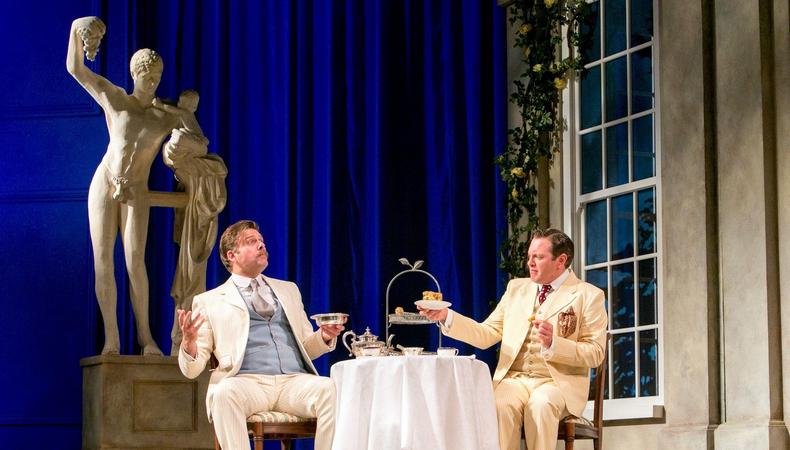
That means a theater company can stage “The Importance of Being Earnest” for free, but a modern edited adaptation or annotated version may still require permission.
For actors and producers hoping to explore public domain play scripts, resources like Project Gutenberg and SUNY Oswego’s public domain theater guide are excellent starting points.
And for those looking to actually stage a production, check out our resources on joining community theater, finding regional theater opportunities, and applying to local theater casting calls.
1. “The Rover,” Aphra Behn
Behn was writing (and selling out theaters!) while most of her male peers were barely getting started. “The Rover” (1677) follows a band of English exiles during Carnival season, weaving together romantic pursuit, mistaken identity, and surprisingly sharp critiques of the marriage market.
The play is often credited as one of the first major comedies by a woman to enter the Western theatrical canon, and it has enjoyed a significant revival in academic and professional productions alike. For ensembles with strong comic instincts, it’s endlessly playable.
2. “The Wonder: A Woman Keeps a Secret,” Susanna Centlivre
One of the most successful playwrights of the 18th century, Centlivre wrote comedies that consistently outran those of her male contemporaries on the London stage. “The Wonder” (1714) is a sparkling romantic farce built around disguise, jealousy, and trust.
The play rewards actors who enjoy high-energy ensemble work and period-inflected comic timing. It’s also a natural conversation starter about how thoroughly women’s theatrical legacies have been erased from the canon.
3. “The Cherry Orchard,” Anton Chekhov
Chekhov’s final play blends comedy and heartbreak in a story about a family facing the loss of their estate. For ensemble-focused companies, “The Cherry Orchard” (1904) offers richly layered character work and subtle emotional dynamics.
Actors often study Chekhov because his writing demands specificity and restraint rather than heightened theatricality.
4. “The Seagull,” Anton Chekhov
Another Chekhov staple, the 1895 play “The Seagull” examines ambition, art, fame, and unrequited love. It’s become especially popular among actor-driven companies because nearly every role offers emotional complexity.
Modern audiences may also connect strongly with the play’s themes of creative insecurity and artistic validation.
5. “Medea,” Euripides
For performers craving emotional intensity, “Medea” remains unmatched. Written in 431 BC, the tragedy centers on betrayal, revenge, and power.
Greek tragedies can initially feel intimidating for smaller companies, but stripped-down modern stagings often work beautifully. The title role, in particular, offers extraordinary material for actors.
6. “Trifles,” Susan Glaspell
“Trifles” (1916) is one of the most quietly devastating one-act plays in American theater. Two women piece together the truth of a neighbor’s murder while the men around them literally overlook the evidence because they can’t be bothered to look where women look.
The play is a master class in subtext and ensemble restraint, making it a staple of acting conservatories and a perennial choice for intimate black-box productions. Its running time also makes it an ideal curtain-raiser or standalone showcase piece.
7. “A Doll’s House,” Henrik Ibsen
First performed in 1879, “A Doll’s House” shocked audiences with its critique of marriage and gender expectations. More than a century later, Nora’s final door slam still resonates.
The play is especially appealing for actors interested in naturalism and emotionally grounded performance work. It also remains highly programmable for contemporary audiences because its themes still feel startlingly modern.
8. “Ghosts,” Henrik Ibsen
Controversial when it premiered in 1882, “Ghosts” tackled taboo subjects including hypocrisy, inheritance, and social repression.
The play remains emotionally devastating and gives actors deeply layered dramatic material. For theaters interested in darker, more intimate realism, it’s an especially compelling choice.
9. “The Glass of Water,” Eugène Scribe
Though less frequently produced today, 1840’s witty political comedy “The Glass of Water” offers intrigue, romance, and sharp dialogue. Lesser-known public domain plays like this one can help theaters stand out while avoiding overproduced classics. It’s also a reminder that public domain theater extends far beyond Shakespeare.
10. “Hamlet,” William Shakespeare
Arguably the most famous tragedy ever written, “Hamlet” (1601) remains a gold mine for actors. The title role alone has become a rite of passage for performers, from Kenneth Branagh’s 1996 film adaptation to Ruth Negga’s acclaimed 2018 Dublin stage production.
The play offers complex emotional arcs, iconic monologues, and endless opportunities for reinterpretation. Productions can be staged traditionally or modernized entirely, which is part of why it remains a favorite for both professional companies and student productions.
11. “Pygmalion,” George Bernard Shaw
Long before it inspired the musical “My Fair Lady” (1956), Shaw’s “Pygmalion” (1913) explored class, language, and identity through the relationship between Eliza Doolittle and Professor Higgins.
The play remains particularly strong for actors who enjoy dialect work and fast-paced verbal sparring. Its themes about social performance also feel remarkably current.
12. “The Rivals,” Richard Brinsley Sheridan
A staple of 18th-century comedy of manners, “The Rivals” (1775) offers heightened characters, romance, and chaos. It’s particularly enjoyable for actors who like physical comedy and stylized language.
The character Mrs. Malaprop even gave the English language the term “malapropism.”
13. “Miss Julie,” August Strindberg
This psychologically charged drama unfolds over a single midsummer night between an aristocratic woman and her servant. The intimacy and tension of “Miss Julie” (1888) make it ideal for black-box productions and smaller casts.
The play is also frequently studied in acting conservatories because of its emotional realism and power dynamics.
14. “The Duchess of Malfi,” John Webster
Fans of gothic storytelling and high-stakes drama will find plenty to love in this Jacobean revenge tragedy. “The Duchess of Malfi” (1613) combines poetic language with shocking violence and psychological tension.
Its atmospheric tone makes it especially appealing for companies looking to stage something visually ambitious on a budget.
15. “The Importance of Being Earnest,” Oscar Wilde
If a theater company needs a crowd-pleasing comedy, few plays deliver like Wilde’s razor-sharp satire. Packed with quotable lines and mistaken identities, “The Importance of Being Earnest” (1895) remains one of the funniest plays in the English language.
The show works especially well for community theaters because it requires relatively minimal technical elements while still offering large comedic payoffs for performers.
Public domain theater offers something increasingly rare in the entertainment industry: accessibility.
Actors can use scenes and monologues without worrying about licensing restrictions. Directors can radically reinterpret classics for modern audiences. Community theaters can produce meaningful work without massive royalty costs. And emerging artists can experiment freely while building their craft.
That freedom is a major reason these plays continue to survive generation after generation. Even centuries later, audiences still connect with Nora walking out the door, Hamlet questioning his existence, and Lady Bracknell interrogating a handbag!
Theater changes constantly, but great stories tend to stick around.